Risk Summary
Limited published data from case reports with Orenitram use in pregnant women are not sufficient to assess for a drug-associated risk of major birth defects, miscarriage, or adverse maternal or fetal outcomes. There are risks to the mother and the fetus associated with pulmonary arterial hypertension (see Clinical Considerations). Animal reproductive studies with treprostinil diolamine administered orally have shown an adverse effect on the fetus. In rats, administration of treprostinil to pregnant rats during the period of organogenesis at doses ≥10 mg/kg/day (approximately 15 times the human exposure at the dose of 3.5 mg BID on an AUC basis) resulted in decreased pregnancy rate, increased post-implantation loss, and decreased fetal viability and growth. In rabbits, teratogenicity and decreased fetal viability and growth were observed at doses ≥1.5 mg/kg/day (approximately 7 times the human exposure at the dose of 3.5 mg BID on an AUC basis) (see Animal Data).
The estimated background risk of major birth defects and miscarriage for the indicated populations is unknown. All pregnancies have a background risk of birth defect, loss, or other adverse outcomes. In the U.S. general population, the estimated background risk of major birth defects and miscarriage in clinically recognized pregnancies is 2 to 4% and 15 to 20%, respectively.
Clinical Considerations
Disease-associated maternal and embryo-fetal risk
Pulmonary arterial hypertension in pregnancy increases the risk of maternal heart failure, stroke and death, preterm delivery, low birth weight, and stillbirth.
Data
Animal Data
In pregnant rats, reversible, dose-dependent decreases in body weight gain and food consumption were observed during the first four days of dosing in animals administered 10, 20, and 30 mg/kg/day treprostinil diolamine. In a dose range-finding study, there was a 17% decrease in the pregnancy rate in the animals administered 20 and 30 mg/kg/day. One dam in each of the 20 and 30 mg/kg/day had litters with no viable fetuses. In the definitive study (0, 5, 10, and 20 mg/kg/day), there were four treatment-related deaths, and a 32% decrease in the pregnancy rate for rats administered 20 mg/kg/day. There was an 8% decrease in the pregnancy rate in the animals administered 10 mg/kg/day. Across both studies, an increase in post-implantation loss was observed in animals administered 10 to 30 mg/kg/day, and a significant decrease in the mean number of live births was seen at dose levels ≥10 mg/kg/day. The no observed adverse effect level was 5 mg/kg/day (maternal, fetal viability and growth), and 20 mg/kg/day (teratogenicity), the highest dose tested in the definitive study. The exposures at 5 and 20 mg/kg/day doses represent 8 and 33 times, respectively, the human exposure at the dose of 3.5 mg BID on an AUC basis.
For F1 progeny, a decreased copulation index was observed at the 5 and 10 mg/kg/day treprostinil diolamine dose levels in rats. The no observed effect levels for physical development, reflex development, exploratory behavior, learning and memory, and sexual maturation was 10 mg/kg/day. The no observed effect level for F1 progeny general development (based on body weight) was 10 mg/kg/day for females and ≤2.5 mg/kg/day for males; the no observed effect level for F1 reproductive performance was 2.5 mg/kg/day (approximately 4 times the human exposure at the dose of 3.5 mg BID on an AUC basis).
In pregnant rabbits, the primary maternal adverse effect was gastrointestinal disturbance; dose-dependent decreases in mean body weight, body weight gain, and food consumption were observed. During the post-dose phase, the effect was reversed. In a dose range-finding study, there was a 17% decrease in the pregnancy rate for animals administered 4 mg/kg/day. A dose-dependent increase in post-implantation loss was observed. Two dams administered 4 mg/kg/day had litters with no viable fetuses; the mean fetal weight was slightly decreased in animals administered 4 mg/kg/day. In the definitive study, mean fetal weights were significantly decreased in animals administered 0.5 to 3 mg/kg/day of treprostinil diolamine. At doses of 1.5 and 3 mg/kg/day, external fetal and soft tissue malformations were observed in a few fetuses, and the total fetal skeletal malformations were significantly increased. The no observed adverse effect level was less than 0.5 mg/kg/day (maternal), 1.5 mg/kg/day (fetal viability and growth), and 0.5 mg/kg/day (teratogenicity). The 0.5 mg/kg/day dose represents about 3 times the human exposure at the dose of 3.5 mg BID on an AUC basis.
Risk Summary
There are no data on the presence of treprostinil in human milk, the effects on the breastfed infant, or the effects on milk production.
Absorption
The absolute oral bioavailability of Orenitram is approximately 17%. Maximum treprostinil concentrations occur between approximately 4 and 6 hours following Orenitram administration. Time to reach steady-state concentrations for both BID and TID regimens is approximately 1 to 2 days.
The absorption of Orenitram is affected by food. The AUCinf of treprostinil was increased by 49% and the Cmax was increased by an average of 13% when Orenitram was administered following a high-fat, high-calorie meal compared to fasting conditions in healthy volunteers. The relative bioavailability of treprostinil following oral administration of Orenitram 1 mg is not significantly altered by meal types ranging from 250 to 500 calories in healthy volunteers.
When Orenitram 1 mg was administered with alcohol at 0.5 mg/kg or the equivalent of 3 servings (at the same time, or ± 1 hour relative to alcohol consumption), there was no significant change (10% to 20% increase) in the exposure to treprostinil compared to Orenitram administered alone.
Distribution
The treprostinil component of Orenitram is highly bound to human plasma proteins, approximately 96% over a treprostinil concentration range of 0.01 to 10 µg/mL.
Metabolism and Excretion
In a study conducted in healthy volunteers using [14C] treprostinil, treprostinil was extensively metabolized on the side chain of the molecule via oxidation, oxidative cleavage, dehydration, and glucuronic acid conjugation. Treprostinil is primarily metabolized by CYP2C8 and to a lesser extent by CYP2C9. No new major metabolites are found upon oral administration compared to parenteral administration of treprostinil. Only 1.13% and 0.19% is excreted as unchanged parent drug in the feces and urine, respectively. Based on in vitro studies, treprostinil does not inhibit or induce major CYP enzymes [see Drug Interactions (7.1)].
Specific Populations
Hepatic Impairment: In subjects with mild (n=8) hepatic impairment, administration of a single 1 mg dose of Orenitram resulted in a mean Cmax and an AUC0-inf that were 1.6- and 2.1-fold values seen in healthy subjects, respectively. With moderate impairment (n=8), the corresponding ratios were 4.0- and 4.8-fold, and with severe impairment (n=6), they were 4.8- and 7.6-fold [see Dosage and Administration (2.3), Contraindications (4), and Use in Specific Populations (8.6)].
Renal Impairment: In patients with severe renal impairment requiring dialysis (n=8), administration of a single 1 mg dose of Orenitram pre- and post-dialysis resulted in an AUC0-inf that was not significantly altered compared to healthy subjects.
Drug Interactions
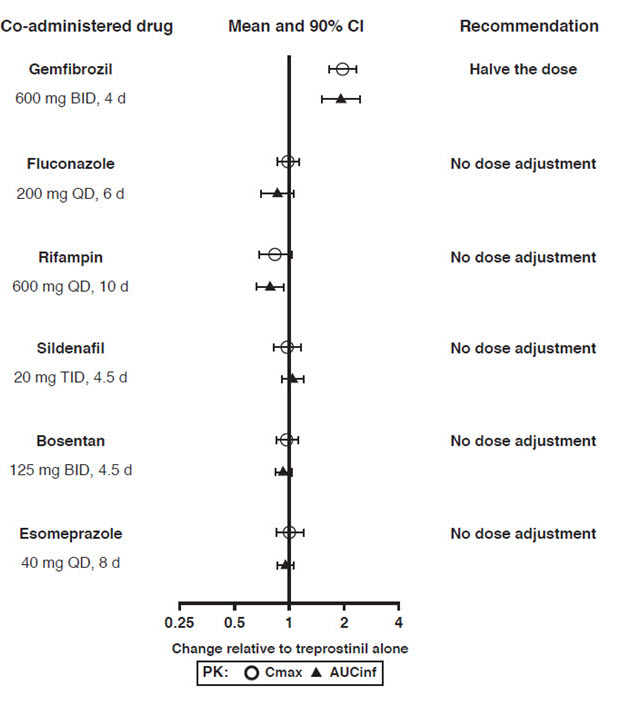
Results of drug interaction studies are shown in Figure 1. Only for the strong CYP2C8 inhibitor does the interaction affect dosing [see Dosage and Administration (2.4)].
Figure 1: Impact of Co-Administered Drugs on the Systemic Exposure of Treprostinil 1 mg Compared to Orenitram Administered Alone
Warfarin: A drug interaction study was carried out with Remodulin co-administered with warfarin (25 mg/day) in healthy volunteers. There was no clinically significant effect of either medication on the pharmacokinetics of treprostinil. Additionally, treprostinil did not affect the pharmacokinetics or pharmacodynamics of warfarin. The pharmacokinetics of R- and S-warfarin and the international normalized ratio (INR) in healthy subjects given a single 25 mg dose of warfarin were unaffected by continuous subcutaneous infusion of treprostinil at an infusion rate of 10 ng/kg/min.
Study 1 (effect seen with no background vasodilator)
Study 1 was a 12-week, randomized (2:1 Orenitram to placebo), double-blind, placebo-controlled, international efficacy and safety study of Orenitram in patients with WHO Group 1 PAH not currently receiving PAH therapy. The primary efficacy endpoint was placebo-corrected change in six-minute walk distance (6MWD) from Baseline to Week 12. Study drug dose was titrated to a maximum of 12 mg BID based on clinical response and study drug tolerability. Study 1 enrolled 349 patients (overall analysis population) who were not receiving any PAH medication. At the beginning of the study, subjects were dosed with only the 1 mg tablets with 0.5 and 0.25 mg tablets introduced at sequentially later dates during the study. The primary analysis population consisted of the 228 patients who had access to the 0.25 mg tablet at the time of randomization. Patients were administered Orenitram or placebo twice daily, with the doses titrated to effect over the course of the 12-week trial. Patients were in WHO functional class II (~33%) and class III (~66%) with either idiopathic or heritable PAH (~75%), collagen vascular disease associated PAH (~19%), or PAH associated with HIV (1%) or congenital heart defect (5%) or other conditions (~6%). The patients' mean baseline 6MWD was approximately 330 meters. In the primary analysis population, 17% of patients discontinued Orenitram compared to 14% of patients on placebo.
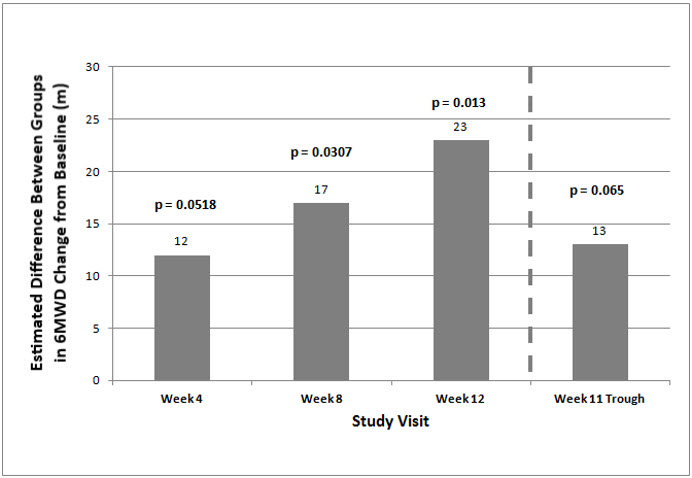
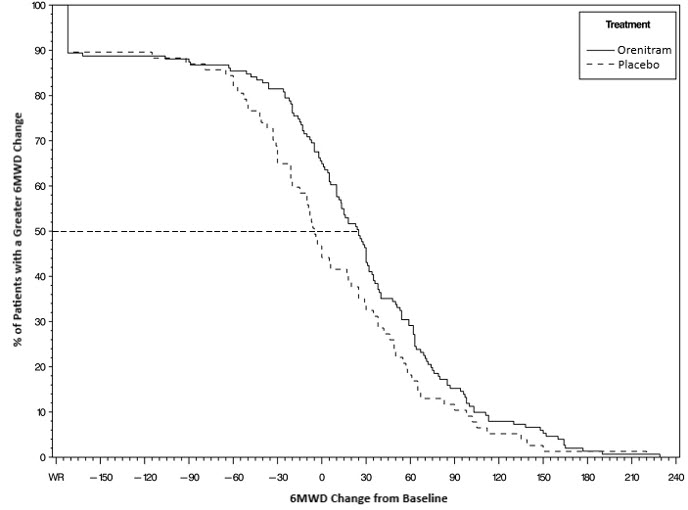
The primary efficacy endpoint of the trial was the change in 6MWD at 12 weeks for the primary analysis population. Analysis of Study 1 results demonstrated that those patients receiving Orenitram compared to patients receiving placebo improved their median change in 6MWD by approximately 23 meters (p=0.013) as compared to patients receiving placebo as demonstrated in (Figure 2). The within group median change from baseline was +25 meters for Orenitram and -5 meters for placebo at Week 12 (N=228). Mean dose (±SD) in the Orenitram group was 2.3 ± 1.3, 3.2 ± 1.9, and 3.4 ± 1.9 mg BID at Weeks 4, 8, and 12, respectively, with a maximum dose of 12 mg BID. The distribution of the 6MWD change from baseline at Week 12 was also plotted across the range of observed values (Figure 3).
Figure 2: Estimate of Treatment Effect by Visit for the Primary Analysis Population (Study 1)
Figure 3: Plot of the Distribution of Peak 6MWD Changes at Week 12 for the Primary Analysis Population (Study 1)
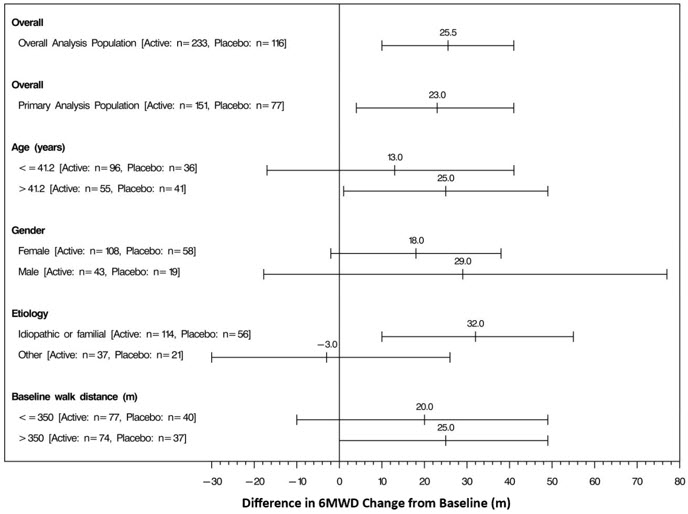
The placebo-corrected median treatment effect on 6MWD was estimated within various subpopulations defined by age, gender, disease etiology, and baseline 6MWD (Figure 4).
Figure 4: Placebo Corrected Median Treatment Effect (with 95% CI) on 6MWD Change from Baseline at Week 12 for Various Subgroups in the Primary Analysis Population (Study 1)
Studies 2 and 3 (no effect on a background of ERA, PDE-5 inhibitor, or both)
Studies 2 (N=350) and 3 (N=310) were 16-week, randomized, double-blind, placebo-controlled, international efficacy and safety studies of Orenitram in patients with WHO Group 1 PAH. The primary efficacy endpoint was placebo-corrected change in 6MWD from Baseline to Week 16. Patients were in WHO functional class II (~23%) and class III (~77%) with either idiopathic or heritable PAH (~66%), collagen vascular disease associated PAH (~29%), or PAH associated with HIV (1%) or congenital heart defect (4%). The patients' mean baseline 6MWD was approximately 340 meters. Approximately 40% were receiving both an ERA and a PDE-5 inhibitor. The results did not demonstrate a benefit in exercise testing with median 6MWD at Week 16.
Study 4 (effect seen with a single background PAH therapy)
The effect of Orenitram on the progression of PAH was demonstrated in an international, multicenter, double-blind, event-driven study in patients with WHO Group 1 PAH randomized 1:1 to Orenitram or placebo (Study 4). The primary efficacy endpoint was the time to first clinical worsening (morbidity or mortality) event. Study drug dose was titrated starting at 0.125 mg TID to a maximum of 12 mg TID based on clinical response and study drug tolerability. Study 4 enrolled a total of 690 patients (primary efficacy analysis population) who were currently receiving a single approved PAH therapy (PDE-5 inhibitor or soluble guanylate cyclase (sGC) [72%]; ERA [28%]). The median age was 43 years and most patients were white (52%) and female (79%). The majority of patients were lower risk in WHO functional class II (63%) with a mean (±SD) baseline 6MWD of 396 (±96) meters. Most patients had either idiopathic or heritable PAH (63%) or collagen vascular disease associated PAH (26%).
Patients treated with Orenitram achieved a median dose of 3.6 mg TID at Week 24, which continued to increase until approximately Week 60 where the median dose of Orenitram was approximately 5 mg TID.
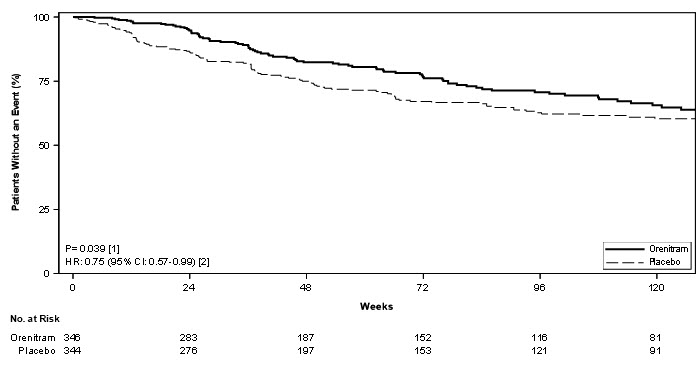
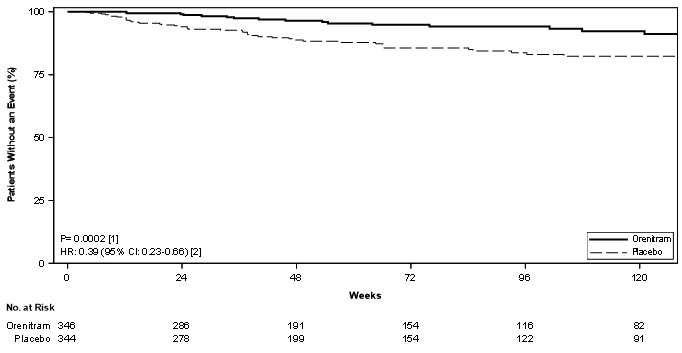
Treatment with Orenitram resulted in a significant increase in the time to first clinical worsening event compared with patients who received placebo, which was associated with a reduction in the risk of an event (HR=0.75 [95% CI; 0.57, 0.99]; p=0.039; Figure 5). The beneficial effect of Orenitram was primarily attributable to a delay in disease progression—defined as a 15% decline in 6MWD plus an increase in either WHO Functional Class or worsening of signs or symptoms of right heart failure—(HR=0.39 [95% CI; 0.23, 0.66]; Figure 6), but there was no effect on the other components of clinical worsening (Table 2).
Figure 5: Kaplan-Meier Plot of Time to Clinical Worsening Events for the Primary Analysis Population (Study 4)
Table 2: Primary Endpoint Events (Study 4) | Orenitram
% N=346 | Placebo
% N=344 | HR (95% CI) |
|---|
| 6MWD - 6-minute walk distance; CI - confidence interval; HR - hazard ratio; IV PGI2 - intravenously administered prostacyclin; PAH - pulmonary arterial hypertension; RHF - right heart failure; WHO - World Health Organization |
| Clinical worsening | 26 | 36 | 0.75 (0.57, 0.99) |
| Any of these | All-cause mortality | 4.3 | 4.1 | |
| Hospitalization for PAH | 10 | 10 | |
| Inhaled/IV PGI2 | 0.6 | 1.5 | |
| Unsatisfactory long-term clinical response | 5.5 | 5.8 | |
| Disease progression | 5.5 | 14.5 | 0.39 (0.23, 0.66) |
| This → | 15% decrease in 6MWD | 5.5 | 14.5 | |
| Plus one of these | Increase in WHO functional class | 2.6 | 8.1 | |
| | Increased RHF symptoms | 2.9 | 6.4 | |
Figure 6: Kaplan-Meier Plot of Time to Disease Progression for the Primary Analysis Population (Study 4)
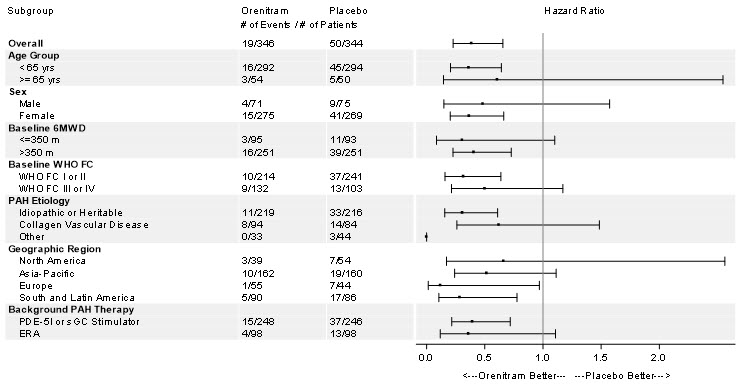
The treatment effect on time to first clinical worsening event due to disease progression was consistent for various subgroups defined by age, sex, baseline 6MWD, WHO functional class, disease etiology, geographical regions, and background therapy (Figure 7).
Figure 7: Forest Plot of Subgroup Analyses of Time to Disease Progression for Various Subgroups in the Primary Analysis Population (Study 4)
Long-Term Treatment of Pulmonary Arterial Hypertension
Patients (N=824) from the placebo-controlled studies entered a long-term, uncontrolled, open-label extension study. The average exposure to Orenitram was approximately 2 years with a maximum exposure of approximately 6 years. The dose of Orenitram continued to increase over time with doses (mean ± SD) of 3.6 ± 2.7, 4.2 ± 3.1, and 5 ± 3.7 mg BID at 6 (n=649), 12 (n=433), and 24 months (n=238), respectively, with a maximum dose of 21 mg BID. Reasons for discontinuation from the study included adverse event (16%), progression of disease (15%), death (13%), and withdrawn consent (7%). In the 522 subjects that completed the 12-month efficacy assessment, their mean 6MWD improved by 24 meters compared to baseline (30 meters in monotherapy patients and 20 meters when Orenitram was used in combination with an ERA and/or a PDE-5 inhibitor). Of the patients that remained in the study, overall survival was 92%, 87%, and 82% at the end of 1, 2, and 3 years, respectively, with progression-free survival (progression defined as death, discontinuation, or addition of a PAH therapy) of 74%, 61%, and 47%. Without a control group, these data must be interpreted cautiously.
Remodulin to Orenitram Transition Study
A 24-week, multicenter, open-label study enrolled 33 WHO Group 1 patients on stable doses of Remodulin. All patients received background therapy with a PDE-5 inhibitor and/or ERA. Patients were WHO functional class I or II and hemodynamically stable at baseline with a cardiac index >2.2 L/m2, RAP <11 mmHg, and PVR <10 Wood units. The primary endpoint of the study was the safety and tolerability of the transition. Successful transition was defined as transition from Remodulin to Orenitram at Week 4 (no longer receiving Remodulin) and clinically maintained on Orenitram through Week 24 (as measured by 6MWD and hemodynamics).
All patients transitioned from Remodulin to Orenitram (median time to transition of 3 days) with thirty-one patients (94%) completing transition in 5 days (range 2 to 29 days). Two subjects discontinued Orenitram. After 24 weeks of treatment with Orenitram, 6MWD and hemodynamics remained stable. Without a control group, these data must be interpreted cautiously.
©Copyright 2021 United Therapeutics Corp. All rights reserved.
United Therapeutics Corp.
Research Triangle Park, NC 27709