- Administer Kepivance by intravenous bolus injection. If heparin is used to maintain an intravenous line, rinse the line with saline prior to and after Kepivance administration
[see Drug Interactions (
7)].
- The reconstituted solution contains no preservatives and is intended for single use only. Discard any unused portion.
- Following reconstitution, it is recommended that the product be used immediately. If not used immediately, the reconstituted solution of Kepivance may be stored refrigerated in its carton at 2° to 8°C (36° to 46°F) for up to 24 hours.
- Prior to injection, allow Kepivance to reach room temperature for a maximum of 1 hour protected from light. Discard Kepivance left at room temperature for more than 1 hour.
Cataracts: In a postmarketing safety study, the incidence of cataracts was numerically higher among patients receiving Kepivance than in the control population. (See
14 CLINICAL STUDIES).
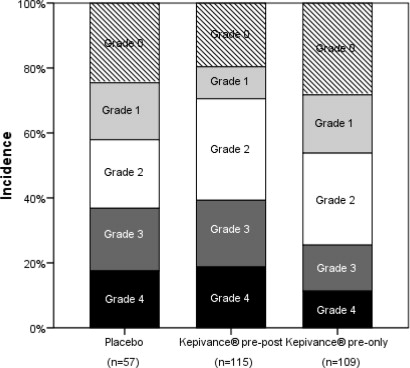
Infections: In a randomized, double-blind, placebo-controlled post-approval study designed to determine the efficacy of Kepivance with a high-dose melphalan preparative regimen, the incidence of treatment-emergent infections was significantly greater in patients treated with Kepivance compared to placebo. A total of 281 patients were randomized to 3 arms: Kepivance before melphalan on days -6, -5, -4 and after melphalan on days 0, 1, and 2 (pre-post) (n=115); Kepivance before melphalan on days -6, -5, -4 (pre) (n=109); or placebo (n=57). The incidence of reported infections were pre-post - 50%; pre - 47%; and placebo - 25%
[see Clinical Studies (
14.2)]
.
Laboratory Test Findings: Reversible elevations in serum lipase and amylase, which did not require treatment, were reported in 28% and 62% of patients receiving Kepivance and 23% and 54% of patients receiving placebo. In general, peak increases were observed during the period of cytotoxic therapy and returned to baseline by the day of hematopoietic stem cell infusion. Amylase was mainly salivary in origin.
Risk Summary
Based on findings in animal studies, Kepivance may cause fetal harm when administered to pregnant women. There are no data available on Kepivance use in pregnant women to inform a drug-associated risk of major birth defects and miscarriage or adverse maternal or fetal outcomes. In animal reproduction studies, intravenous administration of palifermin to pregnant rabbits and rats during the period of organogenesis resulted in embryo-fetal mortality and alterations to growth [see Data].
The estimated background risk of major birth defects and miscarriage for the indicated populations is unknown. All pregnancies have a background risk of birth defect, loss, or other adverse outcomes. In the U.S. general population, the estimated background risk of major birth defects and miscarriage in clinically recognized pregnancies is 2-4% and 15-20%, respectively.
Data
Animal data
In embryo-fetal development studies, palifermin was administered intravenously to pregnant rabbits and rats during the perid of organogenesis. Doses were 5, 60, and 150 μg/kg/day in rabbits (gestation days 6-18) and 100, 300, and 1000 μg/kg/day in rats (gestation days 6 through 17). Increased post-implantation loss and decreased fetal body weights occurred along with maternal toxicity (clinical signs and reductions in body weight gain and food consumption) at doses of 150 μg/kg/day in rabbits and 1000 μg/kg/day in rats. Increased skeletal variations was noted in rats at 1000 μg/kg/day. Doses of 150 μg/kg/day in rabbits and 1000 μg/kg/day in rats are approximately 5-times (rabbits) and 35-times (rats) the exposure (AUC) in patients receiving the recommended dose of 60 μg/kg/day.
Risk Summary
There are no data on the presence of Kepivance in human milk, the effect on the breastfed child, or the effect on milk production. Since many drugs are secreted into human milk, and because of the potential for serious adverse reactions in a nursing child, breastfeeding should be discontinued during treatment and for at least 2 weeks after the last dose.
Infertility
Based on findings from animal studies, palifermin may impair fertility in females and males of reproductive potential [see Nonclinical Toxicology (13.1)]. The reversibility of the effects on fertility is unknown.
Drug Interactions
Co-administration with Heparin
The potential pharmacokinetic interaction between palifermin and heparin was evaluated in a single-dose study in 27 healthy subjects receiving palifermin (60 mcg/kg) co-administered with and without therapeutic levels of unfractionated heparin. This co-administration resulted in a 5-fold increase in palifermin AUC and an 80% decrease in the mean CL. There was no significant effect of palifermin on heparin activity with respect to activated partial thromboplastin time (aPTT). A second study was conducted in 31 evaluable healthy subjects receiving palifermin (40 mcg/kg/day for 3 days) co-administered with and without therapeutic levels of unfractionated heparin. In this study, coadministration of heparin and palifermin resulted in a 425% increase in palifermin AUC and a 76.5, 73.1, and 38.8% decrease in palifermin CL, volume of distribution, and half-life, respectively. These changes in palifermin PK did not have a noticeable effect on Ki67 expression in buccal biopsies, used as a marker of epithelial cell proliferation.
Pharmacokinetics in Specific Populations
Renal Impairment
Results from a pharmacokinetics study in 24 subjects with varying degrees of renal impairment demonstrated that renal impairment has little or no influence on Kepivance pharmacokinetics.
Hepatic Impairment
The pharmacokinetic profile of patients with hepatic insufficiency has not been assessed.
Elderly
In a single-dose study, subjects received a 180-mcg/kg or 90-mcg/kg dose of palifermin administered by intravenous bolus injection. Subjects over the age of 65 (n=8) had an approximately 30% lower rate of CL on average than those 65 and younger (n=19). No dose adjustment is recommended for the geriatric population
[see Use in Specific Populations (
8.5)].