Secondary Prevention of Cardiovascular Disease
In the LESCOL Intervention Prevention Study (LIPS), the effect of fluvastatin capsules 40 mg administered twice daily on the risk of recurrent cardiac events (time to first occurrence of cardiac death, nonfatal myocardial infarction, or revascularization) was assessed in 1677 adult patients with CHD who had undergone a percutaneous coronary intervention (PCI) procedure (mean time from PCI to randomization = 3 days). In this multicenter, randomized, double-blind, placebo-controlled trial, patients were treated with dietary/lifestyle counseling and either fluvastatin 40 mg (n = 844) or placebo (n = 833) given twice daily for a median of 3.9 years. The study population was 84% male, 98% White, with 37% > 65 years of age. Mean baseline lipid concentrations were: total cholesterol 201 mg/dL, LDL-C 132 mg/dL, triglycerides 70 mg/dL, and HDL-C 39 mg/dL.
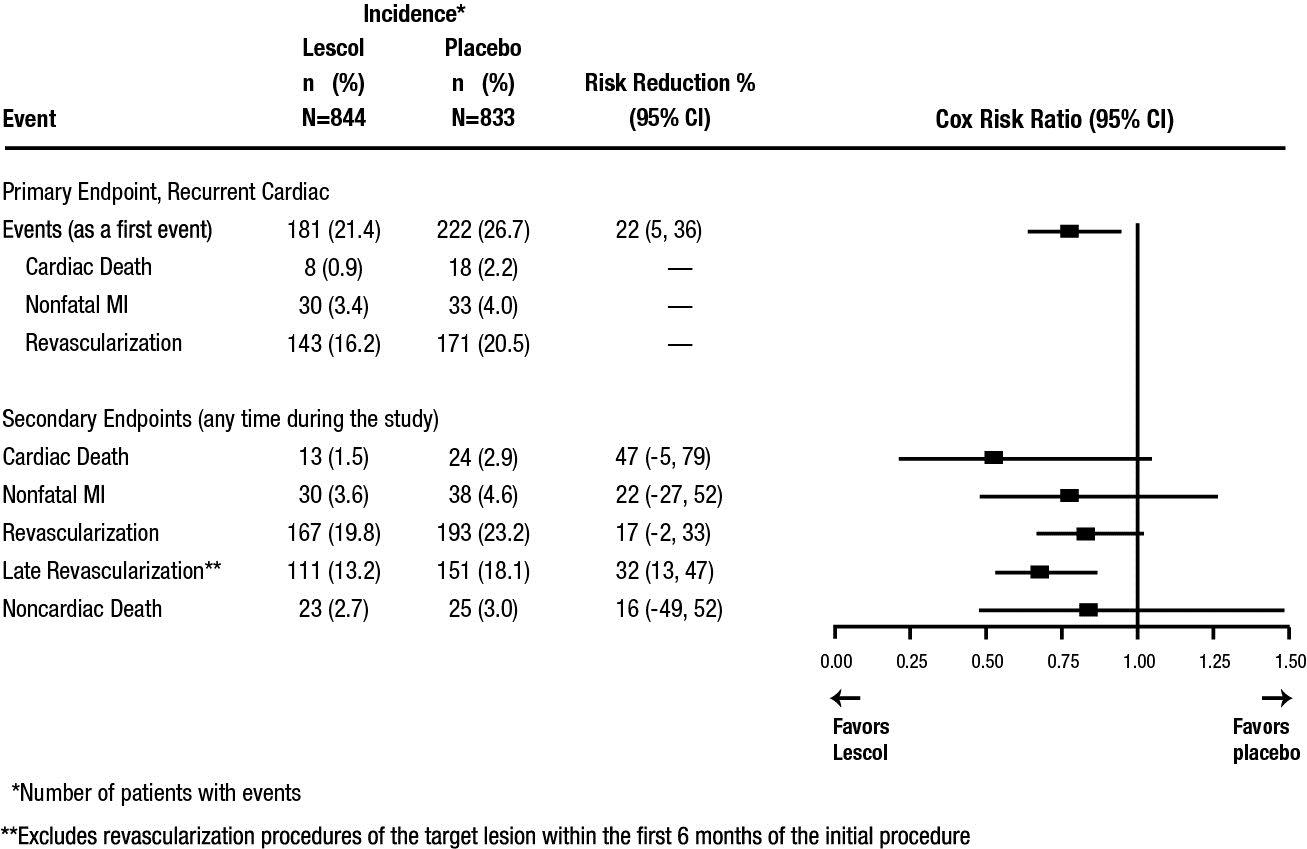
Fluvastatin capsules significantly reduced the risk of recurrent cardiac events (Figure 1) by 22% (p = 0.013, 181 patients in the fluvastatin capsules group versus 222 patients in the placebo group). Revascularization procedures comprised the majority of the initial recurrent cardiac events (143 revascularization procedures in the fluvastatin capsules group and 171 in the placebo group). Consistent trends in risk reduction were observed in patients > 65 years of age.
Figure 1. Primary Endpoint – Recurrent Cardiac Events (Cardiac Death, Nonfatal MI or Revascularization Procedure) (ITT Population)
Outcome data for the LESCOL Intervention Prevention Study are shown in Figure 2. After exclusion of revascularization procedures (CABG and repeat PCI) occurring within the first 6 months of the initial procedure involving the originally instrumental site, treatment with fluvastatin capsules was associated with a 32% (p = 0.002) reduction in risk of late revascularization procedures (CABG or PCI occurring at the original site > 6 months after the initial procedure, or at another site).
Figure 2. LESCOL Intervention Prevention Study–- Primary and Secondary Endpoints
In the Lipoprotein and Coronary Atherosclerosis Study (LCAS), the effect of fluvastatin capsule therapy on coronary atherosclerosis was assessed by quantitative coronary angiography (QCA) in patients with CAD and mild to moderate hypercholesterolemia (baseline LDL-C range 115 to 190 mg/dL). In this randomized double-blind, placebo-controlled trial, 429 patients were treated with conventional measures (Step 1, AHA Diet) and either fluvastatin 40 mg/day or placebo. In order to provide treatment to patients receiving placebo with LDL-C levels ≥160 mg/dL at baseline, adjunctive therapy with cholestyramine was added after Week 12 to all patients in the study with baseline LDL-C values of ≥ 160 mg/dL, which were present in 25% of the study population. Quantitative coronary angiograms were evaluated at baseline and 2.5 years in 340 (79%) angiographic evaluable patients.
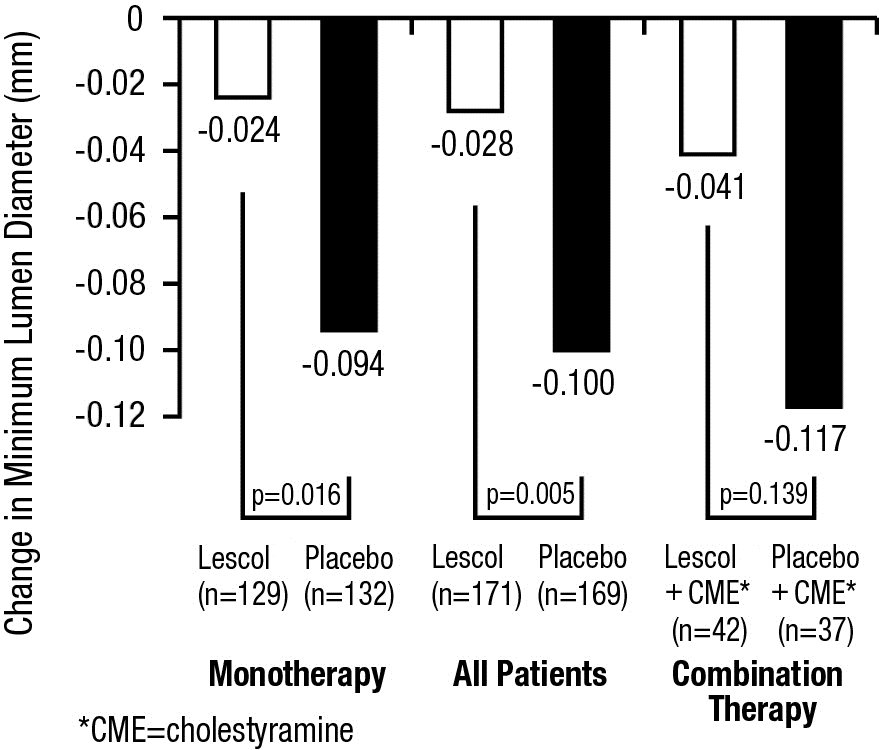
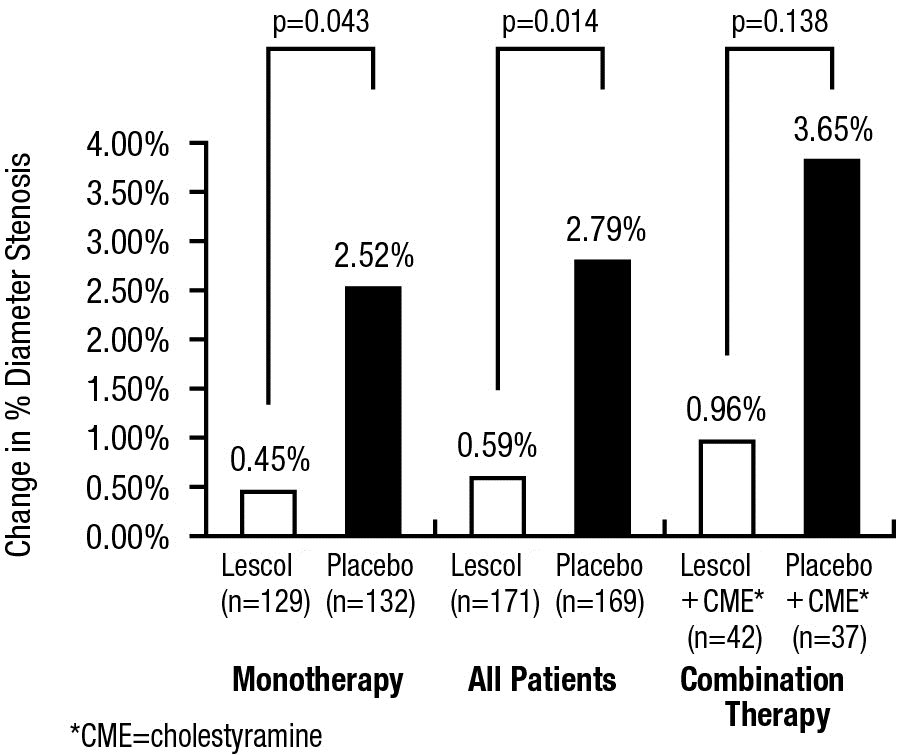
Compared to placebo, fluvastatin capsules significantly slowed the progression of coronary atherosclerosis as measured by within-patient per-lesion change in minimum lumen diameter (MLD), the primary endpoint (Figure 3 below), percent diameter stenosis (Figure 4), and the formation of new lesions (13% of all fluvastatin patients versus 22% of all placebo patients). A significant difference in favor of fluvastatin capsules was found between all fluvastatin and all placebo patients in the distribution among the three categories of definite progression, definite regression, and mixed or no change. Beneficial angiographic results (change in MLD) were independent of patients’ gender and consistent across a range of baseline LDL-C levels.
Figure 3. Change in Minimum Lumen Diameter (mm)
Figure 4. Change in % Diameter Stenosis
Primary Hyperlipidemia in Adults
LESCOL XL has been studied in five controlled trials of adult patients with primary hyperlipidemia and mixed dyslipidemia. LESCOL XL was administered to over 900 patients in trials from 4 to 26 weeks in duration. In the three largest of these trials, LESCOL XL given as a single daily dose of 80 mg significantly reduced Total-C, LDL-C, TG, and Apo B (Table 5).
In patients with primary mixed dyslipidemia as defined by baseline plasma TG levels ≥ 200 mg/dL and < 400 mg/dL, treatment with LESCOL XL produced significant decreases in Total-C, LDL-C, TG, and Apo B (see Table 7).
Table 7. Median Percent Change in Lipid Levels in Adult Patients with Primary Hyperlipidemia and Mixed Dyslipidemia From Baseline to Week 24 Endpoint All Active Controlled Trials (LESCOL XL)
| Total Chol | TG | LDL | Apo B | HDL |
Dose | N | %∆ | N | %∆ | N | %∆ | N | %∆ | N | %∆ |
All Patients | | | | | | | | | | |
| 750 | -25 | 750 | -19 | 748 | -35 | 745 | -27 | 750 | +7 |
Baseline TG ≥ 200 mg/dL | | | | | | | | | | |
| 239 | -25 | 239 | -25 | 237 | -33 | 235 | -27 | 239 | +11 |
aData for LESCOL XL 80 mg tablet from three 24- week controlled trials. |
HeFH in Pediatric Patients Aged 10 Years and Older
Fluvastatin capsules were studied in two open-label, uncontrolled, dose-titration trials. The first trial enrolled 29 pre-pubertal males, 9 to12 years of age, who had an LDL-C level > 90th percentile for age and one parent with primary hypercholesterolemia and either a family history of premature ischemic heart disease or tendon xanthomas. The mean baseline LDL-C was 226 mg/dL (range, 137 to 354 mg/dL). All patients were started on fluvastatin capsules 20 mg daily with dose adjustments every 6 weeks to 40 mg daily then 80 mg daily (40 mg twice daily) to achieve an LDL-C goal between 97 to 124 mg/dL. Endpoint analyses were performed at Year 2. Fluvastatin decreased plasma levels of Total-C and LDL-C by 21% and 27%, respectively. The mean achieved LDL-C was 161 mg/dL (range, 74 to 336 mg/dL).
The second trial enrolled 85 male and female patients, 10 to 16 years of age, who had an LDL-C > 190 mg/dL or LDL-C > 160 mg/dL and one or more risk factors for coronary heart disease, or LDL-C > 160 mg/dL and a proven LDL-receptor defect. The mean baseline LDL-C was 225 mg/dL (range, 148 to 343 mg/dL). All patients were started on fluvastatin capsules 20 mg daily with dose adjustments every 6 weeks to 40 mg daily then 80 mg daily (LESCOL XL tablet) to achieve an LDL-C goal of < 130 mg/dL. Endpoint analyses were performed at Week 114. Fluvastatin decreased plasma levels of Total-C and LDL-C by 22% and 28%, respectively. The mean achieved LDL-C was 159 mg/dL (range, 90 to 295 mg/dL).
The majority of patients in both trials (83% in the first trial and 89% in the second trial) were titrated to the maximum daily dose of 80 mg.