- A dose of 16 mg/kg sugammadex injection is recommended if there is a clinical need to reverse neuromuscular blockade soon (approximately 3 minutes) after administration of a single dose of 1.2 mg/kg of rocuronium. The efficacy of the 16 mg/kg dose of sugammadex injection following administration of vecuronium has not been studied. Immediate reversal in pediatric patients has not been studied
[see Clinical Studies
(14.1)].
Pediatric Patients
2 to <17 years of age
The safety of sugammadex injection has been assessed in a randomized, active-controlled study of pediatric patients 2 to <17 years of age, with 242 receiving treatment with sugammadex injection. Adverse events occurring in ≥5% of pediatric patients are presented in Table 3. The safety profile was generally consistent with that observed in adults.
Table 3: Pediatric Patients with (2 to <17 years of age) with Adverse Events Incidence ≥5% in One or More Treatment Groups Up to 7 Days Post-Treatment | Sugammadex 2 mg/kg | Sugammadex 4 mg/kg |
|---|
| n | (%) | n | (%) |
|---|
| Subjects in population | 51 | | 191 | |
| with one or more specific adverse events | 40 | (78) | 143 | (75) |
| with no specific adverse events | 11 | (22) | 48 | (25) |
| Cardiac disorders | 5 | (10) | 16 | (8) |
| Bradycardia
| 5 | (10) | 13 | (7) |
| Eye disorders | 3 | (6) | 1 | (1) |
| Gastrointestinal disorders | 8 | (16) | 35 | (18) |
| Nausea | 1 | (2) | 12 | (6) |
| Vomiting | 4 | (8) | 20 | (10) |
| Injury, poisoning and procedural complications | 34 | (67) | 121 | (63) |
| Incision site pain | 3 | (6) | 6 | (3) |
| Procedural nausea | 4 | (8) | 9 | (5) |
| Procedural pain | 30 | (59) | 111 | (58) |
| Procedural vomiting | 3 | (6) | 5 | (3) |
1-Combines prefereed terms of bradycardia and sinus bradycardia
Every subject is counted a single time for each applicable row and column.
A system organ class or specific adverse event appears in this table only if its incidence in one or more of the columns meets the incidence criterion in the table title, after rounding.
Anaphylaxis and Hypersensitivity
Hypersensitivity reactions, including anaphylaxis, have occurred in both premarketing clinical trials and in post-marketing spontaneous reports. In a dedicated hypersensitivity study in healthy volunteers, the frequency of anaphylaxis was 0.3%
[see
Warnings and Precautions (5.1)]
. These reactions varied from isolated skin reactions to serious systemic reactions (i.e., anaphylaxis, anaphylactic shock) and have occurred in patients with no prior exposure to sugammadex.
Symptoms associated with these reactions can include: flushing, urticaria, erythematous rash, (severe) hypotension, tachycardia, swelling of tongue, swelling of pharynx, bronchospasm and pulmonary obstructive events. Severe hypersensitivity reactions can be fatal.
A randomized, double-blind study examined the incidence of drug hypersensitivity reactions in healthy volunteers given up to 3 doses of placebo (N=76), sugammadex 4 mg/kg (N=151) or sugammadex 16 mg/kg (N=148). Reports of suspected hypersensitivity were adjudicated by a blinded committee. The incidence of adjudicated hypersensitivity was 1%, 7% and 9% in the placebo, sugammadex 4 mg/kg and sugammadex 16 mg/kg groups, respectively. There were no reports of anaphylaxis after placebo or sugammadex 4 mg/kg. There was a single case of adjudicated anaphylaxis after the first dose of sugammadex 16 mg/kg. The frequency of anaphylaxis for the 299 healthy volunteers treated with intravenous sugammadex was 0.3%. There was no evidence of increased frequency or severity of hypersensitivity with repeat dosing.
In a previous study of similar design, there were three adjudicated cases of anaphylaxis, all after sugammadex 16 mg/kg (incidence 1% in the 298 healthy volunteers treated with sugammadex).
Recurrence of Neuromuscular Blockade
In clinical studies with subjects treated with rocuronium or vecuronium, where sugammadex injection was administered using a dose labeled for the depth of neuromuscular blockade (N=2022), an incidence of <1% was observed for recurrence of neuromuscular blockade as based on neuromuscular monitoring or clinical evidence
[see
Warnings and Precautions (5.8)]
.
Bronchospasm
In one dedicated clinical trial and in post-marketing data, in patients with a history of pulmonary complications
[see
Use in Specific Populations (8.9)]
, bronchospasm was reported as a possibly related adverse event.
Additional pediatric use information is approved for Merck Sharp & Dohme LLC’s BRIDION
® (sugammadex) injection. However, due to Merck Sharp & Dohme LLC’s marketing exclusivity rights, this drug product is not labeled with that information.
Cardiac Disorders:Cases of marked bradycardia and bradycardia with cardiac arrest have been observed within minutes after administration of sugammadex
[see
Warnings and Precautions (5.2)]
. Other cardiac rhythm abnormalities have included atrial fibrillation, atrioventricular block, cardiac/cardiorespiratory arrest, electrocardiographic (ECG) ST segment changes, supraventricular tachycardia/extrasystoles, tachycardia, ventricular fibrillation, and ventricular tachycardia. Anaphylaxis associated with ECG ST segment changes (elevation or depression) consistent with myocardial ischemia or coronary spasm has also been reported.
General Disorders and Administration Site Conditions:Cases of sugammadex injection not having the intended effect.
Immune System Disorders:Hypersensitivity events including anaphylactic shock, anaphylactic reaction, anaphylactoid reaction, and Type 1 hypersensitivity have been reported
[see
Warnings and Precautions (5.1)]
.
Respiratory, Thoracic, and Mediastinal Disorders:Events of laryngospasm, dyspnea, wheezing, pulmonary edema, and respiratory arrest have been reported.
Toremifene
For toremifene, which has a relatively high binding affinity for sugammadex and for which relatively high plasma concentrations might be present, some displacement of vecuronium or rocuronium from the complex with sugammadex injection could occur. The recovery to TOF ratio to 0.9 could therefore be delayed in patients who have received toremifene on the same day of surgery.
Risk Summary
There are no clinical trial data on sugammadex injection use in pregnant women to inform any drug-associated risks. The available data from the pharmacovigilance safety database and published literature on sugammadex injection use in pregnant women are insufficient to identify a drug-associated risk of major birth defects, miscarriage, or adverse maternal or fetal outcomes. In animal reproduction studies, there was no evidence of malformations following daily intravenous administration of sugammadex to rats and rabbits during organogenesis at exposures of up to 6 and 8 times, respectively, the maximum recommended human dose (MRHD) of 16 mg/kg. However, there was an increase in the incidence of incomplete ossification of the sternebra and reduced fetal body weights in the rabbit study at 8 times the MRHD, which is a dose level in which maternal toxicity was also observed. In a pre- and postnatal development study, sugammadex treatment resulted in an increase in early postnatal loss, which correlated with maternal behavior (increased incidence of pup cannibalism), at exposures equivalent to the MRHD and higher
(see
Data)
. The background risk of major birth defects and miscarriage for the indicated population are unknown. However, the background risk in the U.S. general population of major birth defects is 2-4% and of miscarriage is 15-20% of clinically recognized pregnancies.
Data
Animal Data
In an embryofetal development study in rats, pregnant animals received daily intravenous administration of sugammadex at 0, 20, 100, and 500 mg/kg (0.2, 1, and 6 times the MRHD of 16 mg/kg/day, respectively, based on AUC comparison) during organogenesis (Gestational Days 6-17). No treatment-related maternal and embryofetal changes were observed.
In another embryofetal development study, pregnant New Zealand white rabbits received daily intravenous administration of sugammadex at 0, 20, 65, 200 mg/kg (0.6, 2, and 8 times the MRHD, respectively, based on AUC comparison) during organogenesis (Gestational Days 6-18). Fetal body weight decreases (10 and 14%, respectively) were observed in the offspring at maternal doses of 65 mg/kg and 200 mg/kg. In addition, incomplete ossification of sternebra, and unossified 1st metacarpal were noted at a maternal dose of 200 mg/kg/day. Maternal toxicity was also observed at 200 mg/kg. Considering the observed effects of sugammadex on bone
[see
Nonclinical Toxicology (13.2)]
, it is possible that these findings may be attributable to drug. There was no evidence of malformations at any dose.
In a prenatal and postnatal development study, pregnant rats were administered sugammadex intravenously at 0, 30, 120, and 500 mg/kg (0.3, 1, and 6 times the MRHD, respectively, based on AUC comparison) from Gestational Day (GD) 6 to Postnatal Day (PND) 21 (corresponding to the beginning of organogenesis through parturition and subsequent pup weaning). Postnatal loss during PND 1-4 was noted across control litters and treated litters from dams receiving sugammadex as a result of pup cannibalization by dams. Overall incidence of affected litters was 2, 1, 4, and 3 litters, respectively, at 0, 30, 120, or 500 mg/kg/day. The reason for the increased cannibalization is not known. An effect of sugammadex on steroidal hormones and/or pheromones cannot be ruled out. In addition, there were no drug-related effects on parturition in rats during evaluations for prenatal or postnatal development.
Risk Summary
No data are available regarding the presence of sugammadex in human milk, the effects of sugammadex on the breast fed infant, or the effects of sugammadex on milk production. However, sugammadex is present in rat milk (see Data). The developmental and health benefits of breastfeeding should be considered along with the mother’s clinical need for sugammadex injection and any potential adverse effects on the breastfed infant from sugammadex injection or from the underlying maternal condition.
Data
In a milk excretion study in rat dams following single intravenous dose of 20 mg/kg sugammadex on Postnatal Day 9, the maximum drug level was achieved at about 30 minutes after dosing with a ratio of milk to plasma level approximately 1:1. The oral exposure via milk did not induce effects on survival, body weight and physical or the behavioral developmental parameters monitored in rats in the prenatal and postnatal development studies
[see
Use in Specific Populations (8.1)]
.
Contraception
Upon administration of sugammadex injection, the efficacy of hormonal contraceptives may be reduced for up to 7 days. Advise female patients of reproductive potential using hormonal contraceptives to use an additional, non-hormonal contraceptive for the next 7 days following sugammadex injection administration
[see
Drug Interactions (7.3)]
.
Juvenile Animal Studies
In a bone deposition study, sugammadex concentrations were significantly higher in juvenile rats compared to adult rats (13% vs. 3% of the administered dose, respectively) following a single intravenous (IV) dose at 30 mg/kg (0.3 times the MRHD based on adult AUC comparison).
In a juvenile animal bone toxicity study, 7-day old rats were dosed intravenously once daily for 28 days with 0, 30, 120, and 500 mg/kg sugammadex (approximately 0.1, 0.6, and 3 times the MRHD, respectively, by adult AUC comparison). Sugammadex at 120 and 500 mg/kg decreased ulna and femur bone lengths by approximately 3%, which did not recover after an 8-week treatment-free period. Reversible whitish discoloration and disturbance of enamel formation were also observed in the incisors at these dose levels. In molars, this effect was only observed at 500 mg/kg. The no-observed-effect-level (NOEL) was 30 mg/kg.
In a second juvenile animal bone toxicity study, 7-day old rats were dosed once weekly for 8 weeks with 0, 7.5, 30, and 120 mg/kg (up to 1.2 times the MRHD of 16 mg/kg based on adult AUC comparison). No adverse effects on bone or teeth were noted.
Additional pediatric use information is approved for Merck Sharp & Dohme LLC’s BRIDION
® (sugammadex) injection. However, due to Merck Sharp & Dohme LLC’s marketing exclusivity rights, this drug product is not labeled with that information.
Cardiac Electrophysiology
At a dose 2 times the maximum recommended dose, sugammadex does not prolong the QTc interval to any clinically relevant extent.
Distribution
The observed steady-state volume of distribution of sugammadex is approximately 11 to 14 liters in adult patients with normal renal function (based on conventional, non-compartmental pharmacokinetic analysis).
Neither sugammadex nor the complex of sugammadex and rocuronium binds to plasma proteins or erythrocytes, as was shown
in vitro using male human plasma and whole blood. Sugammadex exhibits linear kinetics in the dosage range of 1 to 16 mg/kg when administered as an IV bolus dose.
In nonclinical drug distribution studies, sugammadex is retained in sites of active mineralization, such as bone and teeth, with a mean half-life of 172 and 8 days, respectively
[see
Use in Specific Populations (8.4),
Nonclinical Toxicology (13.2)]
.
Metabolism
In clinical studies, no metabolites of sugammadex have been observed and only renal excretion of the unchanged product was observed as the route of elimination.
Elimination
In adult anesthetized patients with normal renal function, the elimination half-life (t
1/2) of sugammadex is about 2 hours and the estimated plasma clearance is about 88 mL/min (based on compartmental pharmacokinetic analysis). A mass balance study demonstrated that >90% of the dose was excreted within 24 hours. Ninety-six percent (96%) of the dose was excreted in urine, of which at least 95% could be attributed to unchanged sugammadex. Excretion via feces or expired air was less than 0.02% of the dose. Administration of sugammadex injection to healthy volunteers resulted in increased renal elimination of rocuronium in complex.
Patients with Renal Impairment
Sugammadex is known to be substantially excreted by the kidney. The half-life of sugammadex in patients with mild, moderate and severe renal impairment is 4, 6, and 19 hours, respectively.
In one study, exposure to sugammadex was prolonged, leading to 17-fold higher overall exposure in patients with severe renal impairment. Low concentrations of sugammadex are detectable for at least 48 hours post-dose in patients with severe renal impairment.
In a second study comparing subjects with moderate or severe renal impairment to subjects with normal renal function, sugammadex clearance progressively decreased and t
1/2was progressively prolonged with declining renal function. Exposure was 2-fold and 5-fold higher in subjects with moderate and severe renal impairment, respectively. Sugammadex concentrations were no longer detectable beyond 7 days post-dose in subjects with severe renal impairment.
Geriatric Patients
Geriatric patients may have mild or moderate renal impairment. Population pharmacokinetic analysis indicated that, beyond the effects of a decreased creatinine clearance, increased age has limited impact on sugammadex PK parameters
[see
Use in Specific Populations (8.5,
8.6)].
Pediatric Patients
The pharmacokinetics of sugammadex in pediatric patients have been evaluated following administration of intravenous doses of 2 or 4 mg/kg sugammadex administered for reversal of moderate or deep neuromuscular blockade, respectively. In one study, sugammadex pharmacokinetic parameters were estimated in pediatric patients 2 to <17 years of age with patients enrolled into 3 age groups (2 to <6, 6 to <12 and 12 to <17 years of age).
Sugammadex exposure (AUC
0-infand C
max) increased in a dose-dependent, linear manner following administration of 2 or 4 mg/kg across patients 2 to <17 years of age. Sugammadex exposure was approximately 40% lower in patients 2 to <6 years of age following administration of 2 or 4 mg/kg sugammadex compared to older pediatric patients (6 to <17 years) and adults; however, this difference was not clinically relevant
[see
Clinical Studies (14.1)]
.
Both clearance and volume of distribution increase with increasing age in pediatric patients, whereas elimination half-life is generally similar across pediatric patients. As a result, the observed steady-state volume of distribution of sugammadex is approximately 3 to 10 liters and clearance is approximately 38 to 95 mL/min resulting in a half-life of approximately 1-2 hours in pediatric patients 2 to <17 years of age.
Sex
No pharmacokinetic differences between male and female subjects were observed.
Race
In a study in healthy Japanese and Caucasian subjects no clinically relevant differences in pharmacokinetic parameters were observed. Limited data do not indicate differences in pharmacokinetic parameters in Black or African Americans.
Obesity
In one clinical study of obese patients with a body mass index ≥40 kg/m
2, sugammadex 2 mg/kg and 4 mg/kg was dosed according to ABW (n=76) or IBW (n=74). Sugammadex exposure increased in a dose-dependent, linear manner following administration according to ABW or IBW. No clinically relevant differences in pharmacokinetic parameters were observed between obese patients and the general population, when dosed according to ABW.
[See
Use in Specific Populations (8.10).]
Systemic exposure of sugammadex is approximately 50% lower with IBW dosing compared to ABW.
Additional pediatric use information is approved for Merck Sharp & Dohme LLC’s BRIDION
® (sugammadex) injection. However, due to Merck Sharp & Dohme LLC’s marketing exclusivity rights, this drug product is not labeled with that information.
Carcinogenesis
Long-term animal studies to evaluate the carcinogenic potential of sugammadex have not been conducted.
Mutagenesis
Sugammadex and its mono OH-derivative tested negatively in
in vitro bacterial reverse mutation assays (Ames test),
in vitro chromosomal aberration assays in human peripheral blood lymphocytes, and
in vivo micronucleus assays in mice and rats.
Impairment of Fertility
A fertility and early embryonic development study in Sprague-Dawley rats in which male rats were treated daily for 29 days prior to mating and through the mating period and female rats were treated daily for 14 days prior to mating to Day 5 post-coitum via intravenous administration of sugammadex at 20, 100, and 500 mg/kg (0.2, 1, and 6 times the MRHD of 16 mg/kg, respectively, based on AUC comparison) did not show adverse effects on fertility.
Comparative Study of sugammadex injection versus Neostigmine as a Reversal Agent for Neuromuscular Blockade Induced by Rocuronium or Vecuronium at Reappearance of T
2(Moderate Blockade)
A multicenter, randomized, parallel-group, active-controlled, safety-assessor blinded study comparing sugammadex injection and neostigmine enrolled 189 patients (87 women and 102 men, 95% were ASA class 1 and 2 and 99% were Caucasian, median weights were 72 kg and 76 kg and median ages were 50 years and 51 years in the rocuronium and vecuronium groups, respectively). Patients were randomly assigned to the rocuronium or vecuronium group and underwent elective surgical procedures under general anesthesia that required endotracheal intubation and maintenance of neuromuscular blockade. The surgical procedures were mainly endocrine, ocular, ENT, abdominal (gynecological, colorectal, urological), orthopedic, vascular, or dermatological. At the reappearance of T
2, after the last dose of rocuronium or vecuronium, 2 mg/kg sugammadex injection or 50 mcg/kg neostigmine was administered in a randomized order as a single bolus injection. The time from start of administration of sugammadex injection or neostigmine to recovery of the TOF (T
4/T
1) ratio to 0.9 was assessed. Generally, a T
4/T
1ratio ≥0.9 correlates with recovery from neuromuscular blockade.
Return of the T
4/T
1ratio to 0.9 after the reappearance of T
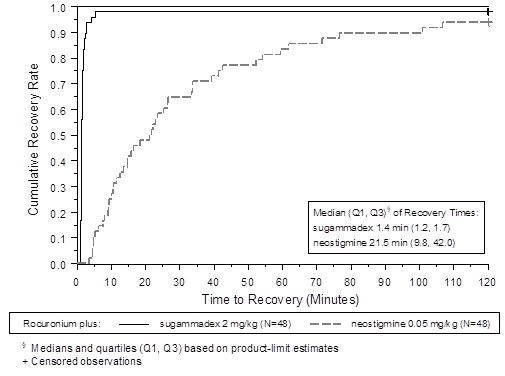
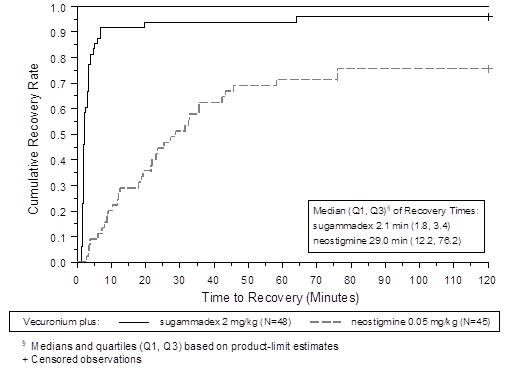
2was overall faster with sugammadex injection 2 mg/kg as compared to neostigmine 50 mcg/kg in the setting of rocuronium or vecuronium-induced neuromuscular blockade (Figures 1 and 2).
| Figure 1: Time (Minutes) from Administration of sugammadex injection or Neostigmine at the Reappearance of T
2after Rocuronium to Recovery of the T
4/T
1Ratio to 0.9
|
|
| Figure 2: Time (Minutes) from Administration of sugammadex injection or Neostigmine at the Reappearance of T
2after Vecuronium to Recovery of the T
4/T
1Ratio to 0.9
|
|
Comparative Study of sugammadex injection versus Neostigmine as a Reversal Agent for Neuromuscular Blockade Induced by Rocuronium or Vecuronium at 1 to 2 PTCs (Deep Blockade)
A multicenter, randomized, parallel-group, active-controlled, safety-assessor blinded study comparing sugammadex injection and neostigmine enrolled 157 patients (86 women and 71 men; 8% ASA class 1, 71% class 2, and 21% class 3; 79% Caucasian; median weights of 81 kg and 84 kg, and median ages of 54 years and 56 years in the rocuronium and vecuronium groups, respectively). Patients were randomly assigned to the rocuronium or vecuronium group and underwent elective surgical procedures under general anesthesia that required endotracheal intubation and maintenance of neuromuscular blockade. The surgical procedures were mainly abdominal (gynecological, colorectal, urological), orthopedic, reconstructive, or neurological. At 1 to 2 PTCs, after the last dose of rocuronium or vecuronium, 4 mg/kg sugammadex injection or 70 mcg/kg neostigmine was administered in a randomized order as a single bolus injection. The time from start of administration of sugammadex injection or neostigmine to recovery of the TOF (T
4/T
1) ratio to 0.9 was assessed, although neostigmine was not expected to reverse neuromuscular blockade at a depth of 1 to 2 PTCs. Generally, a T
4/T
1ratio ≥0.9 correlates with recovery from neuromuscular blockade.
Return of the T
4/T
1ratio to 0.9 in patients with 1 to 2 PTCs with sugammadex injection 4 mg/kg had a wider range of recovery times but the median time to recovery was comparable to the study of reversal at T
2(2.7 minutes with 25
thand 75
thpercentiles of 2.1 and 4.3 minutes for rocuronium [N=37], and 3.3 minutes with 25
thand 75
thpercentiles of 2.3 and 6.6 minutes for vecuronium [N=47]). There were 7 and 6 censored observations in the rocuronium and vecuronium groups, respectively.
Reversal of Neuromuscular Blockade 3 Minutes after Rocuronium 1.2 mg/kg
Time to recovery from neuromuscular blockade induced by succinylcholine compared with recovery from neuromuscular blockade induced by rocuronium followed 3 minutes later with sugammadex injection was assessed in a multicenter, randomized, parallel-group, active-controlled, safety-assessor blinded study. The study was conducted in 110 patients (64 women and 46 men, ASA class 1 and 2, 78% were Caucasian, median weight was 70 kg, median age was 43 years). Patients underwent elective surgical procedures under general anesthesia that required endotracheal intubation and a short duration of neuromuscular relaxation. The laparoscopic or open surgical procedures were mainly gynecological, orthopedic, or reconstructive. Return of the first twitch in a TOF (T
1) to 10% of baseline was compared between sugammadex injection 16 mg/kg for reversal of rocuronium 1.2 mg/kg versus spontaneous recovery from succinylcholine 1 mg/kg.
Recovery to T
1 of 10% of baseline (relative to the time of administration of rocuronium or succinylcholine) was overall faster in the rocuronium/ sugammadex injection group compared with succinylcholine alone (Table 5).
Table 5: Time (minutes) from Start of Administration of Rocuronium or Succinylcholine to Recovery of T
1 to 10% of Baseline
| Treatment Regimen |
|---|
| Rocuronium (1.2 mg/kg) and sugammadex injection (16 mg/kg) | Succinylcholine (1 mg/kg) |
|---|
| N | 55 | 55 |
| Mean (SD) | 4.4 (0.7) | 7.1 (1.6) |
| Median (Range) | 4.2 (3.5 – 7.7) | 7.1 (3.8 – 10.5) |
Comparative Studies of sugammadex injection versus Neostigmine as a Reversal Agent for Neuromuscular Blockade Induced by Rocuronium or Vecuronium in Pediatric Patients
2 to <17 Years of Age
Time to recovery from neuromuscular blockade induced by rocuronium or vecuronium followed by administration of sugammadex injection or neostigmine was assessed in a randomized, double-blind, active comparator-controlled study. The study was conducted in 288 randomized pediatric patients 2 to <17 years of age, of which 276 patients received treatment (153 boys and 123 girls; ASA class 1, 2, and 3; 89.5% were Caucasian; median weight was 25 kg; median age was 7 years). The primary efficacy objective was to evaluate the effect of sugammadex injection compared to neostigmine for reversal of moderate neuromuscular blockade as measured by time to recovery to a TOF ratio of ≥0.9.
Recovery to a TOF ratio of ≥0.9 was statistically significantly faster in pediatric patients 2 to <17 years of age dosed with sugammadex injection 2 mg/kg (N=33) compared with neostigmine (N=34) for reversal of moderate block based on a geometric mean of 1.7 minutes for sugammadex injection 2 mg/kg and 7.4 minutes for neostigmine (ratio of geometric means was 0.22, 95% CI (0.16, 0.32)). These effects were consistent across age cohorts studied (2 to <6; 6 to <12; 12 to <17 years of age) and neuromuscular blocking agent (rocuronium and vecuronium).
Additional pediatric use information is approved for Merck Sharp & Dohme LLC’s BRIDION
® (sugammadex) injection. However, due to Merck Sharp & Dohme LLC’s marketing exclusivity rights, this drug product is not labeled with that information.
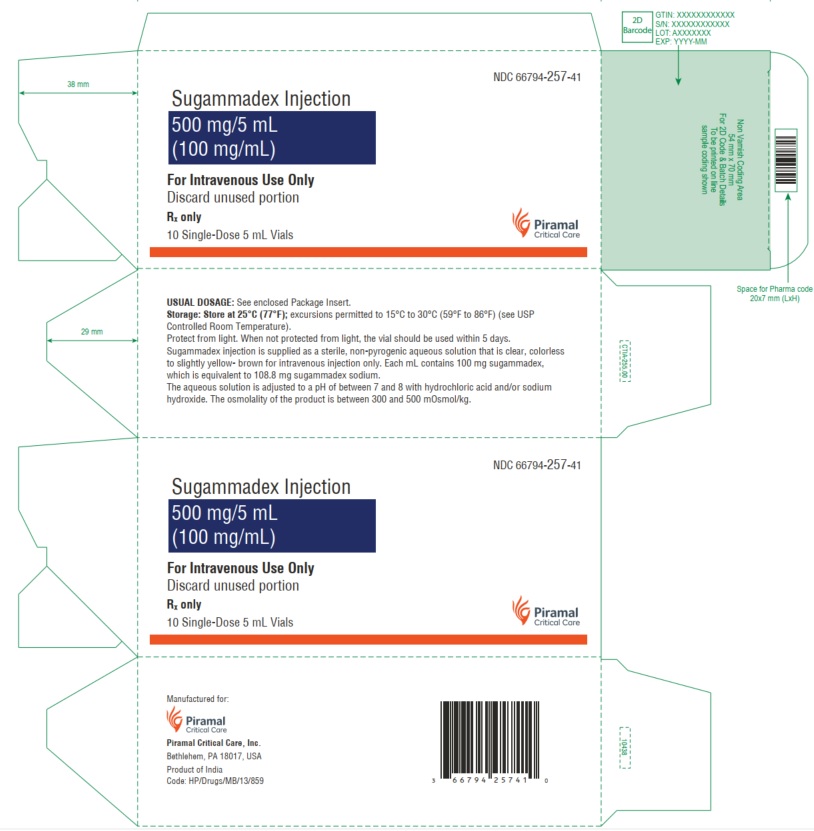
Manufactured for:
Piramal Critical Care, Inc.
Bethlehem, PA 18017, USA
Product of India
Issue date: 04/2025