The efficacy of 0.58 mg of XIAFLEX was evaluated in two randomized, double-blind, placebo-controlled, multicenter trials in 374 adult patients with Dupuytren’s contracture (Studies 1 and 2). At study entry, patients must have had: (1) a finger flexion contracture with a palpable cord of at least one finger (other than the thumb) of 20 to 100 degrees in a metacarpophalangeal (MP) joint or 20 to 80 degrees in a proximal interphalangeal (PIP) joint and (2) a positive “table top test” defined as the inability to simultaneously place the affected finger(s) and palm flat against a table top. Patients could not have received a surgical treatment (e.g., fasciectomy, fasciotomy) on the selected primary joint within 90 days before the first injection of study medication and patients could not have received anticoagulation medication (except for up to 150 mg of aspirin per day) within 7 days before the first injection of study medication.
The cord affecting the selected primary joint received up to 3 injections of 0.58 mg of XIAFLEX or placebo on Days 0, 30, and 60. About 24 hours after each injection of study medication, if needed, the investigator manipulated (extended) the treated finger in an attempt to facilitate rupture of the cord (finger extension procedure). Following manipulation, patients were fitted with a splint, instructed to wear the splint at bedtime for up to 4 months, and instructed to perform a series of finger flexion and extension exercises each day.
Table 6 shows the baseline disease characteristics of patients with Dupuytren’s contracture in Studies 1 and 2.
Table 6. Baseline Disease Characteristics of Patients with Dupuytren’s Contracture| 1 Prior surgery for Dupuytren’s contracture included fasciotomy and fasciectomy. |
| | Study 1 | Study 2 |
| Proportion of patients with prior surgery for Dupuytren’s contracture1 | 38% | 53% |
| Proportion of patients with prior surgery for Dupuytren’s contracture on the same finger as the primary joint1 | 8% | 18% |
| Mean number of affected joints | 3.0 | 3.3 |
In Studies 1 and 2, the primary endpoint was to evaluate the proportion of patients who achieved a reduction in contracture of the selected primary joint (MP or PIP) to within 0 to 5 degrees of normal, 30 days after the last injection of that joint on Days 30, 60, or 90 (after up to 3 injections). As shown in Table 7, a greater proportion of XIAFLEX-treated patients compared to placebo-treated patients achieved the primary endpoint.
Table 7. Percentage of Patients Who Achieved Reduction in Contracture of the Primary Joint to 0° to 5° After Up to 3 Injections in Studies 1 and 2a| a Patients may have received up to 3 injections of study medication into the cords associated with contracture of the primary joints on Days 0, 30, and 60. Assessments were made 30 days after the last injection (on Days 30, 60, or 90). |
| b For XIAFLEX-treated patients, the mean (±SD) number of injections given to the cord associated with the contracture was 1.7 (±0.8) in the 90-day controlled period in each trial. |
| c MP joints are metacarpophalangeal joints. |
| d PIP joints are proximal interphalangeal joints. |
| e 95% confidence interval. |
| Treated Joint | Study 1 | Study 2 |
| XIAFLEXb | Placebo | XIAFLEXb | Placebo |
All Joints (MP and PIP)c,d
Difference (CIe) | N=203 | N=103 | N=45 | N=21 |
64%
57% (47%, 67%) | 7%
- | 44%
40% (14%, 62%) | 5%
- |
MP Jointsc
Difference (CIe) | N=133 | N=69 | N=20 | N=11 |
77%
69% (57%, 79%) | 7%
- | 65%
56% (19%, 83%) | 9%
- |
PIP Jointsd
Difference (CIe) | N=70 | N=34 | N=25 | N=10 |
40%
34% (14%, 52%) | 6%
- | 28%
28% (-10%, 61%) | 0%
- |
The proportion of patients who achieved a contracture reduction of the primary joint to 0 to 5 degrees after the first injection was 39% and 1% in Study 1 and 27% and 5% in Study 2 in the XIAFLEX and placebo groups respectively.
XIAFLEX-treated patients, compared to placebo-treated patients, showed a greater increase from baseline in the range of motion of MP and PIP joints (see Table 8).
Table 8. Mean Increase in Range of Motion from Baseline in Degrees After Up to 3 Injections in Studies 1 and 2a| aPatients may have received up to 3 injections of study medication into the cords associated with contracture of the primary joints on Days 0, 30, and 60. Assessments were made 30 days after the last injection (on Days 30, 60, or 90). Baseline and final range of motion degree values are expressed in mean (SD). |
| bMP = Metacarpophalangeal joint |
| cPIP = Proximal interphalangeal joint |
| Range of Motion = Degrees of Full Flexion minus Degrees of Fixed Extension |
| Not all patients had range of motion values at both time points. |
| Treated Joint | Study 1 | Study 2 |
| XIAFLEX | Placebo | XIAFLEX | Placebo |
| All Joints b,c | N=196 | N=102 | N=45 | N=21 |
| Baseline | 44 (20) | 45 (19) | 40 (15) | 44 (16) |
| Final | 80 (20) | 50 (22) | 76 (18) | 52 (20) |
| Increase | 36 (21) | 4 (15) | 35 (18) | 8 (15) |
| MP Joints b | N=129 | N=68 | N=20 | N=11 |
| Baseline | 43 (20) | 46 (19) | 40 (12) | 41 (21) |
| Final | 83 (16) | 50 (21) | 80 (11) | 50 (22) |
| Increase | 41 (20) | 4 (13) | 40 (13) | 9 (15) |
| PIP Joints c | N=67 | N=34 | N=25 | N=10 |
| Baseline | 46 (20) | 44 (18) | 41 (18) | 47 (10) |
| Final | 75 (24) | 49 (24) | 73 (21) | 54 (18) |
| Increase | 28 (22) | 5 (19) | 32 (20) | 7 (16) |
Recurrence
A long-term, observational, Year 2 to Year 5, follow-up study (Study 4) was undertaken to evaluate recurrence of contracture and long-term safety in subjects who received up to 8 single injections of XIAFLEX 0.58 mg in a previous Phase 3 open-label or double-blind with open-label extension study. Of the 950 patients eligible for Study 4, only 645 patients enrolled. Of the 645 patients enrolled, 30% discontinued the study. Recurrence was assessed in successfully treated joints (i.e., subjects had a reduction in contracture to 5 degrees or less at the Day 30 evaluation after the last injection of XIAFLEX in a previous study) and was defined as an increase in joint contracture by at least 20 degrees in the presence of a palpable cord, or the joint underwent medical or surgical intervention primarily to correct a new or worsening Dupuytren’s contracture in that joint. Data on remaining recurrence free following successful treatment with XIAFLEX are provided in Figure 1.
Figure 1. Kaplan-Meier Plot Displaying Estimated Probability of Remaining Recurrence-Free over Time in the Observational Study 4 Among Joints That Were Successfully Treated in a Previous Study
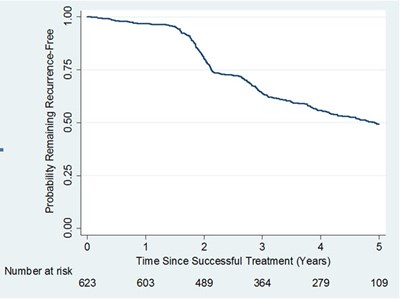
Figure 1. Kaplan-meier Plot Displaying Estimated Probability Of Remaining Recurrence-free Over Time In The Observational Study 4 Among Joints That Were Successfully Treated In A Previous Study (Xiaflex 1)
Retreatment of Recurrent Contractures
Study 5 retreated a subset of patients from Study 4 for a joint that was previously successfully treated but had recurrence. Patients in Study 5 received up to 3 injections of XIAFLEX (0.58 mg). Of the 91patients eligible for Study 5, 52 patients enrolled. In Study 5, 65% of recurrent MP joints and 45% of recurrent PIP joints achieved clinical success after retreatment with up to three injections of XIAFLEX. There was no control group for comparison in Study 5.