Risk Summary
OTOVEL is negligibly absorbed following otic administration and maternal use is not expected to result in fetal exposure to ciprofloxacin and fluocinolone acetonide
[see
Clinical Pharmacology (12.3)].
Risk Summary
OTOVEL is negligibly absorbed by the mother following otic administration and breastfeeding is not expected to result in exposure of the infant to ciprofloxacin and fluocinolone acetonide [
see
Clinical Pharmacology (12.3)].
Mechanism of Action
The bactericidal action of ciprofloxacin results from interference with the enzyme DNA gyrase, which is needed for the synthesis of bacterial DNA.
Resistance
Bacterial resistance to quinolones can develop through chromosomal or plasmid-mediated mechanisms.
In vitro studies demonstrated cross-resistance between ciprofloxacin and some fluoroquinolones. There is generally no cross-resistance between ciprofloxacin and other classes of antibacterial agents such as beta-lactams or aminoglycosides.
Antimicrobial Activity
Ciprofloxacin has been shown to be active against most isolates of the following bacteria, both
in vitro and clinically in otic infections [
see
Indications and Usage (1)]:
Aerobic Bacteria:
Gram-positive Bacteria:
Staphylococcus aureus
Streptococcus pneumoniae
Gram-negative Bacteria:
Pseudomonas aeruginosa
Haemophilus influenzae
Moraxella catarrhalis
Carcinogenesis
No long term studies of OTOVEL have been performed to evaluate carcinogenic potential.
Long-term carcinogenicity studies in mice and rats have been completed for ciprofloxacin. After daily oral doses of 750 mg/kg (mice) and 250 mg/kg (rats) were administered for up to 2 years, there was no evidence that ciprofloxacin had any carcinogenic or tumorigenic effects in these species.
Long-term animal studies have not been performed to evaluate the carcinogenic potential of fluocinolone acetonide.
Mutagenesis
Eight
in vitro mutagenicity tests have been conducted with ciprofloxacin, and the test results are listed below:
- Salmonella/Microsome Test (Negative)
- E. coli DNA Repair Assay (Negative)
- Mouse Lymphoma Cell Forward Mutation Assay (Positive)
- Chinese Hamster V79 Cell HGPRT Test (Negative)
- Syrian Hamster Embryo Cell Transformation Assay (Negative)
- Saccharomyces cerevisiae Point Mutation Assay (Negative)
- Saccharomyces cerevisiae Mitotic Crossover and Gene Conversion Assay (Negative)
- Rat Hepatocyte DNA Repair Assay (Positive)
Thus, 2 of the 8 tests were positive, but results of the following 3
in vivo test systems gave negative results:
- Rat Hepatocyte DNA Repair Assay
- Micronucleus Test (Mice)
- Dominant Lethal Test (Mice)
Studies have not been performed to evaluate the mutagenic potential of fluocinolone acetonide. Some corticosteroids have been found to be genotoxic.
Impairment of Fertility
No reproduction toxicity studies were conducted with OTOVEL. Absorption of ciprofloxacin and fluocinolone acetonide following otic administration of OTOVEL at the recommended dosage is negligible [
see
Clinical Pharmacology (12.3)].
How supplied
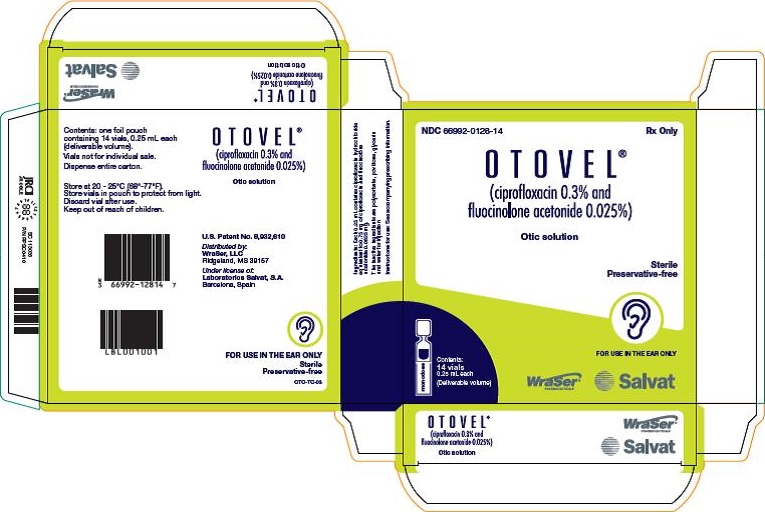
OTOVEL (ciprofloxacin and fluocinolone acetonide) otic solution, 0.3 %/0.025 %, is a sterile, preservative-free, clear otic solution supplied in blue translucent single-dose 0.25 mL vials. Fourteen single-dose vials are packaged in a protective foil pouch contained in a carton (NDC 66992-128-14).
Administration Instructions
- Advise patients that OTOVEL is for otic use only. It is not to be used in the eyes.
- Advise patients to warm the otic solution by holding the vial in the hand for 1 to 2 minutes before instilling it in the ear, to avoid dizziness.
Hypersensitivity Reactions
- Advise patients to immediately discontinue OTOVEL at the first appearance of a skin rash or any other sign of hypersensitivity
[see
Warnings and Precautions (5.1)]
OTOVEL is:
Distributed by:
WraSer, LLC
Ridgeland, MS 39157
Under license of Laboratorios SALVAT, S.A.
OTOVEL is a registered trademark of Laboratorios Salvat, S.A.
U.S. Patent No: 8,932,610
OTO-PIAG-01