The safety and efficacy of fluticasone furoate/vilanterol ELLIPTA were evaluated in more than 24,000 subjects with COPD. The development program included 4 confirmatory trials of 6 and 12 months’ duration, three 12-week active comparator trials with fluticasone propionate/salmeterol 250/50 mcg, 1 long-term trial, and dose-ranging trials of shorter duration. The efficacy of fluticasone furoate/vilanterol ELLIPTA is based primarily on the dose-ranging trials and the 4 confirmatory trials described below.
Dose Selection for Vilanterol
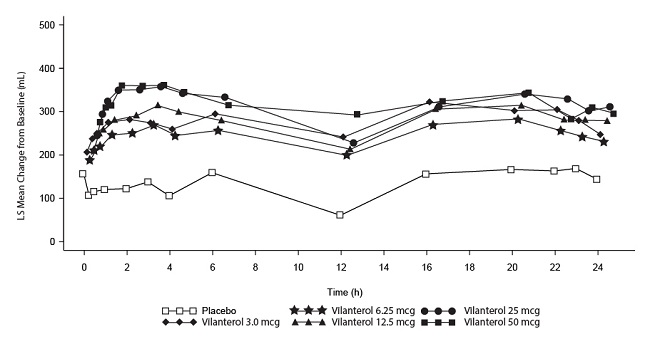
Dose selection for vilanterol in COPD was supported by a 28-day, randomized, double-blind, placebo-controlled, parallel-group trial evaluating 5 doses of vilanterol (3 to 50 mcg) or placebo dosed in the morning in 602 subjects with COPD. Results demonstrated dose-related increases from baseline in FEV1 at Day 1 and Day 28 (Figure 3).
Figure 3. Least Squares (LS) Mean Change from Baseline in Postdose Serial FEV1 (0-24 h) (mL) on Days 1 and 28
Day 1
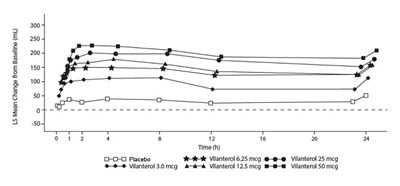
Figure 3 (Ff Vil Spl Graphic 05)
Day 28
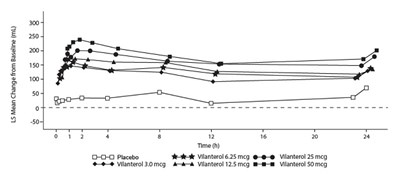
Figure 3 (Ff Vil Spl Graphic 06)
The differences in trough FEV1 on Day 28 from placebo for the 3-, 6.25-, 12.5-, 25-, and 50-mcg doses were 92 mL (95% CI: 39, 144), 98 mL (95% CI: 46, 150), 110 mL (95% CI: 57, 162), 137 mL (95% CI: 85, 190), and 165 mL (95% CI: 112, 217), respectively. These results supported the evaluation of vilanterol 25 mcg once daily in the confirmatory trials for COPD.
Dose Selection for Fluticasone Furoate
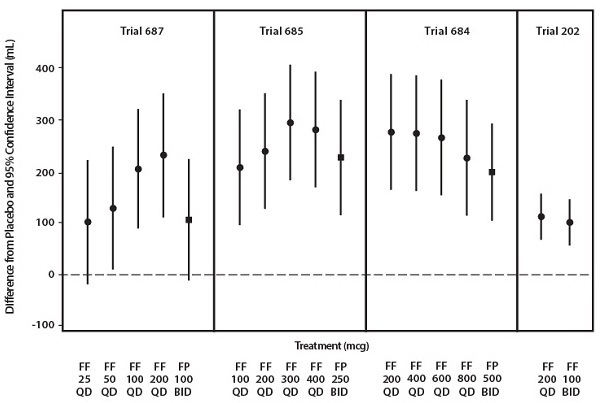
Dose selection of fluticasone furoate for Phase 3 trials in subjects with COPD was based on dose-ranging trials conducted in subjects with asthma; these trials are described in detail below [see Clinical Studies (14.2)].
Confirmatory Trials
The 4 confirmatory trials evaluated the efficacy of fluticasone furoate/vilanterol ELLIPTA on lung function (Trials 1 and 2) and exacerbations (Trials 3 and 4).
Lung Function: Trials 1 and 2 were 24-week, randomized, double-blind, placebo-controlled trials designed to evaluate the efficacy of fluticasone furoate/vilanterol ELLIPTA on lung function in subjects with COPD. In Trial 1, subjects were randomized to fluticasone furoate/vilanterol ELLIPTA 100/25 mcg, fluticasone furoate/vilanterol ELLIPTA 200/25 mcg, fluticasone furoate 100 mcg, fluticasone furoate 200 mcg, vilanterol 25 mcg, and placebo. In Trial 2, subjects were randomized to fluticasone furoate/vilanterol ELLIPTA 100/25 mcg, fluticasone furoate/vilanterol 50/25 mcg, fluticasone furoate 100 mcg, vilanterol 25 mcg, and placebo. All treatments were administered as 1 inhalation once daily.
Of the 2,254 patients, 70% were male and 84% were white. They had a mean age of 62 years and an average smoking history of 44 pack years, with 54% identified as current smokers. At screening, the mean postbronchodilator percent predicted FEV1 was 48% (range: 14% to 87%), mean postbronchodilator FEV1/FVC ratio was 47% (range: 17% to 88%), and the mean percent reversibility was 14% (range: -41% to 152%).
The co-primary efficacy variables in both trials were weighted mean FEV1 (0 to 4 hours) postdose on Day 168 and change from baseline in trough FEV1 on Day 169 (the mean of the FEV1 values obtained 23 and 24 hours after the final dose on Day 168). The weighted mean comparison of the fluticasone furoate/vilanterol combination with fluticasone furoate was assessed to evaluate the contribution of vilanterol to fluticasone furoate/vilanterol ELLIPTA. The trough FEV1 comparison of the fluticasone furoate/vilanterol combination with vilanterol was assessed to evaluate the contribution of fluticasone furoate to fluticasone furoate/vilanterol ELLIPTA.
Fluticasone furoate/vilanterol ELLIPTA 100/25 mcg demonstrated a larger increase in the weighted mean FEV1 (0 to 4 hours) relative to placebo and fluticasone furoate 100 mcg at Day 168 (Table 5).
Table 5. Least Squares Mean Change from Baseline in Weighted Mean FEV1 (0-4 h) and Trough FEV1 at 6 Months| a At Day 168. |
| b At Day 169. |
Treatment | n | Weighted Mean FEV1 (0-4 h)a (mL) | Trough FEV1b (mL) |
Difference from | Difference from |
Placebo (95% CI) | Fluticasone Furoate 100 mcg (95% CI) | Fluticasone Furoate 200 mcg (95% CI) | Placebo (95% CI) | Vilanterol 25 mcg (95% CI) |
Trial 1 |
Fluticasone furoate/vilanterol ELLIPTA 100/25 mcg | 204 | 214 (161, 266) | 168 (116, 220) | –– | 144 (91, 197) | 45 (-8, 97) |
Fluticasone furoate/vilanterol ELLIPTA 200/25 mcg | 205 | 209 (157, 261) | –– | 168 (117, 219) | 131 (80, 183) | 32 (-19, 83) |
Trial 2 |
Fluticasone furoate/vilanterol ELLIPTA 100/25 mcg | 206 | 173 (123, 224) | 120 (70, 170) | –– | 115 (60, 169) | 48 (-6, 102) |
Serial spirometric evaluations were performed predose and up to 4 hours after dosing. Results from Trial 1 at Day 1 and Day 168 are shown in Figure 4. Similar results were seen in Trial 2 (not shown).
Figure 4. Raw Mean Change from Baseline in Postdose Serial FEV1 (0-4 h) (mL) on Days 1 and 168
Day 1
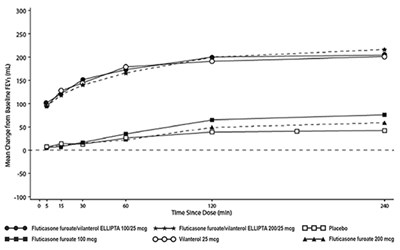
Figure 4 Day 1 (Ff Vil Spl Graphic 07)
Day 168

Figure 4 Day 168 (Ff Vil Spl Graphic 08)
The second co-primary variable was change from baseline in trough FEV1 following the final treatment day. At Day 169, both Trials 1 and 2 demonstrated significant increases in trough FEV1 for all strengths of the fluticasone furoate/vilanterol combination compared with placebo (Table 5). The comparison of fluticasone furoate/vilanterol ELLIPTA 100/25 mcg with vilanterol did not achieve statistical significance (Table 5).
Trials 1 and 2 evaluated FEV1 as a secondary endpoint. Peak FEV1 was defined as the maximum postdose FEV1 recorded within 4 hours after the first dose of trial medicine on Day 1 (measurements recorded at 5, 15, and 30 minutes and 1, 2, and 4 hours). In both trials, differences in mean change from baseline in peak FEV1 were observed for the groups receiving fluticasone furoate/vilanterol ELLIPTA 100/25 mcg compared with placebo (152 and 139 mL, respectively). The median time to onset, defined as a 100-mL increase from baseline in FEV1, was 16 minutes in subjects receiving fluticasone furoate/vilanterol ELLIPTA 100/25 mcg.
Exacerbations: Trials 3 and 4 were randomized, double-blind, 52-week trials designed to evaluate the effect of fluticasone furoate/vilanterol ELLIPTA on the rate of moderate and severe COPD exacerbations. All subjects were treated with fluticasone propionate/salmeterol 250/50 mcg twice daily during a 4-week run-in period prior to being randomly assigned to 1 of the following treatment groups: fluticasone furoate/vilanterol ELLIPTA 100/25 mcg, fluticasone furoate/vilanterol ELLIPTA 200/25 mcg, fluticasone furoate/vilanterol 50/25 mcg, or vilanterol 25 mcg.
The primary efficacy variable in both trials was the annual rate of moderate/severe exacerbations. The comparison of the fluticasone furoate/vilanterol combination with vilanterol was assessed to evaluate the contribution of fluticasone furoate to fluticasone furoate/vilanterol ELLIPTA. In these 2 trials, exacerbations were defined as worsening of 2 or more major symptoms (dyspnea, sputum volume, and sputum purulence) or worsening of any 1 major symptom together with any 1 of the following minor symptoms: sore throat, colds (nasal discharge and/or nasal congestion), fever without other cause, and increased cough or wheeze for at least 2 consecutive days. COPD exacerbations were considered to be of moderate severity if treatment with systemic corticosteroids and/or antibiotics was required and were considered to be severe if hospitalization was required.
Trials 3 and 4 included 3,255 subjects, of which 57% were male and 85% were white. They had a mean age of 64 years and an average smoking history of 46 pack years, with 44% identified as current smokers. At screening, the mean postbronchodilator percent predicted FEV1 was 45% (range: 12% to 91%), and mean postbronchodilator FEV1/FVC ratio was 46% (range: 17% to 81%), indicating that the subject population had moderate to very severely impaired airflow obstruction. The mean percent reversibility was 15% (range: -65% to 313%).
Subjects treated with fluticasone furoate/vilanterol ELLIPTA 100/25 mcg had a lower annual rate of moderate/severe COPD exacerbations compared with vilanterol in both trials (Table 6).
Table 6. Moderate and Severe Chronic Obstructive Pulmonary Disease ExacerbationsTreatment | n | Mean Annual Rate (exacerbations/year) | Ratio vs. Vilanterol | 95% CI |
Trial 3 |
Fluticasone furoate/vilanterol ELLIPTA 100/25 mcg | 403 | 0.90 | 0.79 | 0.64, 0.97 |
Fluticasone furoate/vilanterol ELLIPTA 200/25 mcg | 409 | 0.79 | 0.69 | 0.56, 0.85 |
Fluticasone furoate/vilanterol 50/25 mcg | 412 | 0.92 | 0.81 | 0.66, 0.99 |
Vilanterol 25 mcg | 409 | 1.14 | –– | –– |
Trial 4 |
Fluticasone furoate/vilanterol ELLIPTA 100/25 mcg | 403 | 0.70 | 0.66 | 0.54, 0.81 |
Fluticasone furoate/vilanterol ELLIPTA 200/25 mcg | 402 | 0.90 | 0.85 | 0.70, 1.04 |
Fluticasone furoate/vilanterol 50/25 mcg | 408 | 0.92 | 0.87 | 0.72, 1.06 |
Vilanterol 25 mcg | 409 | 1.05 | –– | –– |
Comparator Trials
Three 12-week, randomized, double-blind, double-dummy trials were conducted with fluticasone furoate/vilanterol ELLIPTA 100/25 mcg once daily versus fluticasone propionate/salmeterol 250/50 mcg twice daily to evaluate the efficacy of serial lung function of fluticasone furoate/vilanterol ELLIPTA in subjects with COPD. The primary endpoint of each study was change from baseline in weighted mean FEV1 (0 to 24 hours) on Day 84. Of the 519 patients in Trial 5, 64% were male and 97% were white; mean age was 61 years; average smoking history was 40 pack years, with 55% identified as current smokers. At screening in the treatment group using fluticasone furoate/vilanterol ELLIPTA 100/25mcg, the mean postbronchodilator percent predicted FEV1 was 48% (range: 19% to 70%), the mean (SD) FEV1/FVC ratio was 0.51 (0.11), and the mean percent reversibility was 11% (range: -12% to 83%). At screening in the treatment group using fluticasone propionate/salmeterol 250/50 mcg, the mean postbronchodilator percent predicted FEV1 was 47% (range: 14% to 71%), the mean (SD) FEV1/FVC ratio was 0.49 (0.10), and the mean percent reversibility was 11% (range: -13% to 50%).
Of the 511 patients in Trial 6, 68% were male and 94% were white; mean age was 62 years; average smoking history was 35 pack years, with 52% identified as current smokers. At screening in the treatment group using fluticasone furoate/vilanterol ELLIPTA 100/25 mcg, the mean postbronchodilator percent predicted FEV1 was 48% (range: 18% to 70%), the mean (SD) FEV1/FVC ratio was 0.51 (0.10), and the mean percent reversibility was 12% (range: -56% to 77%). At screening in the treatment group using fluticasone propionate/salmeterol 250/50 mcg, the mean postbronchodilator percent predicted FEV1 was 49% (range: 15% to 70%), the mean (SD) FEV1/FVC ratio was 0.50 (0.10), and the mean percent reversibility was 12% (range: -66% to 72%).
Of the 828 patients in Trial 7, 72% were male and 98% were white; mean age was 61 years; average smoking history was 38 pack years, with 60% identified as current smokers. At screening in the treatment group using fluticasone furoate/vilanterol ELLIPTA 100/25 mcg, the mean postbronchodilator percent predicted FEV1 was 48% (range: 18% to 70%), the mean (SD) FEV1/FVC ratio was 0.52 (0.10), and the mean percent reversibility was 12% (range: -26% to 84%). At screening in the treatment group using fluticasone propionate/salmeterol 250/50 mcg, the mean postbronchodilator percent predicted FEV1 was 48% (range: 16% to 70%), the mean (SD) FEV1/FVC ratio was 0.51 (0.10), and the mean percent reversibility was 12% (range: -15% to 67%).
In Trial 5, the mean (SE) change from baseline in weighted mean FEV1 (0 to 24 hours) with fluticasone furoate/vilanterol ELLIPTA 100/25 mcg was 174 (15) mL compared with 94 (16) mL with fluticasone propionate/salmeterol 250/50 mcg (treatment difference 80 mL; 95% CI: 37, 124; P<0.001). In Trials 6 and 7, the mean (SE) change from baseline in weighted mean FEV1 (0 to 24 hours) with fluticasone furoate/vilanterol ELLIPTA 100/25 mcg was 142 (18) mL and 168 (12) mL, respectively, compared with 114 (18) mL and 142 (12) mL, respectively, for fluticasone propionate/salmeterol 250/50 mcg (Trial 6 treatment difference 29 mL; 95% CI: -22, 80; P = 0.267; Trial 7 treatment difference 25 mL; 95% CI: -8, 59; P = 0.137).
Mortality Trial
A randomized, double-blind, multicenter, multinational trial prospectively evaluated the efficacy of fluticasone furoate/vilanterol ELLIPTA 100/25 mcg compared with placebo on survival. The trial was event-driven and patients were followed until a sufficient number of deaths occurred. In this trial, 16,568 subjects aged 40 to 80 years received fluticasone furoate/vilanterol ELLIPTA 100/25 mcg (n = 4,140), fluticasone furoate 100 mcg (n = 4,157), vilanterol 25 mcg (n = 4,140), or placebo (n = 4,131). Subjects were treated for up to 4 years, with a median treatment duration of 1.5 years. Median duration of follow-up for the endpoint of survival was 1.8 years for all treatment groups. All subjects had COPD with moderate airflow limitation (≥50% and ≤70% predicted FEV1) and either had a history of, or were at risk of, cardiovascular disease. The primary endpoint was all-cause mortality. Secondary efficacy endpoints included the rate of decline in FEV1, annual rate of moderate/severe COPD exacerbations, and health-related quality of life as measured by the St. George’s Respiratory Questionnaire for COPD patients (SGRQ-C).
Survival: Survival with fluticasone furoate/vilanterol ELLIPTA 100/25 mcg was not significantly improved compared with placebo (hazard ratio 0.88; 95% CI: 0.74, 1.04). Mortality per 100 patient-years was 3.1 for fluticasone furoate/vilanterol ELLIPTA 100/25 mcg, 3.5 for placebo, 3.2 for fluticasone furoate, and 3.4 for vilanterol.
Lung Function: A reduction of 8 mL/year was estimated on-treatment for fluticasone furoate/vilanterol ELLIPTA 100/25 mcg compared with placebo in the rate of lung function decline as measured by FEV1 (95% CI: 1, 15).
Exacerbations: Treatment with fluticasone furoate/vilanterol ELLIPTA 100/25 mcg reduced the on-treatment annual rate of moderate/severe exacerbations by 29% compared with placebo (95% CI: 22, 35). Treatment with fluticasone furoate/vilanterol ELLIPTA 100/25 mcg reduced the annual rate of moderate/severe exacerbations by 19% compared with fluticasone furoate (95% CI: 12, 26) and by 21% compared with vilanterol (95% CI: 14, 28). The on-treatment annual rate of moderate/severe exacerbations was 0.25 for fluticasone furoate/vilanterol ELLIPTA 100/25 mcg, 0.35 for placebo, 0.31 for fluticasone furoate, and 0.31 for vilanterol.
Treatment with fluticasone furoate/vilanterol ELLIPTA 100/25 mcg reduced the on-treatment annual rate of severe exacerbations (i.e., requiring hospitalization) by 27% compared with placebo (95% CI: 13, 39). Treatment with fluticasone furoate/vilanterol ELLIPTA 100/25 mcg reduced the on-treatment annual rate of exacerbations requiring hospitalization by 11% compared with fluticasone furoate (95% CI: -6, 25) and by 9% compared with vilanterol (95% CI: -8, 24).
Health-Related Quality of Life: The St. George’s Respiratory Questionnaire (SGRQ) is a disease-specific patient-reported instrument that measures symptoms, activities, and impact on daily life. The SGRQ-C, a shorter version derived from the original SGRQ, was used in this trial. Results were transformed to the SGRQ for reporting purposes. In a subset of 4,443 subjects, the on-treatment SGRQ responder rates at 1 year (defined as a change in score of 4 or more as threshold) were 49% for fluticasone furoate/vilanterol ELLIPTA 100/25 mcg, 47% for placebo, 48% for fluticasone furoate, and 48% for vilanterol (odds ratio 1.18; 95% CI: 0.97, 1.44 for fluticasone furoate/vilanterol ELLIPTA 100/25 mcg compared with placebo).