The woman should insert Etonogestrel/Ethinyl Estradiol Vaginal Ring on the first day of her menstrual bleeding. Etonogestrel/Ethinyl Estradiol Vaginal Ring may also be started on Days 2-5 of the woman's cycle, but in this case a barrier method, such as male condoms with spermicide, should be used for the first seven days of Etonogestrel/Ethinyl Estradiol Vaginal Ring use in the first cycle.
The woman may switch from her previous CHC on any day, but at the latest on the day following the usual hormone-free interval, if she has been using her hormonal method consistently and correctly, or if it is reasonably certain that she is not pregnant.
The woman may switch from the POP on any day; instruct her to start using Etonogestrel/Ethinyl Estradiol Vaginal Ring on the day after she took her last POP. She should switch from an implant or the IUS on the day of its removal, and from an injectable on the day when the next injection would be due. In all of these cases, the woman should use an additional barrier method such as a male condom with spermicide, for the first seven days.
The woman may start using Etonogestrel/Ethinyl Estradiol Vaginal Ring within the first five days following a complete first trimester abortion or miscarriage, and she does not need to use an additional method of contraception. If use of Etonogestrel/Ethinyl Estradiol Vaginal Ring is not started within five days following a first trimester abortion or miscarriage, the woman should follow the instructions for "No Hormonal Contraceptive Use in the Preceding Cycle." In the meantime, she should be advised to use a non-hormonal contraceptive method.
Start Etonogestrel/Ethinyl Estradiol Vaginal Ring no earlier than four weeks after a second trimester abortion or miscarriage, due to the increased risk of thromboembolism. [See Contraindications (4) and Warnings and Precautions (5.1).]
The use of Etonogestrel/Ethinyl Estradiol Vaginal Ring may be initiated no sooner than four weeks postpartum in women who elect not to breastfeed, due to the increased risk of thromboembolism in the postpartum period. [See Contraindications (4) and Warnings and Precautions (5.1).]
Advise women who are breastfeeding not to use Etonogestrel/Ethinyl Estradiol Vaginal Ring but to use other forms of contraception until the child is weaned.
If a woman begins using Etonogestrel/Ethinyl Estradiol Vaginal Ring postpartum, instruct her to use an additional method of contraception, such as male condoms with spermicide, for the first seven days. If she has not yet had a period, consider the possibility of ovulation and conception occurring prior to initiation of Etonogestrel/Ethinyl Estradiol Vaginal Ring.
Etonogestrel/Ethinyl Estradiol Vaginal Ring can be accidentally expelled, for example, while removing a tampon, during intercourse, or with straining during a bowel movement. Etonogestrel/Ethinyl Estradiol Vaginal Ring should be left in the vagina for a continuous period of three weeks. If the ring is accidentally expelled and is left outside of the vagina for less than three hours, contraceptive efficacy is not reduced. Etonogestrel/Ethinyl Estradiol Vaginal Ring can be rinsed with cool to lukewarm (not hot) water and reinserted as soon as possible, but at the latest within three hours. If Etonogestrel/Ethinyl Estradiol Vaginal Ring is lost, a new vaginal ring should be inserted and the regimen should be continued without alteration.
- Insert a new ring immediately. Inserting a new ring will start the next three-week use period. The woman may not experience a withdrawal bleed from her previous cycle. However, breakthrough spotting or bleeding may occur.
- Insert a new ring no later than seven days from the time the previous ring was removed or expelled, during which time she may have a withdrawal bleed. This option should only be chosen if the ring was used continuously for at least seven days prior to inadvertent removal/expulsion.
In either case, a barrier method such as male condoms with spermicides must be used until the new ring has been used continuously for seven days.
If Etonogestrel/Ethinyl Estradiol Vaginal Ring was out of the vagina for an unknown amount of time, the possibility of pregnancy should be considered. A pregnancy test should be performed prior to inserting a new ring.
Prolonged Ring-Free Interval:
If the ring-free interval has been extended beyond one week, consider the possibility of pregnancy, and an additional method of contraception, such as male condoms with spermicide, MUST be used until Etonogestrel/Ethinyl Estradiol Vaginal Ring has been used continuously for seven days.
Prolonged Use of Etonogestrel/Ethinyl Estradiol Vaginal Ring:
If Etonogestrel/Ethinyl Estradiol Vaginal Ring has been left in place for up to one extra week (i.e., up to four weeks total), the woman will remain protected. Etonogestrel/Ethinyl Estradiol Vaginal Ring should be removed and the woman should insert a new ring after a one-week ring-free interval.
If Etonogestrel/Ethinyl Estradiol Vaginal Ring has been left in place for longer than four weeks, instruct the woman to remove the ring, and rule out pregnancy. If pregnancy is ruled out, Etonogestrel/Ethinyl Estradiol Vaginal Ring may be restarted, and an additional method of contraception, such as male condoms with spermicide, MUST be used until a new Etonogestrel/Ethinyl Estradiol Vaginal Ring has been used continuously for seven days.
Ring Breakage:
There have been reported cases of Etonogestrel/Ethinyl Estradiol Vaginal Ring disconnecting at the weld joint. This is not expected to affect the contraceptive effectiveness of Etonogestrel/Ethinyl Estradiol Vaginal Ring. In the event of a disconnected ring, vaginal discomfort or expulsion (slipping out) is more likely to occur. Vaginal injury associated with ring breakage has been reported [see Adverse Reactions (6.2)].
If a woman discovers that her Etonogestrel/Ethinyl Estradiol Vaginal Ring has disconnected, she should discard the ring and replace it with a new ring.
Impaired Liver Function
Do not use Etonogestrel/Ethinyl Estradiol Vaginal Ring in women with liver disease such as acute viral hepatitis or severe (decompensated) cirrhosis of the liver [see Contraindications (4)]. Acute or chronic disturbances of liver function may necessitate the discontinuation of CHC use until markers of liver function return to normal and CHC causation has been excluded [see Use in Specific Populations (8.6)]. Discontinue Etonogestrel/Ethinyl Estradiol Vaginal Ring use if jaundice develops.
Liver Tumors
Etonogestrel/Ethinyl Estradiol Vaginal Ring is contraindicated in women with benign and malignant liver tumors [see Contraindications (4)]. Hepatic adenomas are associated with CHC use. An estimate of the attributable risk is 3.3 cases per 100,000 CHC users. Rupture of hepatic adenomas may cause death through intra-abdominal hemorrhage.
Studies have shown an increased risk of developing hepatocellular carcinoma in long term (>8 years) CHC users. However, the attributable risk of liver cancers in CHC users is less than one case per million users.
Unscheduled Bleeding and Spotting
Unscheduled bleeding (breakthrough or intracyclic) bleeding and spotting sometimes occur in women using CHCs, especially during the first three months of use. If bleeding persists or occurs after previously regular cycles, check for causes such as pregnancy or malignancy. If pathology and pregnancy are excluded, bleeding irregularities may resolve over time or with a change to a different CHC.
Bleeding patterns were evaluated in three large clinical studies. In the North American study (US and Canada, N=1,177), the percentages of subjects with breakthrough bleeding/spotting ranged from 7.2% to 11.7% during cycles 1-13. In the two non-US studies, the percentages of subjects with breakthrough bleeding/spotting ranged from 2.6% to 6.4% (Europe, N=1,145) and from 2.0% to 8.7% (Europe, Brazil, Chile, N=512).
Amenorrhea and Oligomenorrhea
If scheduled (withdrawal) bleeding does not occur, consider the possibility of pregnancy. If the patient has not adhered to the prescribed dosing schedule, consider the possibility of pregnancy at the time of the first missed period and take appropriate diagnostic measures.
Occasional missed periods may occur with the appropriate use of Etonogestrel/Ethinyl Estradiol Vaginal Ring. In the clinical studies, the percent of women who did not have withdrawal bleeding in a given cycle ranged from 0.3% to 3.8%.
If the patient has adhered to the prescribed regimen and misses two consecutive periods, rule out pregnancy.
Some women may experience amenorrhea or oligomenorrhea after discontinuing CHC use, especially when such a condition was pre-existent.
Substances decreasing the plasma concentrations of CHCs and potentially diminishing the effectiveness of CHCs
Drugs or herbal products that induce certain enzymes, including cytochrome P450 3A4 (CYP3A4), may decrease the plasma concentrations of CHCs and potentially diminish the effectiveness of CHCs or increase breakthrough bleeding. Some drugs or herbal products that may decrease the effectiveness of hormonal contraceptives include: phenytoin, barbiturates, carbamazepine, bosentan, felbamate, griseofulvin, oxcarbazepine, rifampicin, topiramate, rifabutin, rufinamide, aprepitant, and products containing St. John's wort. Interactions between CHCs and other drugs may lead to breakthrough bleeding and/or contraceptive failure.
Counsel women to use an alternative non-hormonal method of contraception or a back-up method when enzyme inducers are used with Etonogestrel/Ethinyl Estradiol Vaginal Ring, and to continue back-up non-hormonal contraception for 28 days after discontinuing the enzyme inducer to ensure contraceptive reliability.
Note: Etonogestrel/Ethinyl Estradiol Vaginal Ring may interfere with the correct placement and position of certain female barrier methods such as a diaphragm or female condom. These methods are not recommended as back-up methods with Etonogestrel/Ethinyl Estradiol Vaginal Ring use [see Dosage and Administration (2.5)].
The serum concentrations of etonogestrel and ethinyl estradiol were not affected by concomitant administration of oral amoxicillin or doxycycline in standard dosages during 10 days of antibiotic treatment. The effects of other antibiotics on etonogestrel or ethinyl estradiol concentrations have not been evaluated.
Substances increasing the plasma concentrations of CHCs
Co-administration of atorvastatin and certain CHCs containing ethinyl estradiol increase AUC values for ethinyl estradiol by approximately 20-25%. Ascorbic acid and acetaminophen may increase plasma ethinyl estradiol concentrations, possibly by inhibition of conjugation. Concomitant administration of strong or moderate CYP3A4 inhibitors such as itraconazole, voriconazole, fluconazole, grapefruit juice, or ketoconazole may increase plasma estrogen and/or progestin concentrations. Co-administration of vaginal miconazole nitrate and Etonogestrel/Ethinyl Estradiol Vaginal Ring increases the serum concentrations of etonogestrel and ethinyl estradiol by up to 40% [see Clinical Pharmacology (12.3)].
Human immunodeficiency virus (HIV) / Hepatitis C Virus (HCV) protease inhibitors and non-nucleoside reverse transcriptase inhibitors
Significant changes in the plasma concentrations of the estrogen and /or progestin have been noted in some cases of co-administration with HIV protease inhibitors (decrease [e.g., nelfinavir, ritonavir, darunavir/ritonavir, (fos)amprenavir/ritonavir, lopinavir/ritonavir, and tipranavir/ritonavir] or increase [e.g., indinavir and atazanavir/ritonavir]) /HCV protease inhibitors (decrease [e.g., boceprevir and telaprevir]) or with non-nucleoside reverse transcriptase inhibitors (decrease [e.g., efavirenz, nevirapine] or increase [e.g., etravirine]). These changes may be clinically relevant in some cases.
Risk Summary
Etonogestrel/Ethinyl Estradiol Vaginal Ring is contraindicated during pregnancy because there is no need for pregnancy prevention in a woman who is already pregnant. Epidemiologic studies and meta-analyses have not shown an increased risk of genital or non-genital birth defects (including cardiac anomalies and limb-reduction defects) following maternal exposure to low dose CHCs prior to conception or during early pregnancy. No adverse developmental outcomes were observed in pregnant rats and rabbits with the administration of etonogestrel during organogenesis at doses approximately 300 times the anticipated daily vaginal human dose (~0.002 mg/kg/day).
No adverse developmental outcomes were observed in pregnant rats and rabbits with the co-administration of the combination desogestrel/ethinyl estradiol during organogenesis at desogestrel/ethinyl estradiol doses at least 2/5 times, respectively, the anticipated daily vaginal human dose (~0.002 desogestrel/0.00025 ethinyl estradiol mg/kg/day).
Discontinue Etonogestrel/Ethinyl Estradiol Vaginal Ring use if pregnancy is confirmed.
Data
Animal Data
In rats and rabbits at dosages up to 300 times the anticipated dose, etonogestrel is neither embryotoxic nor teratogenic. Co-administration of a maternally toxic dose of desogestrel/ethinyl estradiol to pregnant rats was associated with embryolethality and wavy ribs at a desogestrel/ethinyl estradiol dose that was 40/130 times, respectively, the anticipated vaginal human dose (0.002 desogestrel/0.00025 ethinyl estradiol mg/kg/day). No adverse embryofetal effects were observed when the combination was administered to pregnant rats at a desogestrel/ethinyl estradiol dose that was 4/13 times, respectively, the anticipated vaginal human dose. When desogestrel/ethinyl estradiol was given to pregnant rabbits, pre-implantation loss was observed at a desogestrel/ethinyl estradiol dose that was 3/10 times, respectively, the anticipated vaginal human dose. No adverse embryofetal effects were observed when the combination was administered to pregnant rabbits at a desogestrel/ethinyl estradiol dose that was 2/5 times the anticipated vaginal human dose.
Risk Summary
Small amounts of contraceptive steroids and/or metabolites, including etonogestrel and ethinyl estradiol are transferred to human milk. Harmful effects have not been observed in breastfed infants exposed to CHCs through breast milk. CHCs can reduce milk production in breastfeeding mothers. This is less likely to occur once breastfeeding is well-established; however, it can occur at any time in some women.
When possible, advise the nursing mother to use non-estrogen-containing contraception until she has completely weaned her child. The developmental and health benefits of breastfeeding should be considered along with the mother's clinical need for Etonogestrel/Ethinyl Estradiol Vaginal Ring and any potential adverse effects on the breastfed child from Etonogestrel/Ethinyl Estradiol Vaginal Ring or from the underlying maternal condition.
Absorption
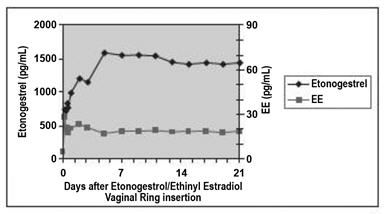
Etonogestrel: Etonogestrel released by Etonogestrel/Ethinyl Estradiol Vaginal Ring is rapidly absorbed. The bioavailability of etonogestrel after vaginal administration is approximately 100%. The serum etonogestrel and ethinyl estradiol concentrations observed during three weeks of Etonogestrel/Ethinyl Estradiol Vaginal Ring use are summarized in Table 2.
Ethinyl estradiol: Ethinyl estradiol released by Etonogestrel/Ethinyl Estradiol Vaginal Ring is rapidly absorbed. The bioavailability of ethinyl estradiol after vaginal administration is approximately 56%, which is comparable to that with oral administration of ethinyl estradiol. The serum ethinyl estradiol concentrations observed during three weeks of Etonogestrel/Ethinyl Estradiol Vaginal Ring use are summarized in Table 2.
Table 2: Mean (SD) Serum Etonogestrel and Ethinyl Estradiol Concentrations (n=16) | 1 week | 2 weeks | 3 weeks |
|---|
etonogestrel
(pg/mL) | 1578 (408) | 1476 (362) | 1374 (328) |
ethinyl estradiol
(pg/mL) | 19.1 (4.5) | 18.3 (4.3) | 17.6 (4.3) |
The pharmacokinetic profile of etonogestrel and ethinyl estradiol during use of Etonogestrel/Ethinyl Estradiol Vaginal Ring is shown in Figure 2.
Figure 2: Mean Serum Concentration-Time Profile of Etonogestrel and Ethinyl Estradiol during Three Weeks of Etonogestrel/Ethinyl Estradiol Vaginal Ring Use  Figure 2 (Etonogestrel 04) |
The pharmacokinetic parameters of etonogestrel and ethinyl estradiol were determined during one cycle of Etonogestrel/Ethinyl Estradiol Vaginal Ring use in 16 healthy female subjects and are summarized in Table 3.
Table 3: Mean (SD) Pharmacokinetic Parameters of Etonogestrel/Ethinyl Estradiol Vaginal Ring (n=16)| Hormone | Cmax
pg/mL | Tmax
hr | t1/2
hr | CL
L/hr |
|---|
Cmax- maximum serum drug concentration
Tmax- time at which maximum serum drug concentration occurs
t1/2 - elimination half-life, calculated by 0.693/Kelim
CL - apparent clearance |
| etonogestrel | 1716 (445) | 200.3 (69.6) | 29.3 (6.1) | 3.4 (0.8) |
| ethinyl estradiol | 34.7 (17.5) | 59.3 (67.5) | 44.7 (28.8) | 34.8 (11.6) |
Prolonged use of Etonogestrel/Ethinyl Estradiol Vaginal Ring: The mean serum etonogestrel concentration at the end of the fourth week of continuous use of Etonogestrel/Ethinyl Estradiol Vaginal Ring was 1272 ± 311 pg/mL compared to a mean concentration range of 1578 ± 408 to 1374 ± 328 pg/mL at the end of weeks one to three. The mean serum ethinyl estradiol concentration at the end of the fourth week of continuous use of Etonogestrel/Ethinyl Estradiol Vaginal Ring was 16.8 ± 4.6 pg/mL compared to a mean concentration range of 19.1 ± 4.5 to 17.6 ± 4.3 pg/mL at the end of weeks one to three.
Distribution
Etonogestrel: Etonogestrel is approximately 32% bound to sex hormone-binding globulin (SHBG) and approximately 66% bound to albumin in blood.
Ethinyl estradiol: Ethinyl estradiol is highly but not specifically bound to serum albumin (98.5%) and induces an increase in the serum concentrations of SHBG.
Metabolism
In vitro data shows that both etonogestrel and ethinyl estradiol are metabolized in liver microsomes by the cytochrome P450 3A4 isoenzyme. Ethinyl estradiol is primarily metabolized by aromatic hydroxylation, but a wide variety of hydroxylated and methylated metabolites are formed. These are present as free metabolites and as sulfate and glucuronide conjugates. The hydroxylated ethinyl estradiol metabolites have weak estrogenic activity. The biological activity of etonogestrel metabolites is unknown.
Excretion
Etonogestrel and ethinyl estradiol are primarily eliminated in urine, bile and feces.
Drug Interactions
[See also Drug Interactions (7).]
The drug interactions of Etonogestrel/Ethinyl Estradiol Vaginal Ring were evaluated in several studies.
A single-dose vaginal administration of an oil-based 1200-mg miconazole nitrate capsule increased the serum concentrations of etonogestrel and ethinyl estradiol by approximately 17% and 16%, respectively. Following multiple doses of 200 mg miconazole nitrate by vaginal suppository or vaginal cream, the mean serum concentrations of etonogestrel and ethinyl estradiol increased by up to 40%.
A single-dose vaginal administration of 100-mg water-based nonoxynol-9 spermicide gel did not affect the serum concentrations of etonogestrel or ethinyl estradiol.
The serum concentrations of etonogestrel and ethinyl estradiol were not affected by concomitant administration of oral amoxicillin or doxycycline in standard dosages during 10 days of antibiotic treatment.
Tampon Use
The use of tampons had no effect on serum concentrations of etonogestrel and ethinyl estradiol during use of Etonogestrel/Ethinyl Estradiol Vaginal Ring [see Dosage and Administration (2.5)].
Carcinogenesis
In a 24-month carcinogenicity study in rats with subdermal implants releasing 10 and 20 mcg etonogestrel per day, (approximately 0.3 and 0.6 times the systemic steady-state exposure of women using Etonogestrel/Ethinyl Estradiol Vaginal Ring), no drug-related carcinogenic potential was observed.
Mutagenesis
Etonogestrel was not genotoxic in the in vitro Ames/Salmonella reverse mutation assay, the chromosomal aberration assay in Chinese hamster ovary cells or in the in vivo mouse micronucleus test.
Impairment of Fertility
A fertility study was conducted with etonogestrel in rats at approximately 600 times the anticipated daily vaginal human dose (~0.002 mg/kg/day). Treatment did not have any adverse effect on resulting litter parameters after cessation of treatment supporting the return to fertility after suppression with etonogestrel.
Increased risk of cardiovascular events
- Advise patients that cigarette smoking increases the risk of serious cardiovascular events from use of Etonogestrel/Ethinyl Estradiol Vaginal Ring, and women who are over 35 years old and smoke should not use Etonogestrel/Ethinyl Estradiol Vaginal Ring [see Boxed Warning].
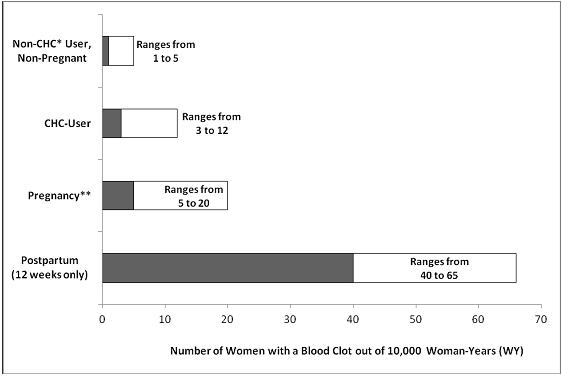
- Inform patients that the increased risk of VTE compared to non-users of CHCs is greatest after initially starting a CHC or restarting (following a 4-week or greater CHC-free interval) the same or a different CHC [see Warnings and Precautions (5.1)].
Use and administration