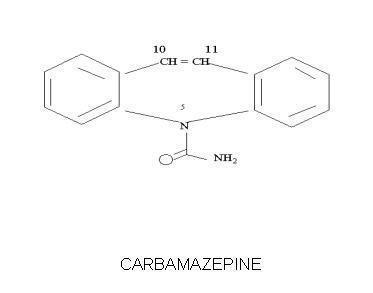
Clinically meaningful drug interactions have occurred with concomitant medications and include, but are not limited to the following:
Agents Highly Bound to Plasma Protein:
Carbamazepine is not highly bound to plasma proteins; therefore, administration of carbamazepine extended-release capsules to a patient taking another drug that is highly protein bound should not cause increased free concentrations of the other drug.
Agents that Inhibit Cytochrome P450 Isoenzymes and/or Epoxide Hydrolase:
Carbamazepine is metabolized mainly by cytochrome P450 (CYP) 3A4 to the active carbamazepine 10,11-epoxide, which is further metabolized to the trans-diol by epoxide hydrolase. Therefore, the potential exists for interaction between carbamazepine and any agent that inhibits CYP3A4 and/or epoxide hydrolase. Agents that are CYP3A4 inhibitors that have been found, or are expected, to increase plasma levels of carbamazepine extended-release capsules include, for example, the following:
Acetazolamide, aprepitant, azole antifungals (e.g., ketoconazole, itraconazole, fluconazole, voriconazole), cimetidine, ciprofloxacin, clarithromycin, dalfopristin, danazol, dantrolene, delavirdine, diltiazem, erythromycin, fluoxetine, fluvoxamine, grapefruit juice, ibuprofen, isoniazid, loratadine, macrolides, nefazodone, niacinamide, nicotinamide, olanzapine, omeprazole, oxybutynin, protease inhibitors, propoxyphene, quinine, quinupristin, ticlopidine, troleandomycin, valproate, verapamil, zileuton.
Human microsomal epoxide hydrolase has been identified as the enzyme responsible for the formation of the 10,11-transdiol derivative from carbamazepine-10,11 epoxide. Coadministration of inhibitors of human microsomal epoxide hydrolase may result in increased carbamazepine-10,11 epoxide plasma concentrations. Accordingly, the dosage of Carbamazepine extended-release should be adjusted and/or the plasma levels monitored when used concomitantly with loxapine, quetiapine, or valproic acid.
Thus, if a patient has been titrated to a stable dosage of carbamazepine extended-release, and then begins a course of treatment with one of these CYP3A4 or epoxide hydrolase inhibitors, it is reasonable to expect that a dose reduction for Carbamazepine extended-release may be necessary.
Agents that Induce Cytochrome P450 Isoenzymes:
Carbamazepine is metabolized by CYP3A4. Therefore, the potential exists for interaction between carbamazepine and any agent that induces CYP3A4. Agents that are CYP inducers that have been found, or are expected, to decrease plasma levels of carbamazepine extended-release capsules include, for example, the following:
Aminophylline, cisplatin, doxorubicin HCL, felbamate, fosphenytoin, methsuximide, phenobarbital, phenytoin(
1), primidone, rifampin and theophylline.
(1)Phenytoin plasma levels have also been reported to increase and decrease in the presence of carbamazepine, see below.
Thus, if a patient has been titrated to a stable dosage on carbamazepine extended-release capsules, and then begins a course of treatment with one of these CYP3A4 inducers, it is reasonable to expect that a dose increase for carbamazepine extended-release capsules may be necessary.
Agents with Decreased Levels in the Presence of Carbamazepine due to Induction of Cytochrome P450 Enzymes:
Carbamazepine is a potent inducer of hepatic CYP3A4 and is also known to be an inducer of CYP1A2, 2B6, 2C9/19 and may therefore reduce plasma concentrations of co-medications mainly metabolized by CYP 1A2, 2B6, 2C9/19 and 3A4, through induction of their metabolism. When used concomitantly with Carbamazepine extended-release capsules, monitoring of concentrations or dosage adjustment of these agents may be necessary:
- When carbamazepine is added to aripiprazole, the aripiprazole dose should be doubled. Additional dose increases should be based on clinical evaluation. If carbamazepine is later withdrawn, the aripiprazole dose should be reduced.
- When carbamazepine is used with tacrolimus, monitoring of tacrolimus blood concentrations and appropriate dosage adjustments are recommended.
- The use of concomitant strong CYP3A4 inducers such as carbamazepine should be avoided with temsirolimus. If patients must be coadministered carbamazepine with temsirolimus, an adjustment of temsirolimus dosage should be considered.
- The use of carbamazepine with lapatinib should generally be avoided. If carbamazepine is started in a patient already taking lapatinib, the dose of lapatinib should be gradually titrated up. If carbamazepine is discontinued, the lapatinib dose should be reduced.
- Concomitant use of carbamazepine with nefazodone results in plasma concentrations of nefazodone and its active metabolite insufficient to achieve a therapeutic effect. Coadministration of carbamazepine with nefazodone is contraindicated (see
CONTRAINDICATIONS).
- Monitor concentrations of valproate when carbamazepine extended-release capsules are introduced or withdrawn in patients using valproic acid.
In addition, Carbamazepine extended-release capsules causes, or would be expected to cause, decreased levels of, for example, the following drugs, for which monitoring of concentrations or dosage adjustment may be necessary:
Acetaminophen, albendazole, alprazolam, aprepitant, buprenorphine, apixaban(
6), bupropion, buspirone, citalopram, clobazam, clonazepam, clozapine, corticosteroids (e.g. prednisolone, dexamethasone), cyclosporin, dabigatran(
6), delavirdine, desipramine, diazepam, dicumarol, dihydropyridine calcium channel blockers (e.g., felodipine), doxycycline, edoxaban(
6), eslicarbazepine, ethosuximide, everolimus, felbamate, haloperidol, imatinib, itraconazole, lamotrigine, levothyroxine, lorazepam, methadone, methsuximide, midazolam, mirtazapine, nefazodone, nortriptyline, olanzapine, oral and other hormonal contraceptives(
2), oxcarbazepine, paliperidone, phenytoin(
3), praziquantel, protease inhibitors, quetiapine, risperidone, rivaroxaban(
6), sertraline, sirolimus, tadalafil, theophylline, tiagabine, topiramate, tramadol, triazolam, trazodone(
4), tricyclic antidepressants (e.g., imipramine, amitriptyline, nortriptyline), valproate, warfarin (
5), ziprasidone, and zonisamide.
(2)Concomitant use of carbamazepine extended-release capsules with hormonal contraceptive products (e.g., oral and levonorgestrel subdermal implant contraceptives) may render the contraceptives less effective because the plasma concentrations of the hormones may be decreased. Breakthrough bleeding and unintended pregnancies have been reported with carbamazepine. Alternative or back-up methods of contraception should be considered.
(3)Phenytoin has also been reported to increase in the presence of carbamazepine. Careful monitoring of phenytoin plasma levels following co-medication with carbamazepine is advised.
(4)Following co-administration of carbamazepine 400mg/day with trazodone 100mg to 300mg daily, carbamazepine reduced trough plasma concentrations of trazodone (as well as meta-chlorophenylpiperazine [mCPP]) by 76 and 60% respectively, compared to precarbamazepine values.
(5)Warfarin's anticoagulant effect can be reduced in the presence of carbamazepine.
(6)Concomitant use of carbamazepine with rivaroxaban, apixaban, dabigatran, and edoxaban (direct acting oral anticoagulants) is expected to result in decreased plasma concentrations of these anticoagulants that may be insufficient to achieve the intended therapeutic effect. In general, coadministration of carbamazepine with rivaroxaban, apixaban, dabigatran, and edoxaban should be avoided.
Thus, if a patient has been titrated to a stable dosage on one of the agents in this category, and then begins a course of treatment with carbamazepine extended-release capsules, it is reasonable to expect that a dose increase for the concomitant agent may be necessary.
Agents with Increased Levels in the Presence of Carbamazepine:
Carbamazepine extended-release capsules increases the plasma levels of the following agents. Thus, if a patient has been titrated to a stable dosage on one of the agents in this category, and then begins a course of the treatment with Carbamazepine extended-release capsules, it is reasonable to expect that a dose decrease for the concomitant agent may be necessary.
Clomipramine HCl, Phenytoin(
7), and Primidone
Carbamazepine extended-release capsules can increase the concentrations of clomipramine, phenytoin, and primidone. If a patient has been titrated to a stable dosage on one of these agents in this category, and then begins treatment with Carbamazepine extended-release capsules, it may be necessary to decrease the dose of these drugs.
(7)Phenytoin has also been reported to decrease in the presence of carbamazepine. Careful monitoring of phenytoin plasma levels following co-medication with carbamazepine is advised.
Cyclophosphamide
Cyclophosphamide is an inactive prodrug and is converted to its active metabolite in part by CYP3A. The rate of metabolism and the leukopenic activity of cyclophosphamide are reportedly increased by chronic co-administration of CYP3A4 inducers. There is a potential for increased cyclophosphamide toxicity when coadministered with carbamazepine.
Pharmacological/Pharmacodynamic Interactions with Carbamazepine:
Delavirdine
Coadministration of carbamazepine extended-release capsules with delavirdine may lead to loss of virologic response and possible resistance to delavirdine or to the class of non-nucleoside reverse transcriptase inhibitors (see
CONTRAINDICATIONS).
Lithium
Concomitant administration of carbamazepine and lithium may increase the risk of neurotoxic side effects.
Thyroid Effects with Other Anticonvulsant Medications
Alterations of thyroid function have been reported in combination therapy with other anticonvulsant medications.
Chloroquine and Mefloquine
Anti-malarial drugs, such as chloroquine and mefloquine, may antagonize the activity of carbamazepine.
Thus if a patient has been titrated to a stable dosage on one of the agents in this category, and then begins a course of treatment with carbamazepine extended-release capsules, it is reasonable to expect that a dose adjustment may be necessary.
CNS Depressants
The concomitant use of Carbamazepine extended-release capsules and other CNS depressants can increase the risk of respiratory depression, profound sedation, hypotension, and syncope. CNS depressants include: alcohol, opioid analgesics, benzodiazepines, tricyclic antidepressants, sedative/hypnotics, anticonvulsants, antipsychotics, antihistamines, anticholinergics, alpha and beta blockers, general anesthetics, muscle relaxants, and illicit CNS depressants. Consider reducing the dose of CNS depressants or Carbamazepine extended-release capsules when using these drugs concomitantly. Because of its primary CNS effect, caution should be used when Carbamazepine extended-release capsules is taken with other centrally acting drugs and alcohol.
Neuromuscular Blocking Agents
Resistance to the neuromuscular blocking action of the nondepolarizing neuromuscular blocking agents pancuronium, vecuronium, rocuronium and cisatracurium has occurred in patients chronically administered carbamazepine. Whether or not carbamazepine has the same effect on other nondepolarizing agents is unknown. Patients should be monitored closely for more rapid recovery from neuromuscular blockade than expected, and infusion rate requirements may be higher.