Namenda
Product Images NDC 67046-489

View Photos of Packaging, Regulatory Labels, and Product Appearance

Product Visual Gallery

This gallery contains 10 technical images submitted to the FDA as part of the official labeling for Namenda (NDC 67046-489). Unlike standard consumer photos, these assets often include clinical data figures, molecular chemical structures, and official manufacturer packaging layouts.

As provided by Contract Pharmacy Services-pa, these visuals offer a comprehensive scientific overview of the product's physical and chemical identity, aiding pharmacists and researchers in product verification and study.

FDA Label Image

Image Of Namenda Chemical Structure (Bc6e059d 1951 4fa3 B904 230d4165724d 01)
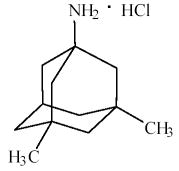
Image Of Namenda Chemical Structure (Bc6e059d 1951 4fa3 B904 230d4165724d 01)
Chemical structure diagram of the active ingredient in Namenda, showing molecular components including amine hydrochloride (NH2 · HCl) and methyl groups (CH3) as part of its bicyclic structure.*
FDA Label Image

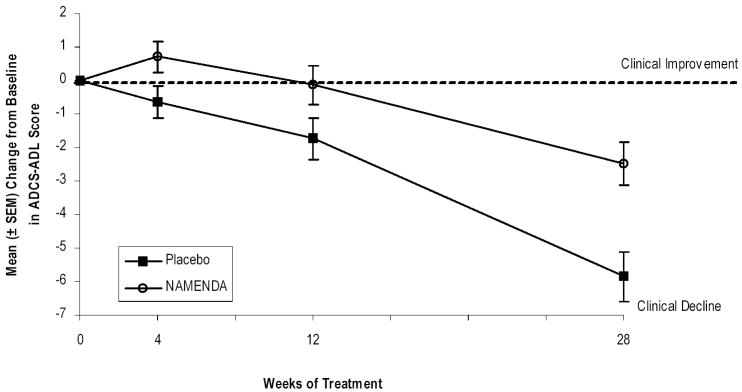
Image Of Figure 1: Time Course Of Change Graph (Bc6e059d 1951 4fa3 B904 230d4165724d 02)

Image Of Figure 1: Time Course Of Change Graph (Bc6e059d 1951 4fa3 B904 230d4165724d 02)
A line graph showing the mean change from baseline in ADCS-ADL score over 28 weeks of treatment comparing Namenda (open circles) and placebo (solid squares). The x-axis represents weeks of treatment, and the y-axis shows mean change in score, with indicators for clinical improvement and decline. Error bars display standard error of the mean.*
FDA Label Image

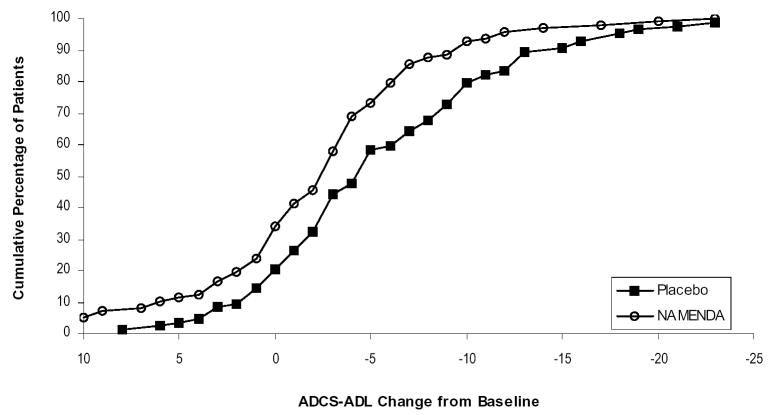
Image Of Figure 2: Cumalative Percentage Graph (Bc6e059d 1951 4fa3 B904 230d4165724d 03)

Image Of Figure 2: Cumalative Percentage Graph (Bc6e059d 1951 4fa3 B904 230d4165724d 03)
A line graph comparing the cumulative percentage of patients versus ADCS-ADL change from baseline, showing two data series labeled as Placebo and NAMENDA. The x-axis represents changes from baseline in ADCS-ADL scores, while the y-axis shows the cumulative percentage of patients. NAMENDA data points are represented with circles, and Placebo with squares.*
FDA Label Image

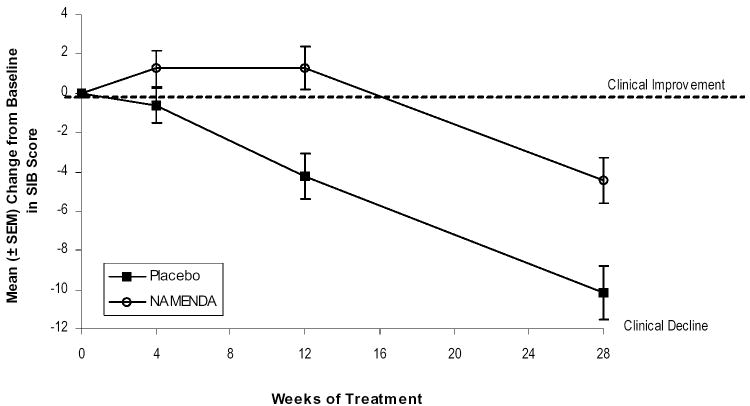
Image Of Figure 3: Time Course Of The Change Graph (Bc6e059d 1951 4fa3 B904 230d4165724d 04)

Image Of Figure 3: Time Course Of The Change Graph (Bc6e059d 1951 4fa3 B904 230d4165724d 04)
A line graph showing the mean change from baseline in SIB Score over 28 weeks of treatment comparing Namenda and placebo. The x-axis represents weeks of treatment and the y-axis shows mean change in SIB Score with error bars for SEM. Results indicate clinical improvement trend for Namenda and clinical decline for placebo over time.*
FDA Label Image

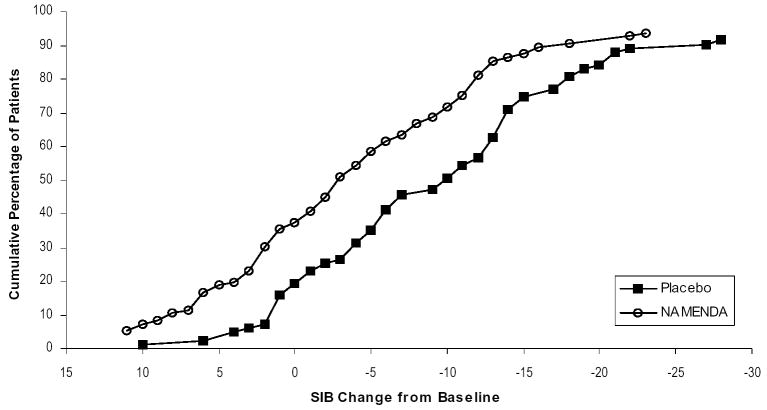
Image Of Figure 4: Cumulative Percentage Graph (Bc6e059d 1951 4fa3 B904 230d4165724d 05)

Image Of Figure 4: Cumulative Percentage Graph (Bc6e059d 1951 4fa3 B904 230d4165724d 05)
A cumulative percentage of patients curve comparing NAMENDA and placebo based on SIB (Severe Impairment Battery) change from baseline. The graph plots cumulative percentage of patients on the vertical axis against SIB change from baseline on the horizontal axis, showing two data series represented as lines with circular markers for NAMENDA and square markers for placebo.*
FDA Label Image

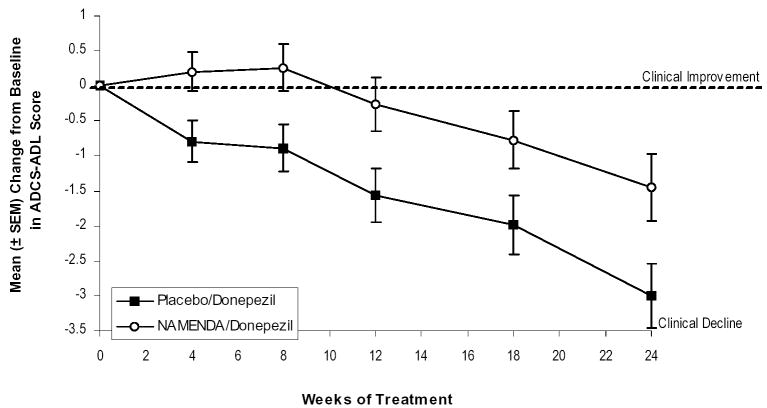
Image Of Figure 5: Time Course Of The Change Graph (Bc6e059d 1951 4fa3 B904 230d4165724d 06)

Image Of Figure 5: Time Course Of The Change Graph (Bc6e059d 1951 4fa3 B904 230d4165724d 06)
A line graph depicting mean change from baseline in ADCS-ADL score over 24 weeks of treatment comparing NAMENDA/Donepezil and Placebo/Donepezil groups. The x-axis represents weeks of treatment from 0 to 24, and the y-axis shows mean change (± SEM). NAMENDA/Donepezil group shows less decline compared to Placebo/Donepezil, with indicators for clinical improvement and decline on the y-axis.*
FDA Label Image

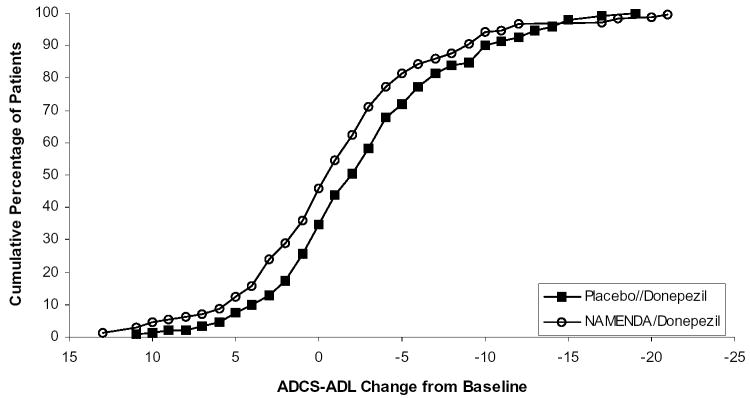
Image Of Figure 6: Cumulative Percentage Graph (Bc6e059d 1951 4fa3 B904 230d4165724d 07)

Image Of Figure 6: Cumulative Percentage Graph (Bc6e059d 1951 4fa3 B904 230d4165724d 07)
A cumulative percentage of patients chart showing ADCS-ADL change from baseline on the x-axis and cumulative percentage of patients on the y-axis. The graph compares two groups: Placebo/Donepezil (black squares) and Namenda/Donepezil (white circles), illustrating patient response distributions for each treatment group.*
FDA Label Image

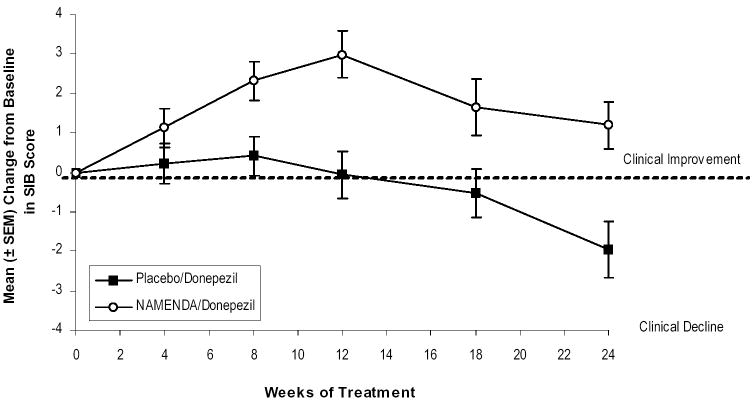
Image Of Figure 7: Time Course Of The Change Graph (Bc6e059d 1951 4fa3 B904 230d4165724d 08)

Image Of Figure 7: Time Course Of The Change Graph (Bc6e059d 1951 4fa3 B904 230d4165724d 08)
A line graph comparing the mean change from baseline in SIB score versus weeks of treatment for Namenda/Donepezil and Placebo/Donepezil groups. The y-axis represents the mean change with error bars, showing clinical improvement above the baseline and decline below it, over a 24-week period. Namenda/Donepezil shows greater improvement than Placebo/Donepezil.*
FDA Label Image

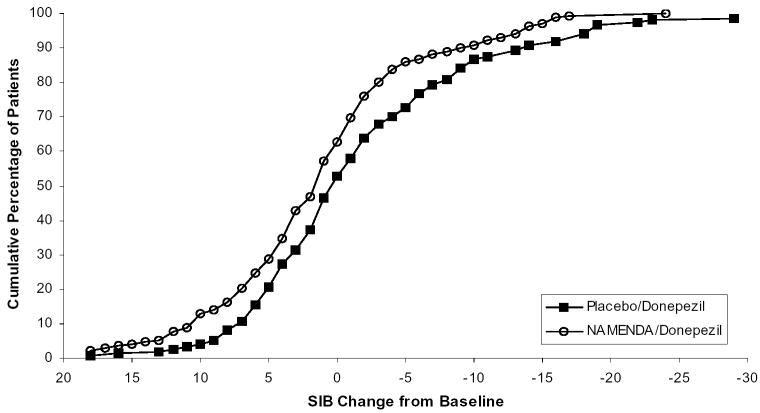
Image Of Figure 8: Cumulative Percentage Graph (Bc6e059d 1951 4fa3 B904 230d4165724d 09)

Image Of Figure 8: Cumulative Percentage Graph (Bc6e059d 1951 4fa3 B904 230d4165724d 09)
A line graph showing the cumulative percentage of patients on the y-axis versus SIB (Severe Impairment Battery) change from baseline on the x-axis. Two treatment groups are compared: Placebo/Donepezil represented by a line with filled squares, and NAMENDA/Donepezil represented by a line with open circles. The graph illustrates the distribution of SIB changes for patients in each treatment group.*
FDA Label Image

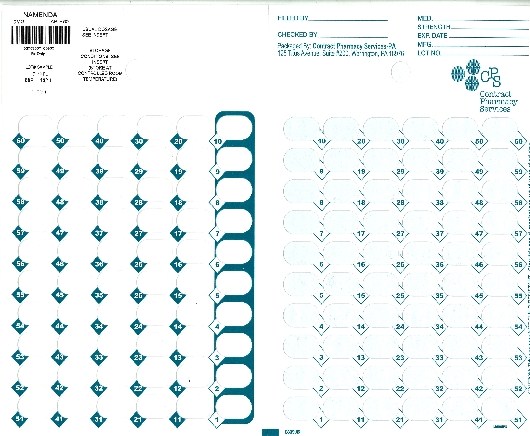
10 mg (Bc6e059d 1951 4fa3 B904 230d4165724d 10)

10 mg (Bc6e059d 1951 4fa3 B904 230d4165724d 10)
Namenda blister card packaging label by Contract Pharmacy Services-PA. The label features two blister sheets containing 30 numbered capsules each, arranged in rows and columns for dose tracking. The label includes product identification, a barcode, and the Contract Pharmacy Services-PA logo.*

* About these descriptions: Image descriptions on this page are generated by automated AI analysis of the product label images from the manufacturer's FDA label submission (SPL). They are provided for reference only and may contain errors or omissions. Always rely on the printed label itself and the official FDA labeling, and consult a pharmacist or healthcare professional with any questions about this product.