Mirabegron Tablet, Film Coated, Extended Release
Product Images NDC 67184-0571

View Photos of Packaging, Regulatory Labels, and Product Appearance

Product Visual Gallery

This gallery contains 13 technical images submitted to the FDA as part of the official labeling for Mirabegron (NDC 67184-0571). Unlike standard consumer photos, these assets often include clinical data figures, molecular chemical structures, and official manufacturer packaging layouts.

As provided by Qilu Pharmaceutical Co., Ltd., these visuals offer a comprehensive scientific overview of the product's physical and chemical identity, aiding pharmacists and researchers in product verification and study.

FDA Label Image

Bottle Label, 25 mg- 30 Tablets (Bottle Label 25mg 30tablets)
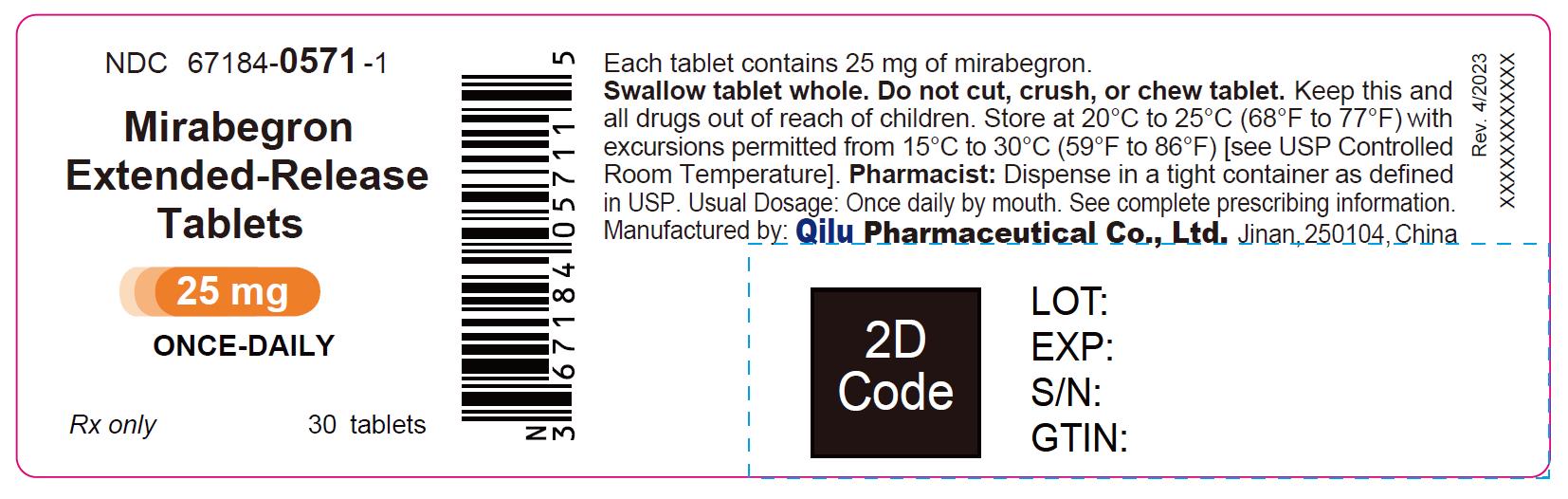
Bottle Label, 25 mg- 30 Tablets (Bottle Label 25mg 30tablets)
Label for Mirabegron Extended-Release Tablets 25 mg, oral film-coated tablets, manufactured by Qilu Pharmaceutical Co., Ltd. The label indicates a 30-tablet package with once-daily dosing. Storage instructions, prescription status, and manufacturer details are included alongside a barcode and a placeholder for 2D code, lot number, expiration, serial number, and GTIN information.*
FDA Label Image

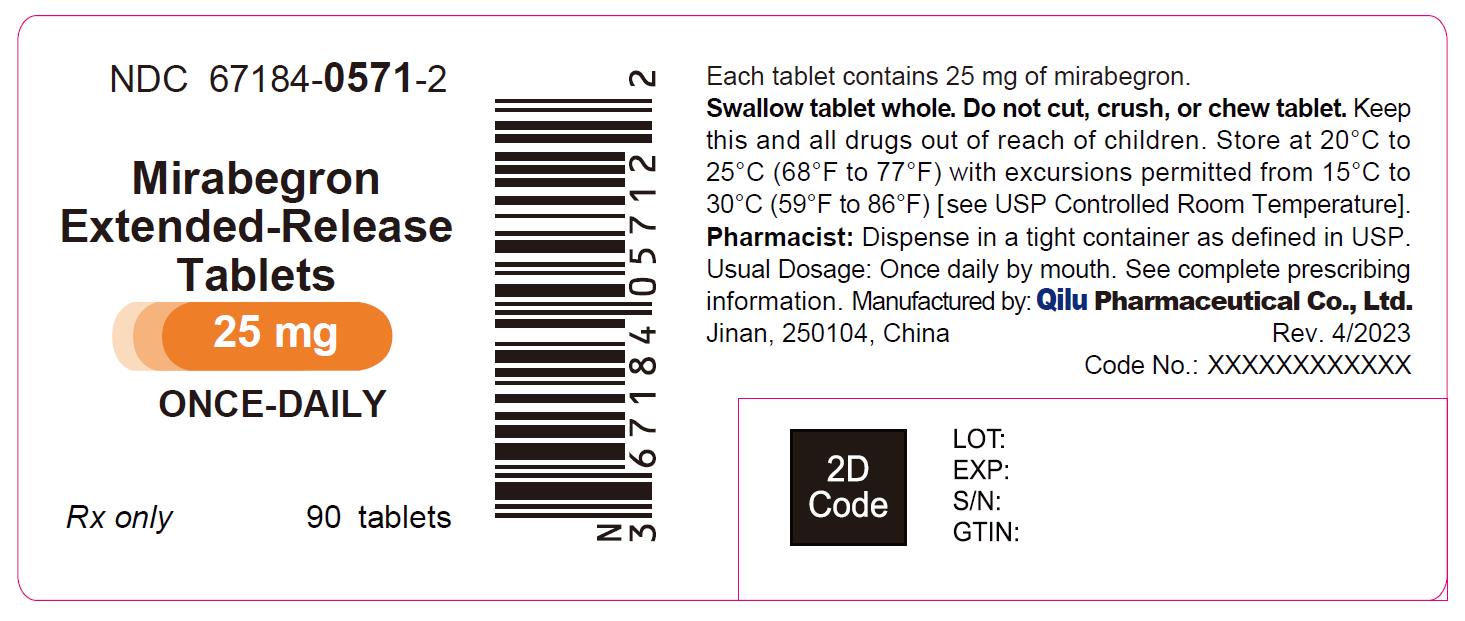
Bottle Label, 25 mg- 90 Tablets (Bottle Label 25mg 90tablets)

Bottle Label, 25 mg- 90 Tablets (Bottle Label 25mg 90tablets)
Label for Mirabegron Extended-Release Tablets 25 mg, film-coated tablets for oral use, containing 90 tablets per bottle. The label indicates once-daily dosing, features a barcode, and states the product is manufactured by Qilu Pharmaceutical Co., Ltd. Storage instructions and a 2D code area are also visible.*
FDA Label Image

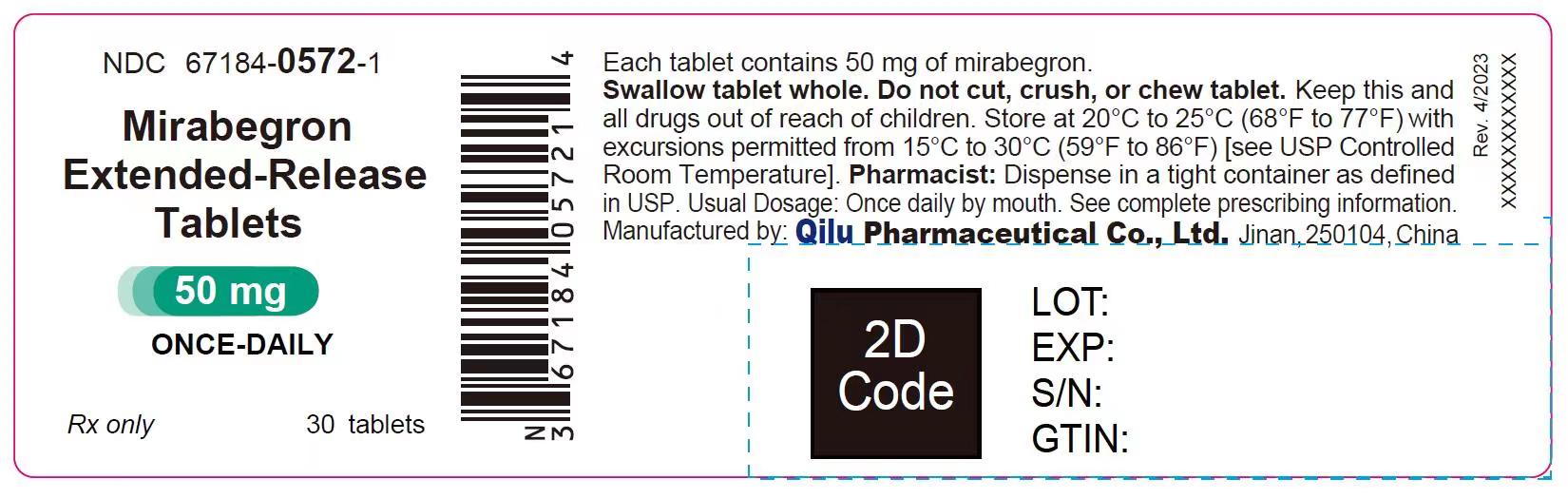
Bottle Label, 50 mg- 30 Tablets (Bottle Label 50mg 30tablets)

Bottle Label, 50 mg- 30 Tablets (Bottle Label 50mg 30tablets)
Mirabegron Extended-Release Tablets 50 mg film-coated tablets, indicated for once-daily oral use, shown in a package containing 30 tablets. The label includes dosage instructions, storage conditions, a barcode, 2D code space, and manufacturer information for Qilu Pharmaceutical Co., Ltd. Contains warnings against cutting, crushing, or chewing the tablets.*
FDA Label Image

Bottle Label, 50 mg- 90 Tablets (Bottle Label 50mg 90tablets)

Bottle Label, 50 mg- 90 Tablets (Bottle Label 50mg 90tablets)
Mirabegron Extended-Release Tablets 50 mg film-coated, extended-release oral tablets, packaged in a container of 90 tablets. The label states 'Once-Daily' dosing and includes warnings to swallow tablets whole without cutting or crushing. Manufactured by Qilu Pharmaceutical Co., Ltd., China. Barcode and storage instructions are also visible.*
FDA Label Image

Mirabegron Structural Formula (Image 01)

Mirabegron Structural Formula (Image 01)
Chemical structure of mirabegron, the active ingredient in Mirabgeorn extended-release oral tablets.*
FDA Label Image

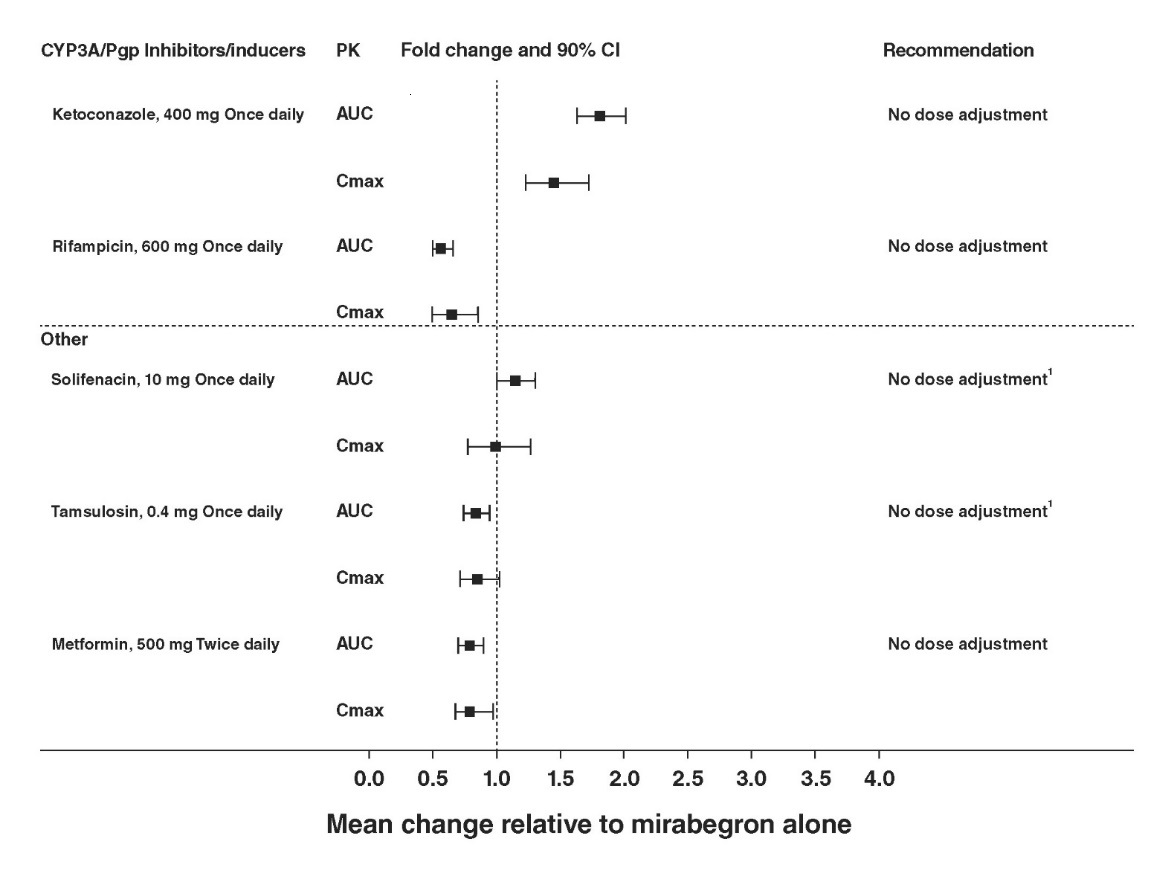
Figure 1 (Image 02)

Figure 1 (Image 02)
A forest plot chart illustrating pharmacokinetic (PK) fold changes and 90% confidence intervals (CI) for area under the curve (AUC) and maximum concentration (Cmax) of mirabegron when co-administered with various CYP3A/P-gp inhibitors and other drugs including Ketoconazole 400 mg once daily, Rifampicin 600 mg once daily, Solifenacin 10 mg once daily, Tamsulosin 0.4 mg once daily, and Metformin 500 mg twice daily. The x-axis represents mean fold change relative to mirabegron alone, ranging from 0.0 to 4.0, with recommendations indicating no dose adjustment is required for these combinations.*
FDA Label Image

Figure 2 (Image 03)

Figure 2 (Image 03)
A horizontal bar chart showing the mean fold change and 90% confidence intervals for pharmacokinetic parameters (AUC and Cmax) of various CYP3A4 and CYP2D6 substrates, and other drugs, relative to substrate alone. It includes recommendations for dose adjustments, with drugs such as Solifenacin, Ethinylestradiol, Levonorgestrel, Desipramine, Metoprolol, Tamsulosin, Digoxin, Warfarin, and Metformin. The x-axis represents the mean change relative to substrate alone, ranging from 0.0 to 4.0.*
FDA Label Image

Figure 3 (Image 04)

Figure 3 (Image 04)
A line graph comparing mean change from baseline over 12 weeks between placebo (291 participants) and mirabegron 50 mg (293 participants) groups. The x-axis shows weeks (baseline, 4, 8, 12) and the y-axis shows mean change from baseline, decreasing over time in both groups, with mirabegron 50 mg showing a greater decrease than placebo at each time point.*
FDA Label Image

Figure 4 (Image 05)

Figure 4 (Image 05)
A line graph showing mean change from baseline over 12 weeks comparing placebo and mirabegron 50 mg. The x-axis represents weeks (Baseline, 4, 8, 12) and the y-axis shows mean change from baseline. Two lines illustrate data points with error bars: one for placebo (n=480) and a second for mirabegron 50 mg (n=473), depicting a greater mean change over time for mirabegron.*
FDA Label Image

Figure 5 (Image 06)

Figure 5 (Image 06)
A line graph depicting mean change from baseline over time in weeks (0, 4, 8, 12) for two groups: placebo (n=325) and mirabegron 50 mg (n=312). The y-axis measures mean change from baseline, showing a decline in both groups, with the mirabegron 50 mg group exhibiting a greater decrease at each time point compared to placebo.*
FDA Label Image

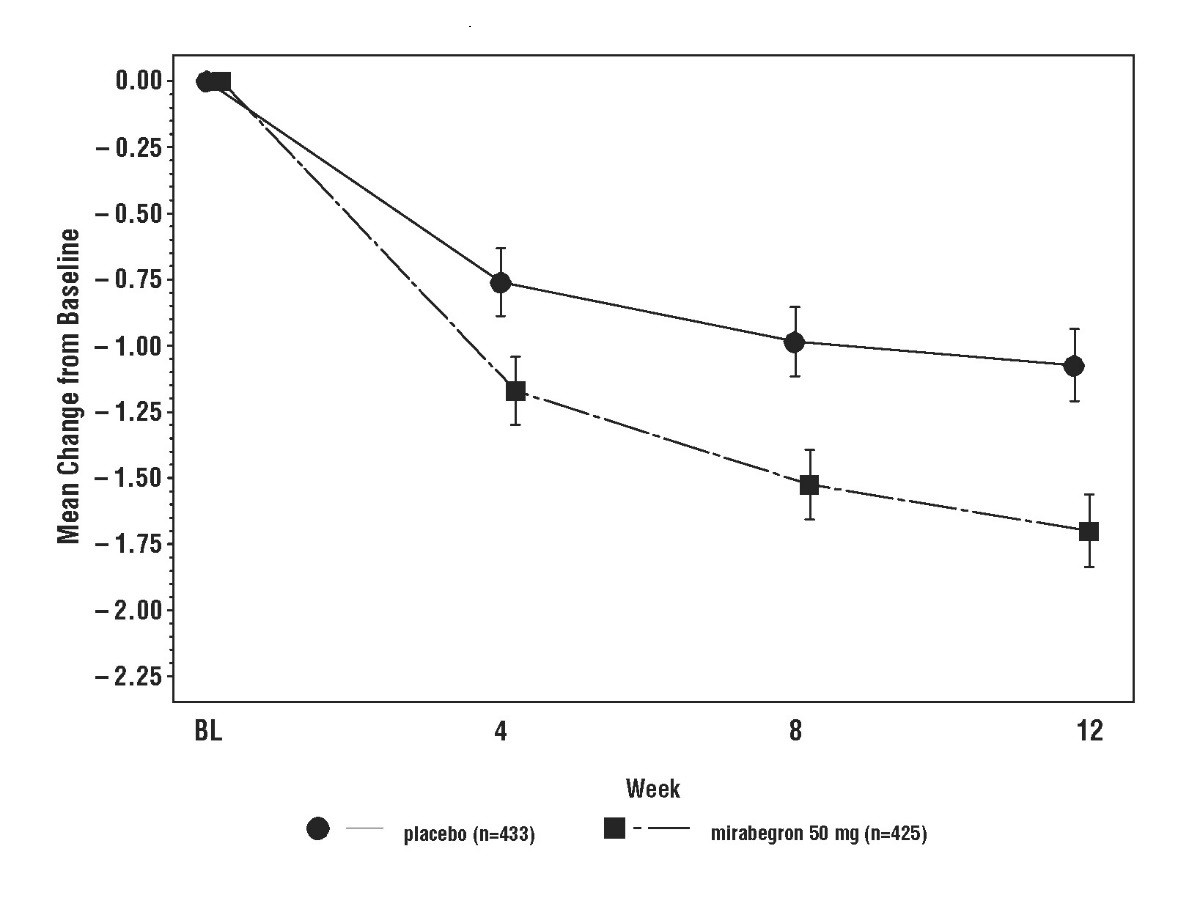
Figure 6 (Image 07)

Figure 6 (Image 07)
Line graph showing mean change from baseline over 12 weeks for placebo and mirabegron 50 mg groups. The x-axis represents weeks (BL, 4, 8, 12) and the y-axis shows mean change from baseline. Two lines depict placebo (solid line with circles) and mirabegron 50 mg (dash-dot line with squares), including error bars around each data point.*
FDA Label Image

Figure 7 (Image 08)

Figure 7 (Image 08)
A line graph showing mean change from baseline over 12 weeks for placebo and mirabegron tablets at 25 mg and 50 mg doses. The x-axis represents time in weeks (BL, 4, 8, 12), and the y-axis represents mean change from baseline, ranging from 0.0 to -2.0. Three data series are plotted: placebo (circle markers), mirabegron 25 mg (triangle markers), and mirabegron 50 mg (square markers), each with error bars.*
FDA Label Image

Figure 8 (Image 09)

Figure 8 (Image 09)
A line graph showing mean change from baseline over 12 weeks comparing placebo, mirabegron 25 mg, and mirabegron 50 mg groups. The x-axis represents weeks (baseline, 4, 8, 12) and the y-axis represents mean change from baseline, with all lines showing a downward trend. Error bars indicate variability in data.*

* About these descriptions: Image descriptions on this page are generated by automated AI analysis of the product label images from the manufacturer's FDA label submission (SPL). They are provided for reference only and may contain errors or omissions. Always rely on the printed label itself and the official FDA labeling, and consult a pharmacist or healthcare professional with any questions about this product.