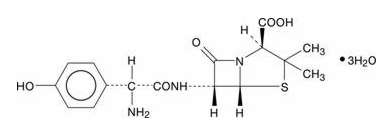
Amoxicillin is similar to ampicillin in its bactericidal action
against susceptible organisms during the stage of active multiplication. It acts
through the inhibition of biosynthesis of cell wall mucopeptide. Amoxicillin has
been shown to be active against most strains of the following microorganisms,
both in vitro and in clinical infections as described
in the INDICATIONS AND USAGE
section.
Aerobic Gram-Positive Microorganisms:
Enterococcus faecalis
Staphylococcus spp. 1 (β-lactamase-negative strains only)
Streptococcus pneumoniae
Streptococcus spp. (α- and β-hemolytic strains only)
Aerobic Gram-Negative Microorganisms:
Escherichia coli (β-lactamase-negative strains
only)
Haemophilus influenzae (β-lactamase-negative
strains only)
Neisseria gonorrhoeae
(β-lactamase-negative strains only)
Proteus
mirabilis (β-lactamase-negative strains only)
Helicobacter:
Helicobacter pylori
1Staphylococci which are susceptible to amoxicillin but resistant to
methicillin/oxacillin should be considered as resistant to
amoxicillin.
Susceptibility Tests
Dilution Techniques
Quantitative methods are used to determine antimicrobial minimum
inhibitory concentrations (MICs). These MICs provide estimates of the
susceptibility of bacteria to antimicrobial compounds. The MICs should be
determined using a standardized procedure. Standardized procedures are based on
a dilution method1 (broth or agar) or equivalent with
standardized inoculum concentrations and standardized concentrations of ampicillin powder. Ampicillin is sometimes used to predict
susceptibility of S. pneumoniae to amoxicillin;
however, some intermediate strains have been shown to be susceptible to
amoxicillin. Therefore, S. pneumoniae susceptibility
should be tested using amoxicillin powder. The MIC values should be interpreted
according to the following criteria:
For Gram-Positive Aerobes:
Enterococcus
| MIC (mcg/mL) | Interpretation |
|---|
| ≤ 8 | Susceptible (S) |
| ≥ 16 | Resistant (R) |
Staphylococcus 2
| MIC (mcg/mL) | Interpretation |
|---|
| ≤ 0.25 | Susceptible (S) |
| ≥ 0.5 | Resistant (R) |
Streptococcus (except S.
pneumoniae)
| MIC (mcg/mL) | Interpretation |
|---|
| ≤ 0.25 | Susceptible (S) |
| 0.5 to 4 | Intermediate (I) |
| ≥ 8 | Resistant (R) |
S. pneumoniae 3 from non-meningitis sources.
(Amoxicillin powder should be used to determine
susceptibility.)
| MIC (mcg/mL) | Interpretation |
|---|
| ≤ 2 | Susceptible (S) |
| 4 | Intermediate (I) |
| ≥ 8 | Resistant (R) |
NOTE: These interpretive criteria are based on the
recommended doses for respiratory tract infections.
For Gram-Negative Aerobes:
Enterobacteriaceae
| MIC (mcg/mL) | Interpretation |
|---|
| ≤ 8 | Susceptible (S) |
| 16 | Intermediate (I) |
| ≥ 32 | Resistant (R) |
H. influenzae 4
| MIC (mcg/mL) | Interpretation |
|---|
| ≤ 1 | Susceptible (S) |
| 2 | Intermediate (I) |
| ≥ 4 | Resistant (R) |
A report of "Susceptible" indicates that the pathogen is likely to be
inhibited if the antimicrobial compound in the blood reaches the concentrations
usually achievable. A report of "Intermediate" indicates that the result should
be considered equivocal, and, if the microorganism is not fully susceptible to
alternative, clinically feasible drugs, the test should be repeated. This
category implies possible clinical applicability in body sites where the drug is
physiologically concentrated or in situations where high dosage of drug can be
used. This category also provides a buffer zone, which prevents small
uncontrolled technical factors from causing major discrepancies in
interpretation. A report of "Resistant" indicates that the pathogen is not
likely to be inhibited if the antimicrobial compound in the blood reaches the
concentrations usually achievable; other therapy should be selected.
Standardized susceptibility test procedures require the use of laboratory
control microorganisms to control the technical aspects of the laboratory
procedures. Standard ampicillin powder should provide
the following MIC values:
| Microorganism | MIC Range (mcg/mL) |
| E. coli | ATCC 25922 | 2 to 8
|
| E. faecalis | ATCC 29212 | 0.5 to 2
|
| H. influenzae | ATCC 49247* | 2 to 8
|
| S. aureus | ATCC 29213 | .25 to 1
|
*This quality control range is applicable to only
H.
influenzae ATCC 49247 tested by a broth microdilution procedure using
HTM.
1Using amoxicillin to determine susceptibility:
| Microorganism
| MIC Range (mcg/ml) |
S. pneumoniae
| ATCC 49619*
| 0.03 to .12
|
*This quality control range is applicable to only
S.
pneumoniae ATCC 49619 tested by the broth microdilution procedure using
cation-adjusted Mueller-Hinton broth with 2-5% lysed horse blood.
2 Staphylococci which are susceptible to amoxicillin but resistant to
methicillin/oxacillin should be considered as resistant to amoxicillin. 3 These interpretive standards are applicable only to broth microdilution
susceptibility tests using cation-adjusted Mueller-Hinton broth with 2-5% lysed
horse blood.4 These interpretive standards are applicable only to broth microdilution test
with
H. influenzae using
Haemophilus Test Medium (HTM).
1Diffusion Techniques
Quantitative methods that require measurement of zone diameters
also provide reproducible estimates of the susceptibility of bacteria to
antimicrobial compounds. One such standardized procedure2
requires the use of standardized inoculum concentrations. This procedure uses
paper disks impregnated with 10 mcg ampicillin to test the susceptibility of
microorganisms, except S. pneumoniae, to amoxicillin.
Interpretation involves correlation of the diameter obtained in the disk test
with the MIC for ampicillin.
Reports from the laboratory providing results of the standard single-disk
susceptibility test with a 10 mcg ampicillin disk should be interpreted
according to the following criteria:
For Gram-Positive Aerobes:
Enterococcus
| Zone Diameter (mm) | Interpretation |
|---|
| ≥ 17 | Susceptible (S) |
| ≤ 16 | Resistant (R) |
Staphylococcus 5
| Zone Diameter (mm) | Interpretation |
|---|
| ≥ 29 | Susceptible (S) |
| ≤ 28 | Resistant (R) |
β-hemolytic streptococci
| Zone Diameter (mm) | Interpretation |
|---|
| ≥ 26 | Susceptible (S) |
| 19 to 25 | Intermediate (I) |
| ≤ 18 | Resistant (R) |
NOTE: For streptococci (other than β-hemolytic
streptococci and S. pneumoniae), an ampicillin MIC
should be determined.
S. pneumoniae
S. pneumoniae should be tested using a 1 mcg
oxacillin disk. Isolates with oxacillin zone sizes of ≥ 20 mm are susceptible to
amoxicillin. An amoxicillin MIC should be determined on isolates of S. pneumoniae with oxacillin zone sizes of ≤ 19 mm.
For Gram-Negative Aerobes:
Enterobacteriaceae
| Zone Diameter (mm) | Interpretation |
|---|
| ≥ 17 | Susceptible (S) |
| 14 to 16 | Intermediate (I) |
| ≤ 13 | Resistant (R) |
H. influenzae 6
| Zone Diameter (mm) | Interpretation |
|---|
| ≥ 22 | Susceptible (S) |
| 19 to 21 | Intermediate (I) |
| ≤ 18 | Resistant (R) |
Interpretation should be as stated above for results using dilution
techniques.
As with standard dilution techniques, disk diffusion susceptibility test
procedures require the use of laboratory control microorganisms. The 10 mcg
ampicillin disk should provide the following zone
diameters in these laboratory test quality control strains:
| Microorganism
| Zone Diameter (mm)
|
E. coli
| ATCC 25922
| 16 to 22
|
H. influenzae
| ATCC 49247*
| 13 to 21
|
S. aureus
| ATCC 25923
| 27 to 35
|
*This quality control range is applicable to only
H.
influenzae ATCC 49247 tested by a disk diffusion procedure using
HTM.
2Using 1 mcg oxacillin disk:
| Microorganism
| Zone Diameter (mm) |
S. pneumoniae
| ATCC 49619*
| 8 to 12
|
*This quality control range is applicable to only
S.
pneumoniae ATCC 49619 tested by a disk diffusion procedure using
Mueller-Hinton agar supplemented with 5% sheep blood and incubated in 5% CO
2.
5 Staphylococci which are susceptible to amoxicillin but resistant to
methicillin/oxacillin should be considered as resistant to amoxicillin. 6 These interpretive standards are applicable only to disk diffusion
susceptibility tests with
H. influenzae using
Haemophilus Test Medium (HTM).
2Susceptibility Testing for
Helicobacter pyloriIn vitro susceptibility testing
methods and diagnostic products currently available for determining minimum
inhibitory concentrations (MICs) and zone sizes have not been standardized,
validated, or approved for testing H. pylori
microorganisms.
Culture and susceptibility testing should be obtained in patients who fail
triple therapy. If clarithromycin resistance is found, a
nonclarithromycin-containing regimen should be used.