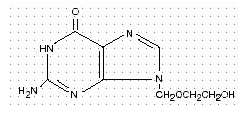
Pharmacokinetics: The
pharmacokinetics of acyclovir after oral administration have been evaluated in
healthy volunteers and in immunocompromised patients with herpes simplex or
varicella-zoster virus infection. Acyclovir pharmacokinetic parameters are
summarized in Table 1.
| Table 1:
Acyclovir Pharmacokinetic Characteristics (Range) |
| Parameter | Range |
| Plasma protein binding | 9% to 33% |
| Plasma elimination
half-life | 2.5 to 3.3 hr |
| Average oral
bioavailability | 10% to 20% |
In one multiple-dose,
cross-over study in healthy subjects (n = 23), it was shown that increases in
plasma acyclovir concentrations were less than dose proportional with increasing
dose, as shown in Table 2. The decrease in
bioavailability is a function of the dose and not the dosage form.
| Table 2:
AcyclovirPeak and Trough Concentrations at Steady State |
| Parameter | 200 mg | 400 mg | 800 mg |
| Cssmax | 0.83 mcg/mL | 1.21 mcg/mL | 1.61 mcg/mL |
| Csstrough | 0.46 mcg/mL | 0.63 mcg/mL | 0.83 mcg/mL |
There was no effect of
food on the absorption of acyclovir (n = 6); therefore, acyclovir capsules and
tablets may be administered with or without food.
The only known urinary
metabolite is 9-[(carboxymethoxy)methyl]guanine.
Special
Populations: Adults with Impaired Renal Function:
The half-life and total body clearance of acyclovir are dependent
on renal function. A dosage adjustment is recommended for patients with reduced
renal function (See DOSAGE AND ADMINISTRATION).
Geriatrics: Acyclovir plasma concentrations are
higher in geriatric patients compared to younger adults, in part due to
age-related changes in renal function. Dosage reduction may be required in
geriatric patients with underlying renal impairment (See PRECAUTIONS: Geriatric Use).
Pediatrics: In general, the pharmacokinetics of
acyclovir in pediatric patients is similar to that of adults. Mean half-life
after oral doses of 300 mg/m2 and 600 mg/m2 in pediatric patients aged 7 months to 7 years was 2.6 hours
(range 1.59 to 3.74 hours).
Drug
Interactions: Co-administration of probenecid with intravenous acyclovir
has been shown to increase the mean acyclovir half-life and the area under the
concentration-time curve. Urinary excretion and renal clearance were
correspondingly reduced.
Clinical Trials
Initial Genital Herpes: Double-blind,
placebo-controlled studies have demonstrated that orally administered acyclovir
significantly reduced the duration of acute infection and duration of lesion
healing. The duration of pain and new lesion formation was decreased in some
patient groups.
Recurrent Genital Herpes: Double-blind,
placebo-controlled studies in patients with frequent recurrences (6 or more
episodes per year) have shown that orally administered acyclovir given daily for
4 months to 10 years prevented or reduced the frequency and/or severity of
recurrences in greater than 95% of patients.
In a study of patients
who received acyclovir 400 mg twice daily for 3 years, 45%, 52%, and 63% of
patients remained free of recurrences in the first, second, and third years,
respectively. Serial analyses of the 3-month recurrence rates for the patients
showed that 71% to 87% were recurrence free in each quarter.
Herpes Zoster Infections: In a double-blind,
placebo-controlled study of immunocompetent patients with localized cutaneous
zoster infection, acyclovir (800 mg 5 times daily for 10 days) shortened the
times to lesion scabbing, healing, and complete cessation of pain, and reduced
the duration of viral shedding and the duration of new lesion formation.
In a similar
double-blind, placebo-controlled study, acyclovir (800 mg 5 times daily for 7
days) shortened the times to complete lesion scabbing, healing, and cessation of
pain; reduced the duration of new lesion formation; and reduced the prevalence
of localized zoster-associated neurologic symptoms (paresthesia, dysesthesia, or
hyperesthesia).
Treatment was begun
within 72 hours of rash onset and was most effective if started within the first
48 hours.
Adults greater than 50
years of age showed greater benefit.
Chickenpox: Three randomized, double-blind,
placebo-controlled trials were conducted in 993 pediatric patients aged 2 to 18
years with chickenpox. All patients were treated within 24 hours after the onset
of rash. In 2 trials, acyclovir was administered at 20 mg/kg 4 times daily (up
to 3,200 mg per day) for 5 days. In the third trial, doses of 10, 15, or 20
mg/kg were administered 4 times daily for 5 to 7 days. Treatment with acyclovir
shortened the time to 50% healing; reduced the maximum number of lesions;
reduced the median number of vesicles; decreased the median number of residual
lesions on day 28; and decreased the proportion of patients with fever,
anorexia, and lethargy by day 2. Treatment with acyclovir did not affect
varicella-zoster virus-specific humoral or cellular immune responses at 1 month
or 1 year following treatment.