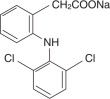
Other
Delayed-Release Tablets USP
Rx only
Prescribing information
Cardiovascular Thrombotic Events
- Nonsteroidal anti-inflammatory drugs (NSAIDs) cause an increased risk of serious cardiovascular thrombotic events, including myocardial infarction and stroke, which can be fatal. This risk may occur early in treatment and may increase with duration of use (see WARNINGS).
- Diclofenac sodium delayed-release tablets are contraindicated in the setting of coronary artery bypass graft (CABG) surgery (see CONTRAINDICATIONS, WARNINGS).
- NSAIDs cause an increased risk of serious gastrointestinal (GI) adverse events including bleeding, ulceration, and perforation of the stomach or intestines, which can be fatal. These events can occur at any time during use and without warning symptoms. Elderly patients and patients with a prior history of peptic ulcer disease and/or GI bleeding are at greater risk for serious GI events (see WARNINGS).
Gastrointestinal Bleeding, Ulceration, And Perforation
Pediatric:The pharmacokinetics of diclofenac has not been investigated in pediatric patients.
Race:Pharmacokinetic differences due to race have not been identified.
Hepatic Impairment:Hepatic metabolism accounts for almost 100% of diclofenac elimination, so patients with hepatic disease may require reduced doses of diclofenac compared to patients with normal hepatic function.
Renal Impairment:Diclofenac pharmacokinetics has been investigated in subjects with renal insufficiency. No differences in the pharmacokinetics of diclofenac have been detected in studies of patients with renal impairment. In patients with renal impairment (inulin clearance 60-90, 30-60, and <30 mL/min; N=6 in each group), AUC values and elimination rate were comparable to those in healthy subjects.
Voriconazole:When co-administered with voriconazole (inhibitor of CYP2C9, 2C19 and 3A4 enzyme), the C maxand AUC of diclofenac increased by 114% and 78%, respectively ( see PRECAUTIONS; Drug Interactions).
Aspirin:When NSAIDs were administered with aspirin, the protein binding of NSAIDs were reduced, although the clearance of free NSAID was not altered. The clinical significance of this interaction is not known. See Table 2for clinically significant drug interactions of NSAIDs with aspirin ( see PRECAUTIONS; Drug Interactions).