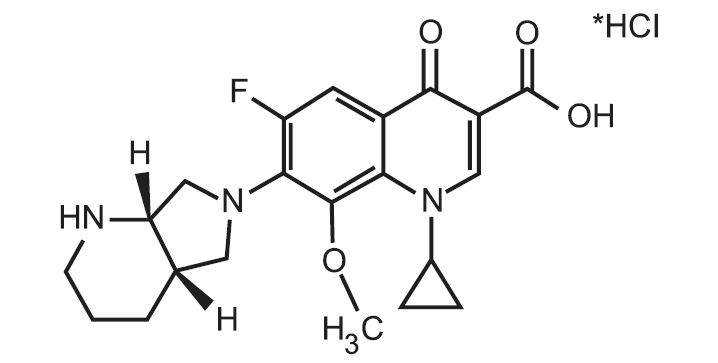
A randomized, double-blind, controlled clinical trial was conducted in the US to compare the efficacy of moxifloxacin tablets (400 mg once daily) to that of high-dose clarithromycin (500 mg twice daily) in the treatment of patients with clinically and radiologically documented community acquired pneumonia. This study enrolled 474 patients (382 of whom were valid for the efficacy analysis conducted at the 14-35 day follow-up visit). Clinical success for clinically evaluable patients was 95% (184/194) for moxifloxacin and 95% (178/188) for high dose clarithromycin.
A randomized, double-blind, controlled trial was conducted in the US and Canada to compare the efficacy of sequential intravenous/oral moxifloxacin 400 mg once a day for 7-14 days to an intravenous/oral fluoroquinolone control (trovafloxacin or levofloxacin) in the treatment of patients with clinically and radiologically documented community acquired pneumonia. This study enrolled 516 patients, 362 of whom were valid for the efficacy analysis conducted at the 7-30 day post-therapy visit. The clinical success rate was 86% (157/182) for moxifloxacin therapy and 89% (161/180) for the fluoroquinolone comparators.
An open-label ex-US study that enrolled 628 patients compared moxifloxacin to sequential intravenous/oral amoxicillin/clavulanate (1.2 gram intravenously every 8 hours/625 mg orally every 8 hours) with or without high-dose intravenous/oral clarithromycin (500 mg twice a day). The intravenous formulations of the comparators are not FDA approved. The clinical success rate at Day 5-7 for moxifloxacin therapy was 93% (241/258) and demonstrated superiority to amoxicillin/clavulanate ± clarithromycin (85%, 239/280) [95% C.I. of difference in success rates between moxifloxacin and comparator (2.9%, 13.2%)]. The clinical success rate at the 21-28 days post-therapy visit for moxifloxacin was 84% (216/258), which also demonstrated superiority to the comparators (74%, 208/280) [95% C.I. of difference in success rates between moxifloxacin and comparator (2.6%, 16.3%)].
The clinical success rates by pathogen across four CAP studies are presented in Table 11.
Table 11: Clinical Success Rates By Pathogen (Pooled CAP Studies)PATHOGEN | MOXIFLOXACIN |
Streptococcus pneumoniae | 80/85 | (94%) |
Staphylococcus aureus | 17/20 | (85%) |
Klebsiella pneumoniae | 11/12 | (92%) |
Haemophilus influenzae | 56/61 | (92%) |
Chlamydophila pneumoniae | 119/128 | (93%) |
Mycoplasma pneumoniae | 73/76 | (96%) |
Moraxella catarrhalis | 11/12 | (92%) |
Community Acquired Pneumonia caused by Multi-Drug Resistant Streptococcus pneumoniae (MDRSP)*
Moxifloxacin was effective in the treatment of community acquired pneumonia (CAP) caused by multi-drug resistant Streptococcus pneumoniae MDRSP* isolates. Of 37 microbiologically evaluable patients with MDRSP isolates, 35 patients (95%) achieved clinical and bacteriological success post-therapy. The clinical and bacteriological success rates based on the number of patients treated are shown in Table 12.
* MDRSP, Multi-drug resistant Streptococcus pneumoniae includes isolates previously known as PRSP (Penicillin-resistant S. pneumoniae), and are isolates resistant to two or more of the following antibiotics: penicillin (MIC ≥ 2 mcg/mL), 2nd generation cephalosporins (for example, cefuroxime), macrolides, tetracyclines, and trimethoprim/sulfamethoxazole.
Table 12: Clinical and Bacteriological Success Rates for Moxifloxacin-Treated MDRSP CAP Patients (Population: Valid for Efficacy)Screening Susceptibility | Clinical Success | Bacteriological Success |
| n/N n = number of patients successfully treated; N = number of patients with MDRSP (from a total of 37 patients) | % | n/N n = number of patients successfully treated (presumed eradication or eradication); N = number of patients with MDRSP (from a total of 37 patients) | % |
Penicillin-resistant | 21/21 | 100% One patient had a respiratory isolate that was resistant to penicillin and cefuroxime but a blood isolate that was intermediate to penicillin and cefuroxime. The patient is included in the database based on the respiratory isolate. | 21/21 | 100% |
2nd generation cephalosporin-resistant | 25/26 | 96% | 25/26 | 96% |
Macrolide-resistant Azithromycin, clarithromycin, and erythromycin were the macrolide antimicrobials tested. | 22/23 | 96% | 22/23 | 96% |
Trimethoprim/sulfamethoxazole-resistant | 28/30 | 93% | 28/30 | 93% |
Tetracycline-resistant | 17/18 | 94% | 17/18 | 94% |
Not all isolates were resistant to all antimicrobial classes tested. Success and eradication rates are summarized in Table 13.
Table 13: Clinical Success Rates and Microbiological Eradication Rates for Resistant Streptococcus pneumoniae (Community Acquired Pneumonia)| S. pneumoniae with MDRSP | Clinical Success | Bacteriological Eradication Rate |
|---|
Resistant to 2 antimicrobials | 12/13 (92.3%) | 12/13 (92.3%) |
Resistant to 3 antimicrobials | 10/11 (90.9%) One patient had a respiratory isolate resistant to 5 antimicrobials and a blood isolate resistant to 3 antimicrobials. The patient was included in the category resistant to 5 antimicrobials. | 10/11 (90.9%) |
Resistant to 4 antimicrobials | 6/6 (100%) | 6/6 (100%) |
Resistant to 5 antimicrobials | 7/7 (100%) | 7/7 (100%) |
Bacteremia with MDRSP | 9/9 (100%) | 9/9 (100%) |