The following table provides adverse reactions reported in the adjuvant therapy colon cancer clinical trial [see Clinical Studies (14)] by body system and decreasing order of frequency in the oxaliplatin injection and infusional 5-fluorouracil/leucovorin arm for events with overall incidences ≥ 5% but with incidences <1% NCI grade 3/4 events.
- Table 4 - Adverse Reactions Reported in Patients with Colon Cancer receiving Adjuvant Treatment (≥ 5% of all patients, but with <1% NCI Grade 3/4 events)
| Oxaliplatin Injection + 5-FU/LV
N=1108 | 5-FU/LV
N=1111 |
|---|
Adverse reaction
(WHO/Pref) | All Grades (%) | All Grades (%) |
|---|
Allergy/Immunology |
Rhinitis | 6 | 8 |
Constitutional Symptoms/Pain/Ocular/Visual |
Epistaxis | 16 | 12 |
Weight Increase | 10 | 10 |
Conjunctivitis | 9 | 15 |
Headache | 7 | 5 |
Dyspnea | 5 | 3 |
Pain | 5 | 5 |
Lacrimation Abnormal | 4 | 12 |
Dermatology/Skin |
Alopecia | 30 | 28 |
Gastrointestinal |
Constipation | 22 | 19 |
Taste Perversion | 12 | 8 |
Dyspepsia | 8 | 5 |
Metabolic |
Phosphate Alkaline increased | 42 | 20 |
Neurology |
Sensory Disturbance | 8 | 1 |
Although specific events can vary, the overall frequency of adverse reactions was similar in men and women and in patients <65 and ≥65 years. However, the following grade 3/4 events were more common in females: diarrhea, fatigue, granulocytopenia, nausea and vomiting. In patients ≥65 years old, the incidence of grade 3/4 diarrhea and granulocytopenia was higher than in younger patients. Insufficient subgroup sizes prevented analysis of safety by race. The following additional adverse reactions, were reported in ≥2% and <5% of the patients in the oxaliplatin injection and infusional 5-fluorouracil/leucovorin combination arm (listed in decreasing order of frequency): pain, leukopenia, weight decrease, coughing.
The number of patients who developed secondary malignancies was similar; 62 in the oxaliplatin injection combination arm and 68 in the infusional 5-fluorouracil/leucovorin arm. An exploratory analysis showed that the number of deaths due to secondary malignancies was 1.96% in the oxaliplatin injection combination arm and 0.98% in infusional 5-fluorouracil/leucovorin arm. In addition, the number of cardiovascular deaths was 1.4% in the oxaliplatin injection combination arm as compared to 0.7% in the infusional 5-fluorouracil/leucovorin arm. Clinical significance of these findings is unknown.
Patients Previously Untreated for Advanced Colorectal Cancer
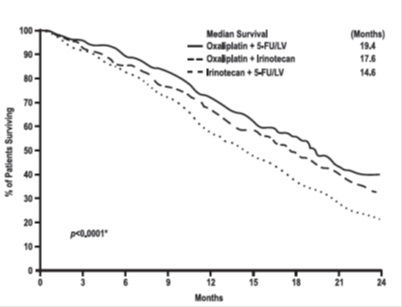
Two hundred and fifty-nine patients were treated in the oxaliplatin injection and 5-fluorouracil/leucovorin combination arm of the randomized trial in patients previously untreated for advanced colorectal cancer [see Clinical Studies (14)]. The adverse reaction profile in this study was similar to that seen in other studies and the adverse reactions in this trial are shown in the tables below. Both 5-fluorouracil and oxaliplatin injection are associated with gastrointestinal and hematologic adverse reactions. When oxaliplatin injection is administered in combination with 5-fluorouracil, the incidence of these events is increased.
The incidence of death within 30 days of treatment in the previously untreated for advanced colorectal cancer study, regardless of causality, was 3% with the oxaliplatin injection and 5-fluorouracil/leucovorin combination, 5% with irinotecan plus 5-fluorouracil/leucovorin, and 3% with oxaliplatin injection plus irinotecan. Deaths within 60 days from initiation of therapy were 2.3% with the oxaliplatin injection and 5-fluorouracil/leucovorin combination, 5.1% with irinotecan plus 5-fluorouracil/leucovorin, and 3.1% with oxaliplatin injection plus irinotecan.
The following table provides adverse reactions reported in the previously untreated for advanced colorectal cancer study [see Clinical Studies (14)] by body system and decreasing order of frequency in the oxaliplatin injection and 5-fluorouracil/leucovorin combination arm for events with overall incidences ≥5% and for grade 3/4 events with incidences ≥1%.
Table 5 – Adverse Reactions Reported in Patients Previously Untreated for Advanced Colorectal Cancer Clinical Trial (≥5% of all patients and with ≥1% NCI Grade 3/4 events)
| Oxaliplatin Injection +
5-FU/LV
N=259 | irinotecan +
5-FU/LV
N=256 | Oxaliplatin Injection + irinotecan
N=258 |
|---|
Adverse reaction (WHO/Pref) | All Grades (%) | Grade 3/4 (%) | All Grades (%) | Grade 3/4 (%) | All Grades (%) | Grade 3/4 (%) |
Any Event | 99 | 82 | 98 | 70 | 99 | 76 |
Allergy/Immunology |
Hypersensitivity | 12 | 2 | 5 | 0 | 6 | 1 |
Cardiovascular |
Thrombosis | 6 | 5 | 6 | 6 | 3 | 3 |
Hypotension | 5 | 3 | 6 | 3 | 4 | 3 |
Constitutional Symptoms/Pain/Ocular/Visual |
Fatigue | 70 | 7 | 58 | 11 | 66 | 16 |
Abdominal Pain | 29 | 8 | 31 | 7 | 39 | 10 |
Myalgia | 14 | 2 | 6 | 0 | 9 | 2 |
Pain | 7 | 1 | 5 | 1 | 6 | 1 |
Vision abnormal | 5 | 0 | 2 | 1 | 6 | 1 |
Neuralgia | 5 | 0 | 0 | 0 | 2 | 1 |
Dermatology/Skin |
Skin reaction – hand/foot | 7 | 1 | 2 | 1 | 1 | 0 |
Injection site reaction | 6 | 0 | 1 | 0 | 4 | 1 |
Gastrointestinal |
Nausea | 71 | 6 | 67 | 15 | 83 | 19 |
Diarrhea | 56 | 12 | 65 | 29 | 76 | 25 |
Vomiting | 41 | 4 | 43 | 13 | 64 | 23 |
Stomatitis | 38 | 0 | 25 | 1 | 19 | 1 |
Anorexia | 35 | 2 | 25 | 4 | 27 | 5 |
Constipation | 32 | 4 | 27 | 2 | 21 | 2 |
Diarrhea-colostomy | 13 | 2 | 16 | 7 | 16 | 3 |
Gastrointestinal NOS* | 5 | 2 | 4 | 2 | 3 | 2 |
Hematology/Infection |
Infection normal ANC** | 10 | 4 | 5 | 1 | 7 | 2 |
Infection low ANC** | 8 | 8 | 12 | 11 | 9 | 8 |
Lymphopenia | 6 | 2 | 4 | 1 | 5 | 2 |
Febrile neutropenia | 4 | 4 | 15 | 14 | 12 | 11 |
Hepatic/Metabolic/Laboratory/Renal |
Hyperglycemia | 14 | 2 | 11 | 3 | 12 | 3 |
Hypokalemia | 11 | 3 | 7 | 4 | 6 | 2 |
Dehydration | 9 | 5 | 16 | 11 | 14 | 7 |
Hypoalbuminemia | 8 | 0 | 5 | 2 | 9 | 1 |
Hyponatremia | 8 | 2 | 7 | 4 | 4 | 1 |
Urinary frequency | 5 | 1 | 2 | 1 | 3 | 1 |
Neurology |
Overall Neuropathy | 82 | 19 | 18 | 2 | 69 | 7 |
Paresthesias | 77 | 18 | 16 | 2 | 62 | 6 |
Pharyngo-laryngeal dysesthesias | 38 | 2 | 1 | 0 | 28 | 1 |
Neuro-sensory | 12 | 1 | 2 | 0 | 9 | 1 |
Neuro NOS* | 1 | 0 | 1 | 0 | 1 | 0 |
Pulmonary |
Cough | 35 | 1 | 25 | 2 | 17 | 1 |
Dyspnea | 18 | 7 | 14 | 3 | 11 | 2 |
Hiccups | 5 | 1 | 2 | 0 | 3 | 2 |
* Not otherwise specified
** Absolute neutrophil count
The following table provides adverse reactions reported in the previously untreated for advanced colorectal cancer study [see Clinical Studies (14)] by body system and decreasing order of frequency in the oxaliplatin injection and 5-fluorouracil/leucovorin combination arm for events with overall incidences ≥5% but with incidences <1% NCI Grade 3/4 events.
Table 6 - Adverse Reactions Reported in Patients Previously Untreated for Advanced Colorectal Cancer Clinical Trial (≥5% of all patients but with < 1% NCI Grade 3/4 events)
Adverse reaction (WHO/Pref) | Oxaliplatin Injection + 5-FU/LV N=259 | irinotecan +5-FU/LV N=256 | Oxaliplatin Injection + irinotecan N=258 |
All Grades (%) | All Grades (%) | All Grades (%) |
Allergy/Immunology |
Rash | 11 | 4 | 7 |
Rhinitis allergic | 10 | 6 | 6 |
Cardiovascular |
Edema | 15 | 13 | 10 |
Constitutional Symptoms/Pain/Ocular/Visual |
Headache | 13 | 6 | 9 |
Weight loss | 11 | 9 | 11 |
Epistaxis | 10 | 2 | 2 |
Tearing | 9 | 1 | 2 |
Rigors | 8 | 2 | 7 |
Dysphasia | 5 | 3 | 3 |
Sweating | 5 | 6 | 12 |
Arthralgia | 5 | 5 | 8 |
Dermatology/Skin |
Alopecia | 38 | 44 | 67 |
Flushing | 7 | 2 | 5 |
Pruritis | 6 | 4 | 2 |
Dry Skin | 6 | 2 | 5 |
Gastrointestinal |
Taste perversion | 14 | 6 | 8 |
Dyspepsia | 12 | 7 | 5 |
Flatulence | 9 | 6 | 5 |
Mouth Dryness | 5 | 2 | 3 |
Hematology/Infection |
Fever normal ANC* | 16 | 9 | 9 |
Hepatic/Metabolic/Laboratory/Renal |
Hypocalcemia | 7 | 5 | 4 |
Elevated Creatinine | 4 | 4 | 5 |
Neurology |
Insomnia | 13 | 9 | 11 |
Depression | 9 | 5 | 7 |
Dizziness | 8 | 6 | 10 |
Anxiety | 5 | 2 | 6 |
* Absolute neutrophil count
Adverse reactions were similar in men and women and in patients <65 and ≥65 years, but older patients may have been more susceptible to diarrhea, dehydration, hypokalemia, leukopenia, fatigue and syncope. The following additional adverse reactions, at least possibly related to treatment and potentially important, were reported in ≥2% and <5% of the patients in the oxaliplatin injection and 5-fluorouracil/leucovorin combination arm (listed in decreasing order of frequency): metabolic, pneumonitis, catheter infection, vertigo, prothrombin time, pulmonary, rectal bleeding, dysuria, nail changes, chest pain, rectal pain, syncope, hypertension, hypoxia, unknown infection, bone pain, pigmentation changes, and urticaria.
Previously Treated Patients with Advanced Colorectal Cancer
Four hundred and fifty patients (about 150 receiving the combination of oxaliplatin injection and 5-fluorouracil/leucovorin) were studied in a randomized trial in patients with refractory and relapsed colorectal cancer [see Clinical Studies (14)]. The adverse reaction profile in this study was similar to that seen in other studies and the adverse reactions in this trial are shown in the tables below.
Thirteen percent of patients in the oxaliplatin injection and 5-fluorouracil/leucovorin combination arm and 18% in the 5-fluorouracil/leucovorin arm of the previously treated study had to discontinue treatment because of adverse effects related to gastrointestinal, or hematologic adverse reactions, or neuropathies. Both 5-fluorouracil and oxaliplatin injection are associated with gastrointestinal and hematologic adverse reactions. When oxaliplatin injection is administered in combination with 5-fluorouracil, the incidence of these events is increased.
The incidence of death within 30 days of treatment in the previously treated study, regardless of causality, was 5% with the oxaliplatin injection and 5-fluorouracil/leucovorin combination, 8% with oxaliplatin injection alone, and 7% with 5-fluorouracil/leucovorin. Of the 7 deaths that occurred on the oxaliplatin injection and 5-fluorouracil/leucovorin combination arm within 30 days of stopping treatment, 3 may have been treatment related, associated with gastrointestinal bleeding or dehydration.
The following table provides adverse reactions reported in the previously treated study [see Clinical Studies (14)] by body system and in decreasing order of frequency in the oxaliplatin injection and 5-fluorouracil/leucovorin combination arm for events with overall incidences ≥5% and for grade 3/4 events with incidences ≥1%. This table does not include hematologic and blood chemistry abnormalities; these are shown separately below.
Table 7 – Adverse Reactions Reported In Previously Treated Colorectal Cancer Clinical Trial (≥5% of all patients and with ≥1% NCI Grade 3/4 events)
| 5-FU/LV (N=142) | Oxaliplatin Injection (N=153) | Oxaliplatin Injection + 5-FU/LV (N=150) |
Adverse reaction (WHO/Pref) | All Grades (%) | | All Grades (%) | Grade 3/4 (%) | All Grades (%) | Grade 3/4 (%) |
Any Event | 98 | 41 | 100 | 46 | 99 | 73 |
Cardiovascular |
Dyspnea | 11 | 2 | 13 | 7 | 20 | 4 |
Coughing | 9 | 0 | 11 | 0 | 19 | 1 |
Edema | 13 | 1 | 10 | 1 | 15 | 1 |
Thromboembolism | 4 | 2 | 2 | 1 | 9 | 8 |
Chest Pain | 4 | 1 | 5 | 1 | 8 | 1 |
Constitutional Symptoms/Pain |
Fatigue | 52 | 6 | 61 | 9 | 68 | 7 |
Back Pain | 16 | 4 | 11 | 0 | 19 | 3 |
Pain | 9 | 3 | 14 | 3 | 15 | 2 |
Dermatology/Skin |
Injection Site Reaction | 5 | 1 | 9 | 0 | 10 | 3 |
Gastrointestinal |
Diarrhea | 44 | 3 | 46 | 4 | 67 | 11 |
Nausea | 59 | 4 | 64 | 4 | 65 | 11 |
Vomiting | 27 | 4 | 37 | 4 | 40 | 9 |
Stomatitis | 32 | 3 | 14 | 0 | 37 | 3 |
Abdominal Pain | 31 | 5 | 31 | 7 | 33 | 4 |
Anorexia | 20 | 1 | 20 | 2 | 29 | 3 |
Gastroesophageal Reflux | 3 | 0 | 1 | 0 | 5 | 2 |
Hematology/Infection |
Fever | 23 | 1 | 25 | 1 | 29 | 1 |
Febrile Neutropenia | 1 | 1 | 0 | 0 | 6 | 6 |
Hepatic/Metabolic/Laboratory/Renal |
Hypokalemia | 3 | 1 | 3 | 2 | 9 | 4 |
Dehydration | 6 | 4 | 5 | 3 | 8 | 3 |
Neurology |
Neuropathy | 17 | 0 | 76 | 7 | 74 | 7 |
Acute | 10 | 0 | 65 | 5 | 56 | 2 |
Persistent | 9 | 0 | 43 | 3 | 48 | 6 |
The following table provides adverse reactions reported in the previously treated study [see Clinical Studies (14)] by body system and in decreasing order of frequency in the oxaliplatin injection and 5-fluorouracil/leucovorin combination arm for events with overall incidences ≥5% but with incidences <1% NCI Grade 3/4 events.
Table 8 - Adverse Reactions Reported In Previously Treated Colorectal Cancer Clinical Trial (≥5% of all patients but with < 1% NCI Grade 3/4 events)
Adverse reaction (WHO/Pref) | 5-FU/LV (N=142) | Oxaliplatin Injection(N=153) | Oxaliplatin Injection + 5-FU/LV (N=150) |
All Grades (%) | All Grades (%) | All Grades (%) |
Allergy/Immunology |
Rhinitis | 4 | 6 | 15 |
Allergic Reaction | 1 | 3 | 10 |
Rash | 5 | 5 | 9 |
Cardiovascular |
Peripheral Edema | 11 | 5 | 10 |
Constitutional Symptoms/Pain/Ocular/Visual |
Headache | 8 | 13 | 17 |
Arthralgia | 10 | 7 | 10 |
Epistaxis | 1 | 2 | 9 |
Abnormal Lacrimation | 6 | 1 | 7 |
Rigors | 6 | 9 | 7 |
Dermatology/Skin |
Hand-Foot Syndrome | 13 | 1 | 11 |
Flushing | 2 | 3 | 10 |
Alopecia | 3 | 3 | 7 |
Gastrointestinal |
Constipation | 23 | 31 | 32 |
Dyspepsia | 10 | 7 | 14 |
Taste Perversion | 1 | 5 | 13 |
Mucositis | 10 | 2 | 7 |
Flatulence | 6 | 3 | 5 |
Hepatic/Metabolic/Laboratory/Renal |
Hematuria | 4 | 0 | 6 |
Dysuria | 1 | 1 | 6 |
Neurology |
Dizziness | 8 | 7 | 13 |
Insomnia | 4 | 11 | 9 |
Pulmonary |
Upper Resp Tract Infection | 4 | 7 | 10 |
Pharyngitis | 10 | 2 | 9 |
Hiccup | 0 | 2 | 5 |
Adverse reactions were similar in men and women and in patients <65 and ≥65 years, but older patients may have been more susceptible to dehydration, diarrhea, hypokalemia and fatigue. The following additional adverse reactions, at least possibly related to treatment and potentially important, were reported in ≥2% and <5% of the patients in the oxaliplatin injection and 5-fluorouracil/leucovorin combination arm (listed in decreasing order of frequency): anxiety, myalgia, erythematous rash, increased sweating, conjunctivitis, weight decrease, dry mouth, rectal hemorrhage, depression, ataxia, ascites, hemorrhoids, muscle weakness, nervousness, tachycardia, abnormal micturition frequency, dry skin, pruritus, hemoptysis, purpura, vaginal hemorrhage, melena, somnolence, pneumonia, proctitis, involuntary muscle contractions, intestinal obstruction, gingivitis, tenesmus, hot flashes, enlarged abdomen, urinary incontinence.
Hematologic Changes
The following tables list the hematologic changes occurring in ≥5% of patients, based on laboratory values and NCI grade, with the exception of those events occurring in adjuvant patients and anemia in the patients previously untreated for advanced colorectal cancer, respectively, which are based on AE reporting and NCI grade alone.
- Table 9 - Adverse Hematologic Reactions in Patients with Colon Cancer Receiving Adjuvant Therapy (≥5% of patients)
Hematology Parameter | Oxaliplatin Injection + 5-FU/LV (N=1108) | 5-FU/LV (N=1111) |
All Grades (%) | Grade 3/4 (%) | All Grades (%) | Grade 3/4 (%) |
Anemia | 76 | 1 | 67 | <1 |
Neutropenia | 79 | 41 | 40 | 5 |
Thrombocytopenia | 77 | 2 | 19 | <1 |
Table 10 – Adverse Hematologic Reactions in Patients Previously Untreated for Advanced Colorectal Cancer (≥5% of patients)
Hematology Parameter | Oxaliplatin Injection + 5-FU/LV (N=259) | Irinotecan + 5-FU/LV (N=256) | Oxaliplatin Injection + irinotecan (N=258) |
All Grades (%) | Grade 3/4 (%) | All Grades (%) | Grade 3/4 (%) | All Grades (%) | Grade 3/4 (%) |
Anemia | 27 | 3 | 28 | 4 | 25 | 3 |
Leukopenia | 85 | 20 | 84 | 23 | 76 | 24 |
Neutropenia | 81 | 53 | 77 | 44 | 71 | 36 |
Thrombocytopenia | 71 | 5 | 26 | 2 | 44 | 4 |
Table 11 – Adverse Hematologic Reactions in Previously Treated Patients (≥5% of patients)
Hematology Parameter | 5-FU/LV (N=142) | Oxaliplatin Injection (N=153) | Oxaliplatin Injection + 5-FU/LV (N=150) |
All Grades (%) | Grade 3/4 (%) | All Grades (%) | Grade 3/4 (%) | All Grades (%) | Grade 3/4 (%) |
Anemia | 68 | 2 | 64 | 1 | 81 | 2 |
Leukopenia | 34 | 1 | 13 | 0 | 76 | 19 |
Neutropenia | 25 | 5 | 7 | 0 | 73 | 44 |
Thrombocytopenia | 20 | 0 | 30 | 3 | 64 | 4 |
Thrombocytopenia and Bleeding
Thrombocytopenia was frequently reported with the combination of oxaliplatin injection and infusional 5-fluorouracil/leucovorin. The incidence of all hemorrhagic events in the adjuvant and previously treated patients was higher on the oxaliplatin injection combination arm compared to the infusional 5-fluorouracil/leucovorin arm. These events included gastrointestinal bleeding, hematuria, and epistaxis. In the adjuvant trial, two patients died from intracerebral hemorrhages.
The incidence of Grade 3/4 thrombocytopenia was 2% in adjuvant patients with colon cancer. In patients treated for advanced colorectal cancer the incidence of Grade 3/4 thrombocytopenia was 3 to 5%, and the incidence of these events was greater for the combination of oxaliplatin injection and 5-fluorouracil/leucovorin over the irinotecan plus 5-fluorouracil/leucovorin or 5-fluorouracil/leucovorin control groups. Grade 3/4 gastrointestinal bleeding was reported in 0.2% of adjuvant patients receiving oxaliplatin injection and 5-fluorouracil/leucovorin. In the previously untreated patients, the incidence of epistaxis was 10% in the oxaliplatin injection and 5-fluorouracil/leucovorin arm, and 2% and 1%, respectively, in the irinotecan plus 5-fluorouracil/leucovorin or irinotecan plus oxaliplatin injection arms.
Neutropenia
Neutropenia was frequently observed with the combination of oxaliplatin injection and 5-fluorouracil/leucovorin, with Grade 3 and 4 events reported in 29% and 12% of adjuvant patients with colon cancer, respectively. In the adjuvant trial, 3 patients died from sepsis/neutropenic sepsis. Grade 3 and 4 events were reported in 35% and 18% of the patients previously untreated for advanced colorectal cancer, respectively. Grade 3 and 4 events were reported in 27% and 17% of previously treated patients, respectively. In adjuvant patients the incidence of either febrile neutropenia (0.7%) or documented infection with concomitant grade 3/4 neutropenia (1.1%) was 1.8% in the oxaliplatin injection and 5-fluorouracil/leucovorin arm. The incidence of febrile neutropenia in the patients previously untreated for advanced colorectal cancer was 15% (3% of cycles) in the irinotecan plus 5-fluorouracil/leucovorin arm and 4% (less than 1% of cycles) in the oxaliplatin injection and 5-fluorouracil/leucovorin combination arm. Additionally, in this same population, infection with grade 3 or 4 neutropenia was 12% in the irinotecan plus 5-fluorouracil/leucovorin, and 8% in the oxaliplatin injection and 5-fluorouracil/leucovorin combination. The incidence of febrile neutropenia in the previously treated patients was 1% in the 5-fluorouracil/leucovorin arm and 6% (less than 1% of cycles) in the oxaliplatin injection and 5-fluorouracil/leucovorin combination arm.
Gastrointestinal
In patients receiving the combination of oxaliplatin injection plus infusional 5-fluorouracil/leucovorin for adjuvant treatment for colon cancer the incidence of Grade 3/4 nausea and vomiting was greater than those receiving infusional 5-fluorouracil/leucovorin alone (see table). In patients previously untreated for advanced colorectal cancer receiving the combination of oxaliplatin injection and 5-fluorouracil/leucovorin, the incidence of Grade 3 and 4 vomiting and diarrhea was less compared to irinotecan plus 5-fluorouracil/leucovorin controls (see table). In previously treated patients receiving the combination of oxaliplatin injection and 5-fluorouracil/leucovorin, the incidence of Grade 3 and 4 nausea, vomiting, diarrhea, and mucositis/stomatitis increased compared to 5fluorouracil/leucovorin controls (see table).
The incidence of gastrointestinal adverse reactions in the previously untreated and previously treated patients appears to be similar across cycles. Premedication with antiemetics, including 5-HT3 blockers, is recommended. Diarrhea and mucositis may be exacerbated by the addition of oxaliplatin injection to 5-fluorouracil/leucovorin, and should be managed with appropriate supportive care. Since cold temperature can exacerbate acute neurological symptoms, ice (mucositis prophylaxis) should be avoided during the infusion of oxaliplatin injection.
Dermatologic
Oxaliplatin Injection did not increase the incidence of alopecia compared to 5-fluorouracil/leucovorin alone. No complete alopecia was reported. The incidence of Grade 3/4 skin disorders was 2% in both the oxaliplatin injection plus infusional 5-fluorouracil/leucovorin and the infusional 5-fluorouracil/leucovorin alone arms in the adjuvant colon cancer patients. The incidence of handfoot syndrome in patients previously untreated for advanced colorectal cancer was 2% in the irinotecan plus 5-fluorouracil/leucovorin arm and 7% in the oxaliplatin injection and 5-fluorouracil/leucovorin combination arm. The incidence of hand-foot syndrome in previously treated patients was 13% in the 5-fluorouracil/leucovorin arm and 11% in the oxaliplatin injection and 5-fluorouracil/leucovorin combination arm.
Intravenous Site Reactions
Extravasation, in some cases including necrosis, has been reported.
Injection site reaction, including redness, swelling, and pain, has been reported.
Anticoagulation and Hemorrhage
There have been reports while on study and from post-marketing surveillance of prolonged prothrombin time and INR occasionally associated with hemorrhage in patients who received oxaliplatin injection plus 5-fluorouracil/leucovorin while on anticoagulants. Patients receiving oxaliplatin injection plus 5-fluorouracil/leucovorin and requiring oral anticoagulants may require closer monitoring.
Renal
About 5 to 10% of patients in all groups had some degree of elevation of serum creatinine. The incidence of Grade 3/4 elevations in serum creatinine in the oxaliplatin injection and 5-fluorouracil/leucovorin combination arm was 1% in the previously treated patients. Serum creatinine measurements were not reported in the adjuvant trial.
Hepatic
Hepatotoxicity (defined as elevation of liver enzymes) appears to be related to oxaliplatin injection combination therapy [see Warnings and Precautions (5.6)]. The following tables list the clinical chemistry changes associated with hepatic toxicity occurring in ≥5% of patients, based on adverse reactions reported and NCI CTC grade for adjuvant patients and patients previously untreated for advanced colorectal cancer, laboratory values and NCI CTC grade for previously treated patients.
Table 12 - Adverse Hepatic Reactions in Patients with Stage II or III Colon Cancer Receiving Adjuvant Therapy (≥5% of patients)
Hepatic Parameter | Oxaliplatin Injection + 5-FU/LV (N=1108) | 5-FU/LV (N=1111) |
All Grades (%) | Grade 3/4 (%) | All Grades (%) | Grade 3/4 (%) |
Increase in transaminases | 57 | 2 | 34 | 1 |
ALP increased | 42 | <1 | 20 | <1 |
Bilirubinaemia | 20 | 4 | 20 | 5 |
Table 13 – Adverse Hepatic – Clinical Chemistry Abnormalities in Patients Previously Untreated for Advanced Colorectal Cancer (≥5% of patients)
Clinical Chemistry | Oxaliplatin Injection + 5-FU/LV (N=259) | Irinotecan + 5-FU/LV (N=256) | Oxaliplatin Injection + irinotecan (N=258) |
All Grades (%) | Grade 3/4 (%) | All Grades (%) | Grade 3/4 (%) | All Grades (%) | Grade 3/4 (%) |
ALT (SGPT-ALAT) | 6 | 1 | 2 | 0 | 5 | 2 |
AST (SGOT-ASAT) | 17 | 1 | 2 | 1 | 11 | 1 |
Alkaline Phosphatase | 16 | 0 | 8 | 0 | 14 | 2 |
Total Bilirubin | 6 | 1 | 3 | 1 | 3 | 2 |
Table 14 – Adverse Hepatic – Clinical Chemistry Abnormalities in Previously Treated Patients (≥5% of patients)
Clinical Chemistry | 5-FU/LV (N=142) | Oxaliplatin Injection (N=153) | Oxaliplatin Injection + 5-FU/LV (N=150) |
All Grades (%) | Grade 3/4 (%) | All Grades (%) | Grade 3/4 (%) | All Grades (%) | Grade 3/4 (%) |
ALT (SGPT-ALAT) | 28 | 3 | 36 | 1 | 31 | 0 |
AST (SGOT-ASAT) | 39 | 2 | 54 | 4 | 47 | 0 |
Total Bilirubin | 22 | 6 | 13 | 5 | 13 | 1 |
Thromboembolism
The incidence of thromboembolic events in adjuvant patients with colon cancer was 6% (1.8% grade 3/4) in the infusional 5-fluorouracil/leucovorin arm and 6% (1.2% grade 3/4) in the oxaliplatin injection and infusional 5-fluorouracil/leucovorin combined arm, respectively. The incidence was 6 and 9% of the patients previously untreated for advanced colorectal cancer and previously treated patients in the oxaliplatin injection and 5-fluorouracil/leucovorin combination arm, respectively.