The following less common adverse reactions have been reported in 1 to 4% of the 115 pediatric patients with ALL or AML:
Gastrointestinal Disorders: cecitis, pancreatitis
Hepatobiliary Disorders: hyperbilirubinemia
Immune System Disorders: hypersensitivity
Infections and Infestations: bacterial infection, Enterococcal bacteremia, Escherichia bacteremia, Escherichia sepsis, fungal infection, fungal sepsis, gastroenteritis adenovirus, infection, influenza, parainfluenza virus infection, pneumonia fungal, pneumonia primary atypical, Respiratory syncytial virus infection, sinusitis, staphylococcal infection
Investigations: blood creatinine increased
Psychiatric Disorders: mental status change
Respiratory, Thoracic and Mediastinal Disorder: pulmonary edema
Table 2 lists the incidence of treatment-emergent laboratory abnormalities after clofarabine injection administration at 52 mg/m2 among pediatric patients with ALL and AML (N=115).
Table 2: Incidence of Treatment-Emergent Laboratory Abnormalities after Clofarabine Injection Administration| Parameter | Any Grade | Grade 3 or higher |
|---|
Anemia (N=114) | 83% | 75% |
Leukopenia (N=114) | 88% | 88% |
Lymphopenia (N=113) | 82% | 82% |
Neutropenia (N=113) | 64% | 64% |
Thrombocytopenia (N=114) | 81% | 80% |
Elevated Creatinine (N=115) | 50% | 8% |
Elevated SGOT (N=100) | 74% | 36% |
Elevated SGPT (N=113) | 81% | 43% |
Elevated Total Bilirubin (N=114) | 45% | 13% |
Dose Escalation Study in Pediatric Patients with Hematologic Malignancies
The safety and efficacy of clofarabine injection were evaluated in pediatric patients with refractory or relapsed hematologic malignancies in an open-label, dose-escalation, noncomparative study. The starting dose of clofarabine was 11.25 mg/m2/day intravenous infusion daily × 5 and escalated to 70 mg/m2/day intravenous infusion daily × 5. This dosing schedule was repeated every 2 to 6 weeks depending on toxicity and response. Nine of 17 ALL patients were treated with clofarabine injection 52 mg/m2 daily for 5 days. In the 17 ALL patients there were 2 complete remissions (12%) and 2 partial remissions (12%) at varying doses. Dose-limiting toxicities (DLTs) in this study were reversible hyperbilirubinemia and elevated transaminase levels and skin rash, experienced at 70 mg/m2. As a result of this study, the recommended dose for subsequent study in pediatric patients was determined to be 52 mg/m2/day for 5 days.
Single-Arm Study in Pediatric ALL
Clofarabine injection was evaluated in an open-label, single-arm study of 61 pediatric patients with relapsed/refractory ALL. Patients received a dose of 52 mg/m2 over 2 hours for 5 consecutive days repeated every 2 to 6 weeks for up to 12 cycles. There was no dose escalation in this study.
All patients had disease that had relapsed after and/or was refractory to two or more prior therapies. Most patients, 38/61 (62%), had received >2 prior regimens and 18/61 (30%) of the patients had undergone at least 1 prior transplant. The median age of the treated patients was 12 years, 61% were male, 39% were female, 44% were Caucasian, 38% were Hispanic, 12% were African-American, 2% were Asian and 5% were Other race.
The overall remission (OR) rate (Complete Remission [CR] + CR in the absence of total platelet recovery [CRp]) was evaluated. CR was defined as no evidence of circulating blasts or extramedullary disease, an M1 bone marrow (≤5% blasts), and recovery of peripheral counts [platelets ≥100 × 109/L and absolute neutrophil count (ANC) ≥1.0 × 10⁹/L]. CRp was defined as meeting all criteria for CR except for recovery of platelet counts to ≥100 × 109/L. Partial Response (PR) was also determined, defined as complete disappearance of circulating blasts, an M2 bone marrow (≥5% and ≤25% blasts), and appearance of normal progenitor cells or an M1 marrow that did not qualify for CR or CRp. Duration of remission was also evaluated. Transplantation rate was not a study endpoint.
Response rates for these studies were determined by an unblinded Independent Response Review Panel (IRRP).
Table 3 summarizes results for the pediatric ALL study. Responses were seen in both pre-B and T-cell immunophenotypes of ALL. The median cumulative dose was 530 mg (range 29 to 2815 mg) in 1 (41%), 2 (44%) or 3 or more (15%) cycles. The median number of cycles was 2 (range 1 to 12). The median time between cycles was 28 days with a range of 12 to 55 days.
Table 3: Results in Single-Arm Pediatric ALL | N = 61 |
|---|
| CR = Complete response |
| CRp = Complete response without platelet recovery |
CR % [95% CI] | 11.5 (4.7, 22.2) |
CRp % [95% CI] | 8.2 (2.7, 18.1) |
Median Duration of CR plus CRp (range in weeks) Does not include 4 patients who were transplanted (duration of response, including response after transplant, in these 4 patients was 28.6 to 107.7 weeks). | 10.7 (4.3 to 58.6) |
Six (9.8%) patients achieved a PR; the clinical relevance of a PR in this setting is unknown.
Of 35 patients who were refractory to their immediately preceding induction regimen, 6 (17%) achieved a CR or CRp. Of 18 patients who had at least 1 prior hematopoietic stem cell transplant (HSCT), 5 (28%) achieved a CR or CRp.
Among the 12 patients who achieved at least a CRp, 6 patients achieved the best response after 1 cycle of clofarabine, 5 patients required 2 courses and 1 patient achieved a CR after 3 cycles of therapy.
Hematologic Toxicity: Advise patients to return for regular blood counts and to report any symptoms associated with hematologic toxicity (such as weakness, fatigue, pallor, shortness of breath, easy bruising, petechiae, purpura, fever) to their physician [see Warnings and Precautions (5.1), Adverse Reactions (6.1)].
Infection: Advise patients of the signs or symptoms of infection (e.g., fever) and report to the physician immediately if any occur [see Warnings and Precautions (5.3), Adverse Reactions (6.1)].
Hepatic and Renal Toxicity: Advise patients to avoid medications including over the counter and herbal medications, which may be hepatotoxic or nephrotoxic, during the 5 days of clofarabine injection administration. Also, advise patients of the possibility of developing liver function abnormalities and to immediately report signs or symptoms of jaundice. Advise patients of the signs or symptoms of renal failure/ acute renal failure [see Warnings and Precautions (5.7), (5.8)].
Systemic Inflammatory Response Syndrome (SIRS)/Capillary Leak Syndrome: Advise patients of the signs or symptoms of SIRS, such as fever, tachycardia, tachypnea, dyspnea and symptoms suggestive of hypotension [see Warnings and Precautions (5.5),Adverse Reactions (6.1)].
Pregnancy and Breastfeeding: Advise male and female patients with reproductive potential to use effective contraceptive measures to prevent pregnancy [see Warnings and Precautions (5.11),Use in Specific Populations (8.1)]. Advise female patients to avoid breastfeeding during clofarabine treatment [see Use in Specific Populations (8.3)].
Gastrointestinal Disorders: Advise patients that they may experience nausea,vomiting, and/or diarrhea with clofarabine injection. If these symptoms are significant, they should seek medical attention. [see Warnings and Precautions (5.9)].
Rash: Advise patients that they may experience skin rash with clofarabine injection. If this symptom is significant, they should seek medical attention.
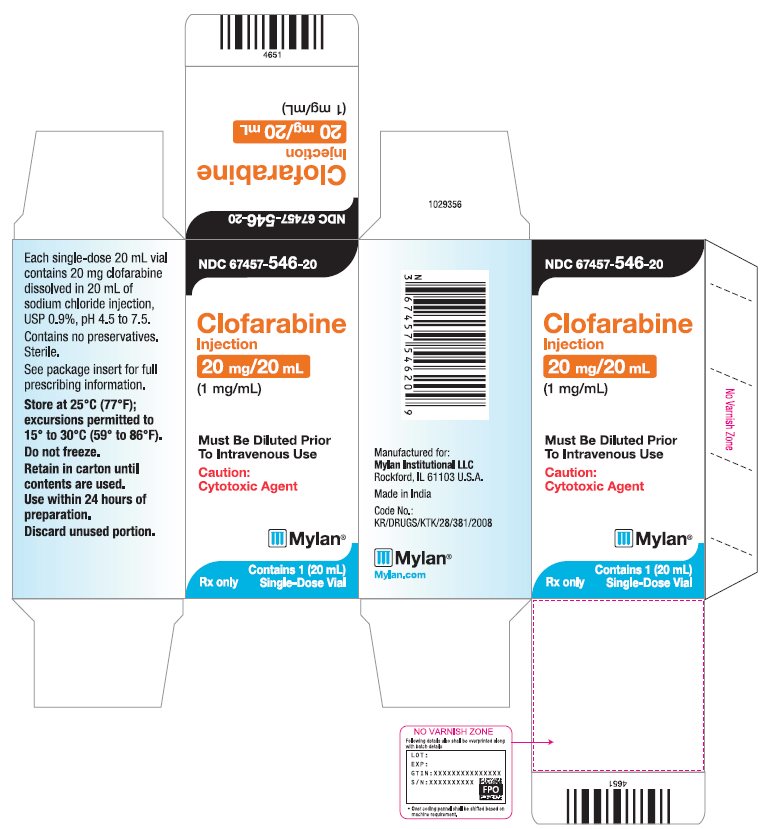
Manufactured for:
Mylan Institutional LLC
Rockford, IL 61103 U.S.A.
Manufactured by:
Mylan Laboratories Limited
Bangalore, India
AUGUST 2017