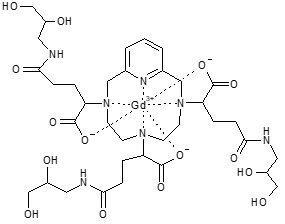
The Cmax and AUCinf of gadopiclenol increased proportionally over a dosage range from 0.025 mmol/kg to 0.3 mmol/kg (0.5 times to 6 times the recommended dosage). At the recommended dose, the mean (CV%) Cmax and AUCinf were 525 (13%) µg/mL and 569 (18%) µg·h/mL, respectively.
Distribution
After intravenous administration of ELUCIREM, gadopiclenol is distributed in the extracellular fluids.
The mean (CV%) volume of distribution of gadopiclenol at steady state is 13 (13%) L.
Protein binding of gadopiclenol is ≤ 1.8% at clinically relevant concentrations.
Following GBCA administration, gadolinium is present for months or years in brain, bone, skin, and other organs [see Warnings and Precautions (5.3)]. It is unknown whether the recommended dose of ELUCIREM results in similar or different levels of gadolinium retention relative to those of other approved macrocyclic GBCAs at their recommended doses.
Elimination
The mean (CV%) elimination half-life (t1/2) of gadopiclenol is 1.5 (14%) hour.
The mean (CV%) total body clearance (CL) and renal clearance (CLr) of gadopiclenol are 100 (9.5%) mL/min and 81 (35%) mL/min, respectively.
Metabolism
Gadopiclenol is not metabolized.
Excretion
Gadopiclenol is mainly eliminated through the kidneys by glomerular filtration. Approximately 98% of the dose was recovered in urine within 48 hours after administration.
Specific Populations
No clinically significant differences in the pharmacokinetics of gadopiclenol were observed based on sex.
Pediatric Patients
The pharmacokinetics of gadopiclenol for pediatric patients (2 to 17 years of age) were within range to those of adults (> 18 years of age) [see Dosage and Administration (2.1)].
The pharmacokinetic parameters (median [range]) of gadopiclenol in pediatric patients are presented in Table 4.
Table 4. Pharmacokinetics Parameters (Median [Range])a According to Age Classes | 2-6 years | 7-11 years | 12-17 years | >18 years |
Cl (L/h/kg) | 0.12 [0.05; 0.28] | 0.10 [0.04; 0.24] | 0.08 [0.04; 0.20] | 0.08 [0.05; 0.14] |
t1/2 (h) | 1.29 [0.69; 3.38] | 1.48 [0.83; 3.20] | 1.77 [1.00; 3.57] | 1.82 [0.93; 3.68] |
AUCinf (ng.h/L) | 403 [169; 964] | 478 [183; 1077] | 582 [267; 1291] | 590 [353; 937] |
C20 (µg/mL) | 236 [136; 387] | 260 [151; 401] | 286 [155; 441] | 296 [166; 485] |
aAt the recommended dosage
Patients with Renal Impairment
The pharmacokinetic parameters (mean (%CV)) of gadopiclenol in patients with renal impairment are presented in Table 5.
Table 5. Effect of Renal Impairment on the Pharmacokinetics of Gadopiclenola,b
| Normal (eGFR ≥ 90 mL/min) | Mild (eGFR 60 to < 90 mL/min) | Moderate (eGFR 30 to < 60 mL/min) | Severe (eGFR 15 to < 30 mL/min) |
AUCinf (µg·h/mL) | 1113 (24%) | 1711 (31%) | 2759 (28%) | 9671 (18%) |
CLr (mL/min) | 96 (10%) | 76 (23%) | 44 (25%) | 14 (26%) |
t1/2 (h) | 1.9 | 3.3 | 3.8 | 11.7 |
a Following administration of a single gadopiclenol 0.1 mmol/kg dose (2 times the recommended dosage).
b eGFR: estimate of GFR based on an estimation equation and expressed in mL/min. To convert mL/min/1.73 m2 to mL/min, multiply by the individual’s BSA and divide by 1.73.
In patients with mild or moderate renal impairment, more than 90% of the administered ELUCIREM was recovered in urine within 48 hours. In patients with severely impaired renal function about 84% of the administered ELUCIREM was recovered in urine within 5 days.
In patients with eGFR < 15 mL/min, hemodialysis effectively removed gadopiclenol from plasma as the percentage of decrease in blood concentrations was 95 to 98% at the end of the first hemodialysis session and 100% after the third hemodialysis session [see Warnings and Precautions (5.1), Use in Specific Populations (8.6)].