Duloxetine Capsule, Delayed Release
Product Images NDC 67877-263
View Photos of Packaging, Regulatory Labels, and Product Appearance
Product Visual Gallery
This gallery contains 12 technical images submitted to the FDA as part of the official labeling for Duloxetine (NDC 67877-263). Unlike standard consumer photos, these assets often include clinical data figures, molecular chemical structures, and official manufacturer packaging layouts.
As provided by Ascend Laboratories, Llc, these visuals offer a comprehensive scientific overview of the product's physical and chemical identity, aiding pharmacists and researchers in product verification and study.
Product Images & Figures Index
Duloxetine-30mg-100s (Duloxetine 30mg 100s)
This is a medication called Ascend containing duloxetine hydrochloride. Each capsule contains 33.7mg of the drug which is equivalent to 30mg of duloxetine. The label size is 42 x 28mm (LXH) with a UV varnish on a blank area. The capsules are delayed-release and should be stored at 25°C (77°F) with excursions allowed between 15-30°C (69-86°F). Do not use if the inner seal is broken. The medication guide should be dispensed to each patient by a pharmacist. The medication is manufactured by Akem LaboratoriesL1d, Mumbai, India and distributed by Ascend Laboratories, LLC, Parsippany, NJ 07054.*
Duloxetine-60mg-30s (Duloxetine 60mg 30s)
This is a medication called "Duloxetine" manufactured by Akem Laboratories in Mumbai, India. Each capsule contains 67.3 mg of duloxetine hydrochloride equivalent to 60 mg of duloxetine. The product code is NDC 67877-265-30. The label dimensions are 40 x 28 mm (LXH) and should have UV varnish. The medication should be stored at 25°C (77°F) with excursions permitted at 15-30°C (69-86°F). The label warns not to use if the inner seal is missing or broken. It comes in a bottle of 30 capsules distributed by Ascend Laboratories in Parsippany, NJ.*
Duloxetine Fig 5
Duloxetine Fig 6
Duloxetine-fig3 (Duloxetine Fig3)
Duloxetine-fig4 (Duloxetine Fig4)
Duloxetine-fig7 (Duloxetine Fig7)
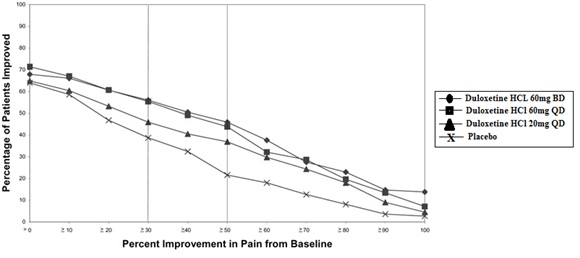
This appears to be a chart displaying the percentage of patients who experienced improvement in pain from their baseline after receiving either a placebo or a certain medication. The medication name appears to be "Didoreine" and the dosage is listed as "601120 g once sy". The chart shows varying levels of improvement, with a range from 0% to 100%.*
Duloxetine-fig8 (Duloxetine Fig8)
The text is showing a chart or graph displaying the percentage of patients who have improved based on a measure of pain compared to a baseline (BOCF). The graph displays measurements denoted by MO, with values ranging from 0 to 230, and S0, with a value of 60. There is an axis for percent improvement ranging from 0 to 100.*
Duloxetine-figure1 (Duloxetine Figure1)
Duloxetine-figure2 (Duloxetine Figure2)
This appears to be a graph showing the time from randomization to relapse in a certain group of patients. The x-axis represents the number of days and the y-axis represents the proportion of patients who have relapsed during that time period. However, without additional context, it is difficult to provide a more specific description of the data.*
Duloxetine-structure (Duloxetine Structure)
* These product label images have been analyzed using experimental machine learning. Please verify findings with the primary label text.