Timing of Loading Dose
In the clinical trial that established the efficacy and safety of Prasugrel tablets, the loading dose of Prasugrel tablets was not administered until coronary anatomy was established in UA/NSTEMI patients and in STEMI patients presenting more than 12 hours after symptom onset. In STEMI patients presenting within 12 hours of symptom onset, the loading dose of Prasugrel tablets was administered at the time of diagnosis, although most received Prasugrel tablets at the time of PCI
[see Clinical Studies (
14)]
. For the small fraction of patients that required urgent CABG after treatment with Prasugrel tablets, the risk of significant bleeding was substantial.
Although it is generally recommended that antiplatelet therapy be administered promptly in the management of ACS because many cardiovascular events occur within hours of initial presentation, in a trial of 4033 NSTEMI patients, no clear benefit was observed when Prasugrel tablets loading dose was administered prior to diagnostic coronary angiography compared to at the time of PCI; however, risk of bleeding was increased with early administration in patients undergoing PCI or early CABG.
Dosing in Low Weight Patients
Compared to patients weighing ≥60 kg, patients weighing <60 kg have an increased exposure to the active metabolite of prasugrel and an increased risk of bleeding on a 10-mg once daily maintenance dose. Consider lowering the maintenance dose to 5-mg in patients <60 kg. The effectiveness and safety of the 5-mg dose have not been prospectively studied
[see Warnings and Precautions (
5.1), Adverse Reactions (
6.1), and Clinical Pharmacology (
12.3)].
Drug Discontinuation
The rate of study drug discontinuation because of adverse reactions was 7.2% for Prasugrel tablets and 6.3% for clopidogrel. Bleeding was the most common adverse reaction leading to study drug discontinuation for both drugs (2.5% for Prasugrel tablets and 1.4% for clopidogrel).
Bleeding Unrelated to CABG Surgery -In TRITON-TIMI 38, overall rates of TIMI Major or Minor bleeding adverse reactions unrelated to coronary artery bypass graft surgery (CABG) were significantly higher on Prasugrel tablets than on clopidogrel, as shown in Table 1
Table 1: Non-CABG-Related Bleeding
a (TRITON-TIMI 38)
| Prasugrel tablets
(%)
(N=6741) | Clopidogrel
(%)
(N=6716) |
| TIMI Major or Minor bleeding | 4.5 | 3.4 |
| TIMI Major bleeding
b | 2.2 | 1.7 |
| Life-threatening | 1.3 | 0.8 |
| Fatal | 0.3 | 0.1 |
| Symptomatic intracranial hemorrhage (ICH) | 0.3 | 0.3 |
| Requiring inotropes | 0.3 | 0.1 |
| Requiring surgical intervention | 0.3 | 0.3 |
| Requiring transfusion (≥4 units) | 0.7 | 0.5 |
| TIMI Minor bleeding
b | 2.4 | 1.9 |
a Patients may be counted in more than one row.
b See 5.1 for definition.
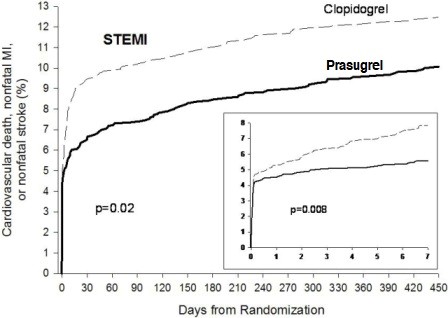
Figure 1 demonstrates non-CABG related TIMI Major or Minor bleeding. The bleeding rate is highest initially, as shown in Figure 1 (inset: Days 0 to 7)
[see Warnings and Precautions (
5.1)]
. Bleeding by Weight and Age - In TRITON-TIMI 38, non-CABG-related TIMI Major or Minor bleeding rates in patients with the risk factors of age 75 years and weight <60 kg are shown in Table 2.
Table 2: Bleeding Rates for Non-CABG-Related Bleeding by Weight and Age (TRITON-TIMI 38) | Major/Minor | Fatal |
| Prasugrel tablets
a
(%) | Clopidogrel
b
(%) | Prasugrel
a tablets
(%) | Clopidogrel
b
(%) |
| Weight <60 kg (N=308 Prasugrel tablets, N=356 clopidogrel) | 10.1 | 6.5 | 0.0 | 0.3 |
| Weight 60 kg (N=6373 Prasugrel tablets, N=6299 clopidogrel) | 4.2 | 3.3 | 0.3 | 0.1 |
| Age <75 years (N=5850 Prasugrel tablets, N=5822 clopidogrel) | 3.8 | 2.9 | 0.2 | 0.1 |
| Age 75 years (N=891 Prasugrel tablets, N=894 clopidogrel) | 9.0 | 6.9 | 1.0 | 0.1 |
|
a 10-mg Prasugrel tabletsa maintenance dose
b 75-mg clopidogrel maintenance dose
Bleeding Related to CABG -In TRITON-TIMI 38, 437 patients who received a thienopyridine underwent CABG during the course of the study. The rate of CABG-related TIMI Major or Minor bleeding was 14.1% for the Prasugrel tablets group and 4.5% in the clopidogrel group (see Table 3). The higher risk for bleeding adverse reactions in patients treated with Prasugrel tablets persisted up to 7 days from the most recent dose of study drug
Table 3: CABG-Related Bleeding
a (TRITON-TIMI 38)
| Prasugrel tablets (%)
(N=213) | Clopidogrel (%)
(N=224) |
| TIMI Major or Minor bleeding | 14.1 | 4.5 |
| TIMI Major bleeding | 11.3 | 3.6 |
| Fatal | 0.9 | 0 |
| Reoperation | 3.8 | 0.5 |
| Transfusion of ≥5 units | 6.6 | 2.2 |
| Intracranial hemorrhage | 0 | 0 |
| TIMI Minor bleeding | 2.8 | 0.9 |
a Patients may be counted in more than one row.
Bleeding Reported as Adverse Reactions - Hemorrhagic events reported as adverse reactions in TRITON-TIMI 38 were, for Prasugrel tablets and clopidogrel, respectively: epistaxis (6.2%, 3.3%), gastrointestinal hemorrhage (1.5%, 1.0%), hemoptysis (0.6%, 0.5%), subcutaneous hematoma (0.5%, 0.2%), post-procedural hemorrhage (0.5%, 0.2%), retroperitoneal hemorrhage (0.3%, 0.2%), pericardial effusion/hemorrhage/tamponade (0.3%, 0.2%), and retinal hemorrhage (0.0%, 0.1%).
Malignancies
During TRITON-TIMI 38, newly-diagnosed malignancies were reported in 1.6% and 1.2% of patients treated with prasugrel and clopidogrel, respectively. The sites contributing to the differences were primarily colon and lung. In another Phase 3 clinical study of ACS patients not undergoing PCI, in which data for malignancies were prospectively collected, newly-diagnosed malignancies were reported in 1.8% and 1.7% of patients treated with prasugrel and clopidogrel, respectively. The site of malignancies was balanced between treatment groups except for colorectal malignancies. The rates of colorectal malignancies were 0.3% prasugrel, 0.1% clopidogrel and most were detected during investigation of GI bleed or anemia. It is unclear if these observations are causally-related, are the result of increased detection because of bleeding, or are random occurrences.
Other Adverse Events
In TRITON-TIMI 38, common and other important non-hemorrhagic adverse events were, for Prasugrel tablets and clopidogrel, respectively: severe thrombocytopenia (0.06%, 0.04%), anemia (2.2%, 2.0%), abnormal hepatic function (0.22%, 0.27%), allergic reactions (0.36%, 0.36%), and angioedema (0.06%, 0.04%). Table 4 summarizes the adverse events reported by at least 2.5% of patients.
Table 4: Non-Hemorrhagic Treatment Emergent Adverse Events Reported by at Least 2.5% of Patients in Either Group | Prasugrel tablets (%)
(N=6741) | Clopidogrel (%)
(N=6716) |
| Hypertension | 7.5 | 7.1 |
| Hypercholesterolemia/Hyperlipidemia | 7.0 | 7.4 |
| Headache | 5.5 | 5.3 |
| Back pain | 5.0 | 4.5 |
| Dyspnea | 4.9 | 4.5 |
| Nausea | 4.6 | 4.3 |
| Dizziness | 4.1 | 4.6 |
| Cough | 3.9 | 4.1 |
| Hypotension | 3.9 | 3.8 |
| Fatigue | 3.7 | 4.8 |
| Non-cardiac chest pain | 3.1 | 3.5 |
| Atrial fibrillation | 2.9 | 3.1 |
| Bradycardia | 2.9 | 2.4 |
| Leukopenia (<4 x 10⁹ WBC/L) | 2.8 | 3.5 |
| Rash | 2.8 | 2.4 |
| Pyrexia | 2.7 | 2.2 |
| Peripheral edema | 2.7 | 3.0 |
| Pain in extremity | 2.6 | 2.6 |
| Diarrhea | 2.3 | 2.6 |
Specific Populations
Geriatric - In a study of 32 healthy subjects between the ages of 20 and 80 years, age had no significant effect on pharmacokinetics of prasugrel's active metabolite or its inhibition of platelet aggregation. In TRITON-TIMI 38, the mean exposure (AUC) of the active metabolite was 19% higher in patients ≥75 years of age than in patients <75 years of age. In a study in subjects with stable atherosclerosis, the mean exposure (AUC) to the active metabolite of prasugrel in subjects ≥75 years old taking a 5-mg maintenance dose was approximately half that seen in subjects 45 to 64 years old taking a 10-mg maintenance dose.
[See Warnings and Precautions (
5.1) and Use in Specific Populations (
8.5)].
Body Weight - The mean exposure (AUC) to the active metabolite is approximately 30 to 40% higher in subjects with a body weight of <60 kg than in those weighing ≥60 kg. In a study in subjects with stable atherosclerosis, the AUC of the active metabolite on average was 38% lower in subjects <60 kg taking 5-mg (N=34) than in subjects ≥60 kg taking 10-mg (N=38)
[see Dosage and Administration (
2), Warnings and Precautions (
5.1), Adverse Reactions (
6.1), and Use in Specific Populations (
8.6)].
Gender -Pharmacokinetics of prasugrel's active metabolite are similar in men and women.
Ethnicity -Exposure in subjects of African and Hispanic descent is similar to that in Caucasians. In clinical pharmacology studies, after adjusting for body weight, the AUC of the active metabolite was approximately 19% higher in Chinese, Japanese, and Korean subjects than in Caucasian subjects.
Smoking -Pharmacokinetics of prasugrel's active metabolite are similar in smokers and nonsmokers.
Renal Impairment - Pharmacokinetics of prasugrel's active metabolite and its inhibition of platelet aggregation are similar in patients with moderate renal impairment (CrCL=30 to 50 mL/min) and healthy subjects. In patients with end-stage renal disease, exposure
to the active metabolite (both Cmax and AUC (0-tlast)) was about half that in healthy controls and patients with moderate renal impairment
[see Warnings and Precautions (
5.1) and Use in Specific Populations (
8.7)].
Hepatic Impairment - Pharmacokinetics of prasugrel's active metabolite and inhibition of platelet aggregation were similar in patients with mild to moderate hepatic impairment compared to healthy subjects. The pharmacokinetics and pharmacodynamics of prasugrel's
active metabolite in patients with severe hepatic disease have not been studied
[see Warnings and Precautions (
5.1) and Use in Specific Populations (
8.8)].
Drug Interactions
Potential for Other Drugs to Affect Prasugrel
Inhibitors of CYP3A - Ketoconazole (400 mg daily), a selective and potent inhibitor of CYP3A4 and CYP3A5, did not affect prasugrel-mediated inhibition of platelet aggregation or the active metabolite's AUC and Tmax, but decreased the Cmax by 34% to 46%. Therefore, CYP3A inhibitors such as verapamil, diltiazem, indinavir, ciprofloxacin, clarithromycin, and grapefruit juice are not expected to have a significant effect on the pharmacokinetics of the active metabolite of prasugrel
[see Drug Interactions (
7.4)].
Inducers of Cytochromes P450 - Rifampicin (600 mg daily), a potent inducer of CYP3A and CYP2B6 and an inducer of CYP2C9, CYP2C19, and CYP2C8, did not significantly change the pharmacokinetics of prasugrel's active metabolite or its inhibition of platelet aggregation. Therefore, known CYP3A inducers such as rifampicin, carbamazepine, and other inducers of cytochromes P450 are not expected to have significant effect on the pharmacokinetics of the active metabolite of prasugrel
[see Drug Interactions (
7.4)].
Drugs that Elevate Gastric pH - Daily coadministration of ranitidine (an H2 blocker) or lansoprazole (a proton pump inhibitor) decreased the Cmax of the prasugrel active metabolite by 14% and 29%, respectively, but did not change the active metabolite's AUC and Tmax. In TRITON-TIMI 38, Prasugrel tablets was administered without regard to coadministration of a proton pump inhibitor or H2 blocker
[see Drug Interactions (
7.4)].
Statins - Atorvastatin (80 mg daily), a drug metabolized by CYP450 3A4, did not alter the pharmacokinetics of prasugrel's active metabolite or its inhibition of platelet aggregation
[see Drug Interactions (
7.4)]
.
Heparin - A single intravenous dose of unfractionated heparin (100 U/kg) did not significantly alter coagulation or the prasugrel-mediated inhibition of platelet aggregation; however, bleeding time was increased compared with either drug alone
[see Drug Interactions (
7.4)].
Aspirin - Aspirin 150 mg daily did not alter prasugrel-mediated inhibition of platelet aggregation; however, bleeding time was increased compared with either drug alone
[see Drug Interactions (
7.4)].
Warfarin - A significant prolongation of the bleeding time was observed when prasugrel was coadministered with 15-mg of warfarin
[see Drug Interactions (
7.1)]
.
Potential for Prasugrel to Affect Other Drugs
In vitro metabolism studies demonstrate that prasugrel's main circulating metabolites are not likely to cause clinically significant inhibition of CYP1A2, CYP2C9, CYP2C19, CYP2D6, or CYP3A, or induction of CYP1A2 or CYP3A.
Drugs Metabolized by CYP2B6 — Prasugrel is a weak inhibitor of CYP2B6. In healthy subjects, prasugrel decreased exposure to hydroxybupropion, a CYP2B6-mediated metabolite of bupropion, by 23%, an amount not considered clinically significant. Prasugrel is not anticipated to have significant effect on the pharmacokinetics of drugs that are primarily metabolized by CYP2B6, such as halothane, cyclophosphamide, propofol, and nevirapine.
Effect on Digoxin - The potential role of prasugrel as a Pgp substrate was not evaluated. Prasugrel is not an inhibitor of Pgp, as digoxin clearance was not affected by prasugrel coadministration
[see Drug Interactions (
7.4)].
Morphine -Co-administration of 5 mg intravenous morphine with 60 mg loading dose of prasugrel in healthy adults decreased the C
max of prasugrel's active metabolite by 31% with no change in max AUC, T
max, or inhibition of ADP-induced platelet aggregation. ADP induced platelet aggregation was higher up to 2 hours following 60 mg loading dose of prasugrel in stable patients more than 1 max year after an ACS who were co-administered morphine. In the patients with a 2-hour delay in the onset of platelet aggregation (5 of 11), T
max was delayed and prasugrel active metabolite levels max were significantly lower at 30 min (5 vs 120 ng/mL) following co-administration with morphine.
Carcinogenesis -No compound-related tumors were observed in a 2-year rat study with prasugrel at oral doses up to 100 mg/kg/ day (>100 times the recommended therapeutic exposures in humans (based on plasma exposures to the major circulating human metabolite). There was an increased incidence of tumors (hepatocellular adenomas) in mice exposed for 2 years to high doses (>250 times the human metabolite exposure).
Mutagenesis - Prasugrel was not genotoxic in two in vitro tests (Ames bacterial gene mutation test, clastogenicity assay in Chinese hamster fibroblasts) and in one in vivo test (micronucleus test by intraperitoneal route in mice).
Impairment of Fertility - Prasugrel had no effect on fertility of male and female rats at oral doses up to 300 mg/kg/day (80 times the human major metabolite exposure at daily dose of 10-mg prasugrel).
Advise the patient to read the FDA-approved patient labeling (Medication Guide).
Administration
- Advise patients not to break Prasugrel tablets.
- Remind patients not to discontinue Prasugrel tablets without first discussing it with the physician who prescribed Prasugrel tablets
[see Warnings and Precautions (
5.3)].
- Inform patients to keep Prasugrel tablets in the container in which it comes, and keep the container closed tightly with the opaque white cylinder (desiccant) inside.
Bleeding
Inform patients that they:
• will bruise and bleed more easily.
• will take longer than usual to stop bleeding.
• should report any unanticipated, prolonged, or excessive bleeding, or blood in their stool or urine
[see Warnings and Precautions (
5.1)]
.
Thrombotic Thrombocytopenic Purpura
- Inform patients that TTP is a rare but serious condition that has been reported with Prasugrel tablets.
- Instruct patients to get prompt medical attention if they experience symptoms of TTP that cannot otherwise be explained
[see Warnings and Precautions (
5.4)].
Hypersensitivity
Inform patients that they may have hypersensitivity reactions and to seek immediate medical attention if any signs and symptoms of a hypersensitivity reaction occur. Patients who have had hypersensitivity reactions to other thienopyridines may have hypersensitivity reactions to Prasugrel tablets.
Invasive Procedures
Instruct patients to:
- inform physicians and dentists that they are taking Prasugrel tablets before any invasive procedure is scheduled
[see Warnings and Precautions (
5.1)].
- tell the doctor performing the invasive procedure to talk to the prescribing health care professional before stopping Prasugrel tablets.
Concomitant Medications
Ask patients to list all prescription medications, over-the-counter medications, or dietary supplements they are taking or plan to take so the physician knows about other treatments that may affect bleeding risk (e.g., warfarin and NSAIDs)
[see Drug Interactions (
7.1,
7.2)].
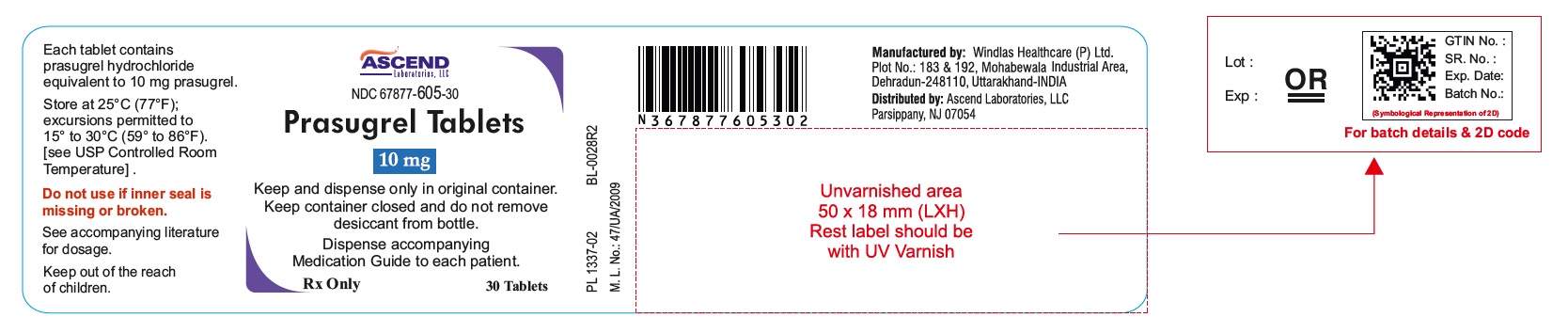
Manufactured by:
Windlas Healthcare (P) Ltd.
Plot No.: 183 & 192, Mohabewala industrial Area,
Dehradun-248110, Uttarakhand-INDIA
Distributed by:
Ascend Laboratories, LLC
Parsippany, NJ 07054
Revised: 06/2019