Advise the patient to read the FDA-approved patient labeling (Medication Guide).
Controlled Substance Status/High Potential for Abuse and Dependence
Advise patients that methylphenidate hydrochloride extended-release tablets is controlled substance, and they can be abused and lead to dependence. Instruct patients that they should not give methylphenidate hydrochloride extended-release tablets to anyone else. Advise patients to store methylphenidate hydrochloride extended-release tablets in a safe place, preferably locked, to prevent abuse. Advise patients to comply with laws and regulations on drug disposal. Advise patients to dispose of remaining, unused, or expired methylphenidate hydrochloride extended-release tablets by a medicine take-back program if available [see Boxed Warning, Warnings and Precautions (5.1), Drug Abuse and Dependence (9.1, 9.2, 9.3), How Supplied/Storage and Handling (16)].
Serious Cardiovascular Risks
Advise patients that there is a potential serious cardiovascular risk including sudden death, myocardial infarction, stroke, and hypertension with methylphenidate hydrochloride extended-release tablets use. Instruct patients to contact a healthcare provider immediately if they develop symptoms such as exertional chest pain, unexplained syncope, or other symptoms suggestive of cardiac disease [see Warnings and Precautions (5.2)].
Blood Pressure and Heart Rate Increases
Instruct patients that methylphenidate hydrochloride extended-release tablets can cause elevations of their blood pressure and pulse rate [see Warnings and Precautions (5.3)].
Psychiatric Risks
Advise patients that methylphenidate hydrochloride extended-release tablets, at recommended doses, can cause psychotic or manic symptoms, even in patients without prior history of psychotic symptoms or mania [see Warnings and Precautions (5.4)].
Priapism
Advise patients of the possibility of painful or prolonged penile erections (priapism). Instruct them to seek immediate medical attention in the event of priapism [see Warnings and Precautions (5.5)].
Circulation Problems in Fingers and Toes [Peripheral Vasculopathy, Including Raynaud’s Phenomenon]
Instruct patients about the risk of peripheral vasculopathy, including Raynaud’s Phenomenon, and associated signs and symptoms: fingers or toes may feel numb, cool, painful, and/or may change color from pale, to blue, to red. Instruct patients to report to their physician any new numbness, pain, skin color change, or sensitivity to temperature in fingers or toes.
Instruct patients to call their physician immediately with any signs of unexplained wounds appearing on fingers or toes while taking methylphenidate hydrochloride extended-release tablets. Further clinical evaluation (e.g., rheumatology referral) may be appropriate for certain patients [see Warnings and Precautions (5.6)].
Suppression of Growth
Advise patients that methylphenidate hydrochloride extended-release tablets may cause slowing of growth and weight loss [see Warnings and Precautions (5.7)].
Pregnancy Registry
Advise patients that there is a pregnancy exposure registry that monitors pregnancy outcomes in patients exposed to ADHD medications, including methylphenidate hydrochloride extended release tablets, during pregnancy [see Use in Specific Populations (8.1)].
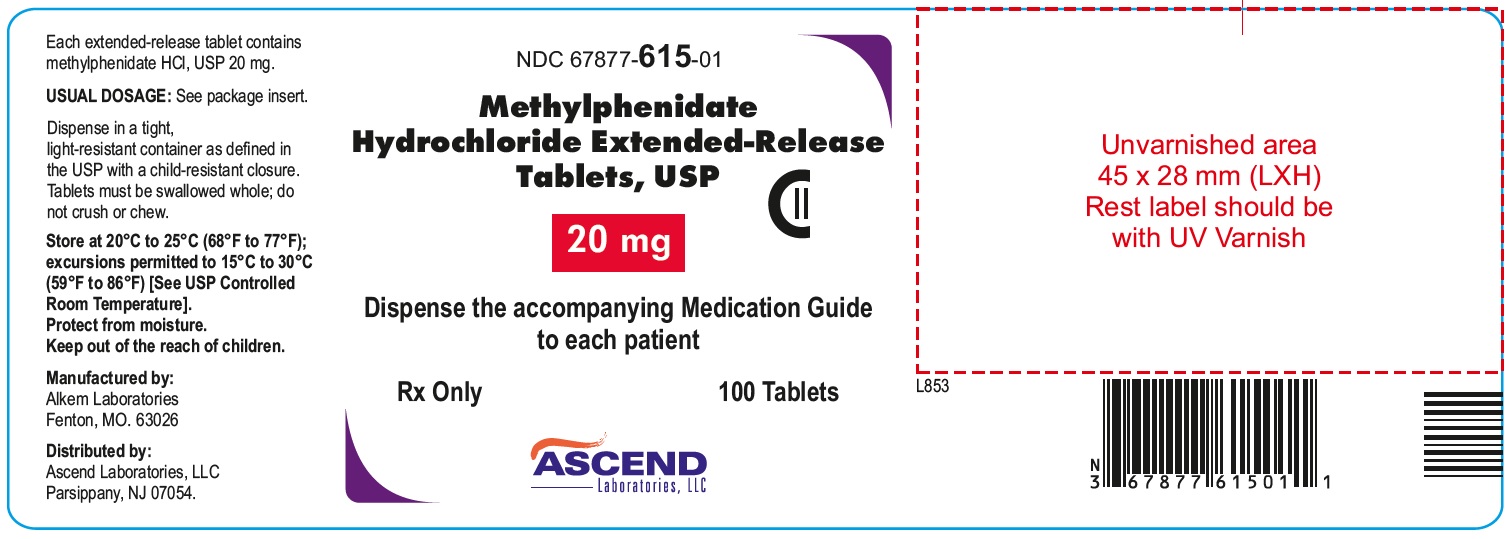
Manufactured by:
Alkem Laboratories
Fenton, MO. 63026
Distributed by:
Ascend Laboratories, LLC
Parsippany, NJ 07054
L854
Revised: December, 2019