Because clinical trials are conducted under widely varying conditions, adverse reaction rates observed in the clinical trials of a drug cannot be directly compared to rates in the clinical trials of another drug and may not reflect the rates observed in practice.
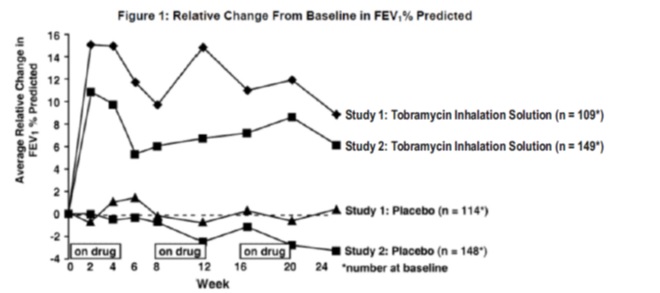
Tobramycin inhalation solution was studied in two phase 3 clinical studies involving 258 cystic fibrosis patients ranging in age from 6 to 48 years.
Patients received tobramycin inhalation solution in alternating periods of 28 days on and 28 days off drug in addition to their standard cystic fibrosis therapy for a total of 24 weeks.
Table 1 lists the percent of patients with selected adverse reactions that occurred in >5% of tobramycin inhalation solution patients during the two Phase III studies.
Table 1: Percent of Patients With Selected Adverse Reactions Occurring in >5% of tobramycin inhalation solution Patients
Adverse Reaction
| Tobramycin
Inhalation Solution
(n=258)
%
| Placebo
(n=262)
%
|
Cough Increased
| 46.1
| 47.3
|
Pharyngitis
| 38.0
| 39.3
|
Sputum Increased
| 37.6
| 39.7
|
Dyspnea
| 33.7
| 38.5
|
Hemoptysis
| 19.4
| 23.7
|
Lung Function Decreased1
| 16.3
| 15.3
|
Voice Alteration
| 12.8
| 6.5
|
Taste Perversion
| 6.6
| 6.9
|
Rash
| 5.4
| 6.1
|
1 Includes reported decreases in pulmonary function tests or decreased lung volume on chest radiograph associated with intercurrent illness or study drug administration.
Selected adverse reactions that occurred in less than or equal to 5% of patients treated with tobramycin inhalation solution:
Ear and labyrinth disorders: Tinnitus
Musculoskeletal and connective tissue disorders: Myalgia
Infections and infestations: Laryngitis
Voice Alteration and Tinnitus
Voice alteration and tinnitus were the only adverse reactions reported by significantly more tobramycin inhalation solution-treated patients. Thirty-three patients (13%) treated with tobramycin inhalation solution complained of voice alteration compared to 17 (7%) placebo patients. Voice alteration was more common in the on-drug periods.
Eight patients from the tobramycin inhalation solution group (3%) reported tinnitus compared to no placebo patients. All episodes were transient, resolved without discontinuation of the tobramycin inhalation solution treatment regimen, and were not associated with loss of hearing in audiograms. Tinnitus is one of the sentinel symptoms of cochlear toxicity, and patients with this symptom should be carefully monitored for high frequency hearing loss. The numbers of patients reporting vestibular adverse experiences such as dizziness were similar in the tobramycin inhalation solution and placebo groups.
Changes in Serum Creatinine
Nine (3%) patients in the tobramycin inhalation solution group and nine (3%) patients in the placebo group had increases in serum creatinine of at least 50% over baseline. In all nine patients in the tobramycin inhalation solution group, creatinine decreased at the next visit.