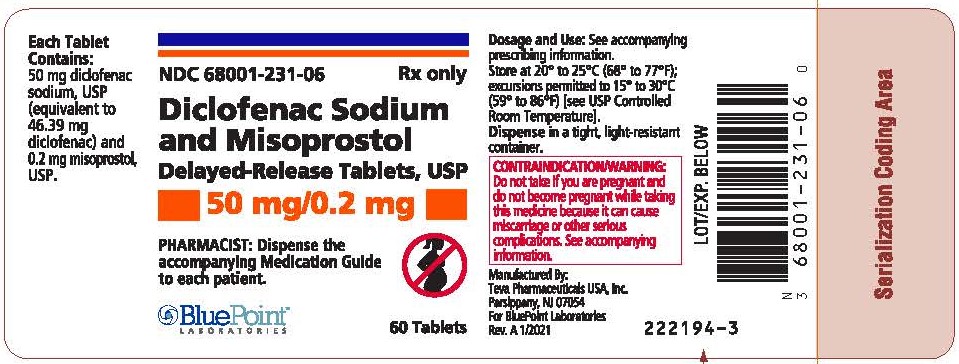
Diclofenac Sodium And Misoprostol Tablet, Delayed Release
FDA Label NDC 68001-232

43 label sections · Submitted to the FDA by Bluepoint Laboratories · Indications, Dosage, Usage, and Precautions

Structured Product Label

The following Structured Product Label (SPL) was submitted to the FDA by Bluepoint Laboratories for the product Diclofenac Sodium And Misoprostol (NDC 68001-232). This document serves as the official prescribing information, containing essential scientific data and clinical materials required for healthcare providers and patients.

This specific version of the label includes detailed information regarding boxed warning, 1 indications and usage, 2.1 important dosage information, 2.2 recommended dosage in patients with osteoarthritis, 2.3 recommended dosage in patients with rheumatoid arthritis, 2.4 additional dosage recommendations, 3 dosage forms and strengths, 4 contraindications, and other regulatory disclosures. Use the navigation below to review specific sections of the FDA submission.

Label Section Quick Index

2.1 Important Dosage Information

  • Carefully consider the potential benefits and risks of diclofenac sodium and misoprostol delayed-release tablets and other treatment options before deciding to use diclofenac sodium and misoprostol delayed-release tablets. Use the lowest effective dosage for the shortest duration consistent with individual patient treatment goals [see Warnings and Precautions (5)] .
  • After observing the response to initial therapy with diclofenac sodium and misoprostol delayed-release tablets, the dose and frequency should be adjusted to suit an individual patient’s needs.
  • Diclofenac sodium and misoprostol delayed-release tablets are not recommended for patients who would not receive the appropriate dosage of both active ingredients.
  • Diclofenac sodium and misoprostol delayed-release tablets, a fixed combination product, are administered as diclofenac sodium and misoprostol delayed-release tablets (50 mg diclofenac sodium/0.2 mg misoprostol) or as diclofenac sodium and misoprostol delayed-release tablets (75 mg diclofenac sodium/0.2 mg misoprostol).

The recommended dosage for the treatment of osteoarthritis for maximal GI mucosal protection is diclofenac sodium and misoprostol delayed-release tablets 50 mg/0.2 mg three times a day. For patients who experience intolerance, diclofenac sodium and misoprostol delayed-release tablets 75 mg/0.2 mg two times a day or diclofenac sodium and misoprostol delayed-release tablets 50 mg/0.2 mg two times a day can be used, but these dosages are less effective in preventing ulcers. A daily dosage of diclofenac sodium greater than 150 mg/day is not recommended. Daily doses of the components delivered with these regimens are as follows:

Osteoarthritis Regimen

Diclofenac Sodium

(mg/day)

Misoprostol

(mcg/day)

Diclofenac Sodium and Misoprostol Delayed-Release Tablets 50 mg/0.2 mg

three times a day

two times a day*

150

600

100

400

Diclofenac Sodium and Misoprostol Delayed-Release Tablets 75 mg/0.2 mg

two times a day*

150

400

*For patients who experience intolerance; these dosages are less effective in preventing ulcers

The recommended dosage for the treatment of rheumatoid arthritis is diclofenac sodium and misoprostol delayed-release tablets 50 mg/0.2 mg three or four times a day. For patients who experience intolerance, diclofenac sodium and misoprostol delayed-release tablets 75 mg/0.2 mg two times a day or diclofenac sodium and misoprostol delayed release tablets 50 mg/0.2 mg two times a day can be used, but are less effective in preventing ulcers. A daily dosage of diclofenac sodium greater than 200 mg/day is not recommended. Daily doses of the components delivered with these regimens are as follows:

Osteoarthritis Regimen

Diclofenac Sodium

(mg/day)

Misoprostol

(mcg/day)

Diclofenac Sodium and Misoprostol Delayed-Release Tablets 50 mg/0.2 mg

four time a day

three times a

day

two times a day*

200

800

150

600

100

400

Diclofenac Sodium and Misoprostol Delayed-Release Tablets 75 mg/0.2 mg

two times a day*

150

400

*For patients who experience intolerance; these dosages are less effective in preventing ulcers

2.4 Additional Dosage Recommendations

Diclofenac sodium and misoprostol delayed-release tablets contain misoprostol, which provides protection against gastric and duodenal ulcers [see Clinical Studies (14)] . For gastric ulcer prevention, the 200 mcg four and three times a day regimens are therapeutically equivalent, but more protective than the two times a day regimen. For duodenal ulcer prevention, the four times a day regimen is more protective than the three or two times a day regimens. However, the four times a day regimen is less well tolerated than the three times a day regimen because of usually self-limited diarrhea related to the misoprostol dose [see Adverse Reactions (6.1)] , and the two times a day regimen may be better tolerated than three times a day in some patients.

Dosages may be individualized using the separate products (misoprostol and diclofenac sodium), after which the patient may be switched to the appropriate diclofenac sodium and misoprostol delayed-release tablets dosage. If clinically indicated, misoprostol co-therapy with diclofenac sodium and misoprostol delayed-release tablets to optimize the misoprostol dose and/or frequency of administration, may be appropriate. Do not exceed a total misoprostol dose of 800 mcg/day and do not administer more than 200 mcg of misoprostol at any one time.

When concomitant use of CYP2C9 inhibitors is necessary, the maximum total daily dose of diclofenac is 100 mg per day. Do not exceed a dosage of diclofenac sodium and misoprostol delayed-release tablets 50 mg/0.2 mg twice daily [see Drug Interactions (7)].

For additional information, refer to the Prescribing Information for the individual products of diclofenac sodium and misoprostol.

5.14 Laboratory Monitoring

Because serious GI bleeding, hepatotoxicity, and renal injury can occur without warning symptoms or signs, consider monitoring patients on long-term NSAID treatment with a complete blood count (CBC) and a chemistry profile periodically [see Warnings and Precautions ( 5.3, 5.7)].

8.6 Renal Impairment

Diclofenac and misoprostol are primarily excreted by the kidney. Long-term administration of NSAIDs has resulted in renal toxicity. Correct volume status in dehydrated or hypovolemic patients prior to initiating diclofenac sodium and misoprostol delayed-release tablets. Monitor renal function, especially during concomitant use of ACE inhibitors or ARBs. Also, monitor renal function in patients with hepatic impairment. Avoid the use of diclofenac sodium and misoprostol delayed-release tablets in patients with advanced renal disease. If use cannot be avoided in patients with advanced renal disease, use the lowest dosage for the shortest duration, monitor the patient’s renal function and monitor for clinical signs of worsening renal function [see Warnings and Precautions (5.7), Drug Interactions (7) and Clinical Pharmacology (12.3)] .

* Please review the disclaimer below.