Dutasteride Capsule, Liquid Filled
Product Images NDC 68071-3757

View Photos of Packaging, Regulatory Labels, and Product Appearance

Product Visual Gallery

This gallery contains 9 technical images submitted to the FDA as part of the official labeling for Dutasteride (NDC 68071-3757). Unlike standard consumer photos, these assets often include clinical data figures, molecular chemical structures, and official manufacturer packaging layouts.

As provided by Nucare Pharmaceuticals, Inc., these visuals offer a comprehensive scientific overview of the product's physical and chemical identity, aiding pharmacists and researchers in product verification and study.

FDA Label Image

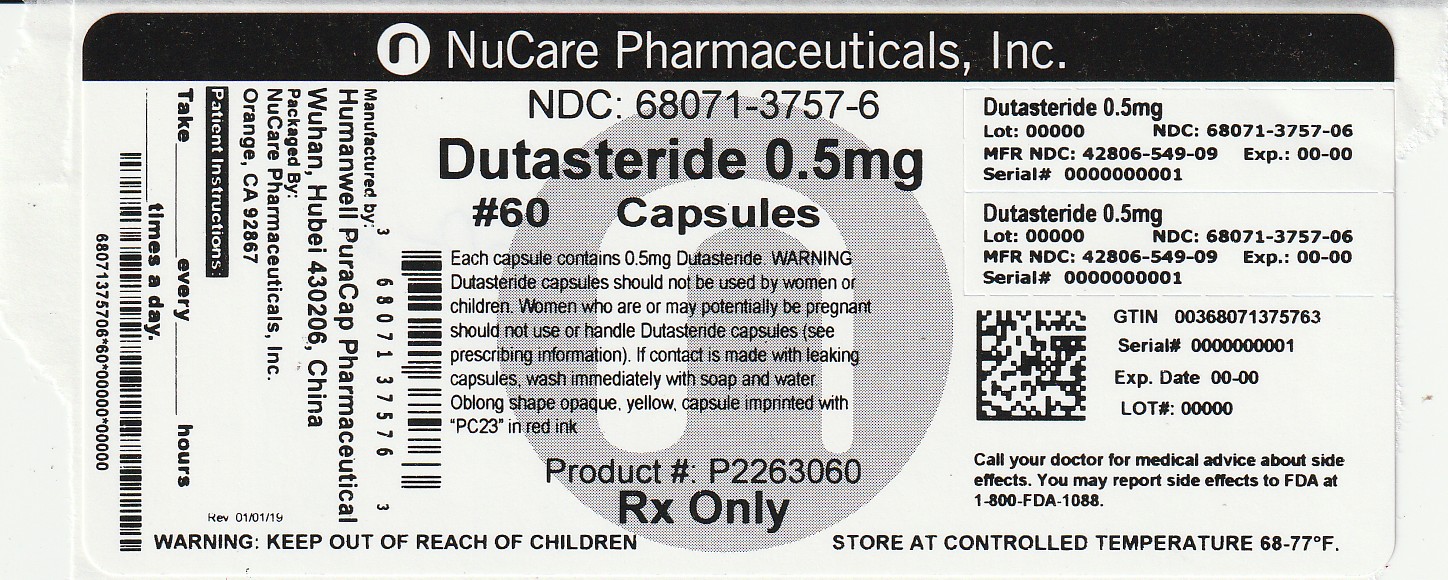
Pdp (68071 3757 6)

Pdp (68071 3757 6)
Label for Dutasteride 0.5 mg capsules from NuCare Pharmaceuticals, Inc. Contains 60 liquid-filled oral capsules. The label includes warnings about use by women and children, storage instructions at controlled temperature 68-77°F, and manufacturer details: Humanwell PuraCap Pharmaceutical, Wuhan, China. Capsules are described as oblong, opaque, yellow, imprinted with "PC23" in red ink. The product is Rx only.*
FDA Label Image

Figure-1 (Figure 1)

Figure-1 (Figure 1)
Line graph illustrating the mean change from baseline in AUA-SI over 24 months of treatment. It compares Dutasteride and placebo groups, plotting mean change on the vertical axis against months of treatment on the horizontal axis, with sample sizes provided for each time point.*
FDA Label Image

Figure-2 (Figure 2)

Figure-2 (Figure 2)
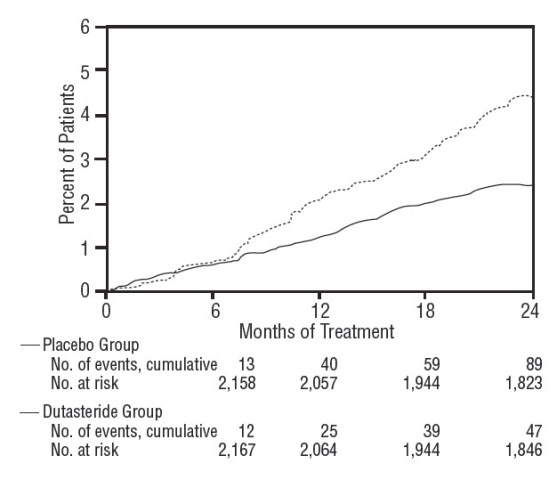
A line graph showing the percent of patients over 24 months of treatment for two groups: Placebo and Dutasteride. The graph plots cumulative events and number at risk at various time points, illustrating a lower percent of events in the Dutasteride group compared to the Placebo group over time.*
FDA Label Image

Figure-3 (Figure 3)

Figure-3 (Figure 3)
A line graph comparing the cumulative percent of patients over 24 months of treatment between a Placebo Group and a Dutasteride Group. The x-axis represents months of treatment from 0 to 24, and the y-axis shows percent of patients from 0 to 6. The graph includes cumulative event counts and numbers at risk for both groups at 0, 6, 12, 18, and 24 months.*
FDA Label Image

Figure-4 (Figure 4)

Figure-4 (Figure 4)
A bar chart showing mean percent change from baseline over months of treatment (0, 1, 3, 6, 12, 24) comparing Dutasteride and Placebo groups. Dutasteride bars show decreasing mean percent values over time, while Placebo bars remain near zero. Sample sizes (n) for each group and timepoint are indicated on the x-axis.*
FDA Label Image

Figure-5 (Figure 5)

Figure-5 (Figure 5)
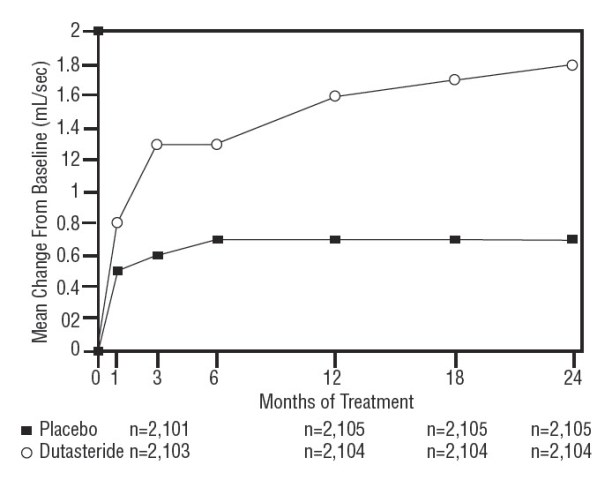
A line graph showing mean change from baseline (mL/sec) over 24 months of treatment comparing Dutasteride and placebo. Dutasteride data points are marked with open circles, showing a rise to about 1.8 mL/sec by 24 months. Placebo data points are marked with solid squares, remaining near 0.7 mL/sec. Sample sizes for both groups are listed below the x-axis.*
FDA Label Image

Figure-6 (Figure 6)

Figure-6 (Figure 6)
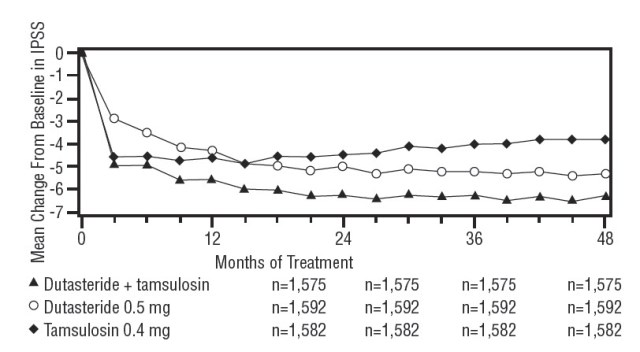
A line graph depicting the mean change from baseline in IPSS scores over 48 months of treatment. It compares three groups: Dutasteride plus tamsulosin, Dutasteride 0.5 mg, and Tamsulosin 0.4 mg. The x-axis represents months of treatment, and the y-axis represents the mean change in IPSS.*
FDA Label Image

Figure-7 (Figure 7)

Figure-7 (Figure 7)
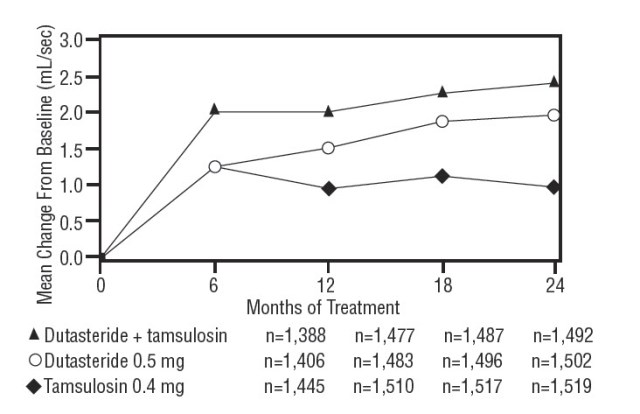
A line graph showing mean change from baseline in mL/sec over 24 months of treatment for Dutasteride + tamsulosin, Dutasteride 0.5 mg, and Tamsulosin 0.4 mg. The x-axis represents months of treatment (0 to 24), and the y-axis shows mean change from baseline. The graph includes sample sizes at each time point for the three groups.*
FDA Label Image

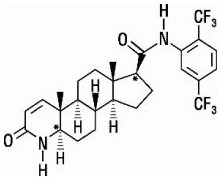
Structural-formula (Image 01)

Structural-formula (Image 01)
Chemical structure of Dutasteride, showing its steroidal core with attached trifluoromethyl-substituted aromatic ring and various functional groups.*

* About these descriptions: Image descriptions on this page are generated by automated AI analysis of the product label images from the manufacturer's FDA label submission (SPL). They are provided for reference only and may contain errors or omissions. Always rely on the printed label itself and the official FDA labeling, and consult a pharmacist or healthcare professional with any questions about this product.