Gabapentin Capsule
Product Images NDC 68071-4978

7 FDA label images from Nucare Pharmaceuticals,inc. · Packaging, Regulatory Labels, and Product Appearance

Product Visual Gallery

This gallery contains 7 technical images submitted to the FDA as part of the official labeling for Gabapentin (NDC 68071-4978). Unlike standard consumer photos, these assets often include clinical data figures, molecular chemical structures, and official manufacturer packaging layouts.

As provided by Nucare Pharmaceuticals,inc., these visuals offer a comprehensive scientific overview of the product's physical and chemical identity, aiding pharmacists and researchers in product verification and study.

FDA Label Image

Pdp (68071 4978 9)

Pdp (68071 4978 9)
Gabapentin 100 mg capsules label from NuCare Pharmaceuticals, Inc. The label indicates a package count of 90 capsules. It specifies each capsule contains 100 mg of Gabapentin, USP, and describes the capsule as oblong, white, and opaque with an imprint of 'AHD' on the cap and '100' on the body. The label shows the NDC 68071-4978-9 and includes manufacturer details, storage instructions to keep at controlled temperatures between 59-86°F, and standard warnings such as keeping out of reach of children.*
FDA Label Image

Formula (Ab1e0185 B802 4cf2 A5d4 B71f27f1dcb0 00)

Formula (Ab1e0185 B802 4cf2 A5d4 B71f27f1dcb0 00)
Formula diagram showing the calculation of creatinine clearance (CLCr) based on patient age in years, weight in kilograms, serum creatinine in mg/dL, with an adjustment factor for female patients. This formula is used in clinical pharmacokinetics.*
FDA Label Image

Figure1 (D45f499b 8612 479e 8dd2 4fe28b1f5f9c 01)

Figure1 (D45f499b 8612 479e 8dd2 4fe28b1f5f9c 01)
Chemical structure of Gabapentin, showing its molecular arrangement used as the active ingredient in the prescription drug Gabapentin capsules by NuCare Pharmaceuticals, Inc.*
FDA Label Image

Image 1 (D45f499b 8612 479e 8dd2 4fe28b1f5f9c 02)

Image 1 (D45f499b 8612 479e 8dd2 4fe28b1f5f9c 02)
A line graph comparing mean pain scores over 8 weeks between placebo and Gabapentin 3600 mg/day groups. The x-axis represents weeks including a 4-week dose titration period and a 4-week fixed dose period. The y-axis shows mean pain scores, with Gabapentin group scores decreasing over time compared to relatively stable placebo scores.*
FDA Label Image

Image 2 (D45f499b 8612 479e 8dd2 4fe28b1f5f9c 03)

Image 2 (D45f499b 8612 479e 8dd2 4fe28b1f5f9c 03)
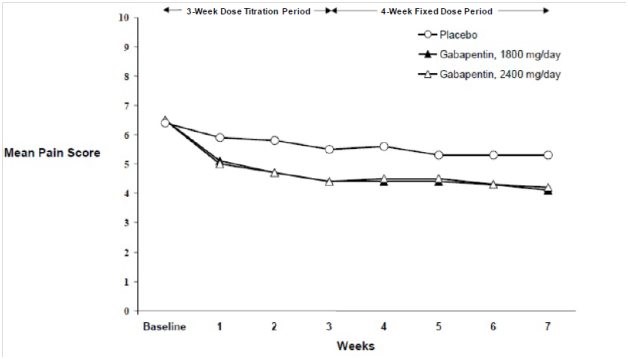
A line graph depicting mean pain scores over seven weeks for three groups: placebo, gabapentin 1800 mg/day, and gabapentin 2400 mg/day. The x-axis represents weeks, including a 3-week dose titration period followed by a 4-week fixed dose period. The y-axis shows mean pain scores from 0 to 10. Gabapentin groups show a notable pain score reduction compared to placebo over time.*
FDA Label Image

Image 3 (D45f499b 8612 479e 8dd2 4fe28b1f5f9c 04)

Image 3 (D45f499b 8612 479e 8dd2 4fe28b1f5f9c 04)
A bar chart titled 'Proportion of Responders (patients with ≥ 50% reduction in pain score) at Endpoint: Controlled PHN Studies' showing data from two studies. Study 1 compares placebo (12%) to Gabapentin 3600 mg (29%), and Study 2 compares placebo (14%) to Gabapentin 1800 mg (32%) and Gabapentin 2400 mg (34%). Statistical significance is indicated by asterisks with p-values documented in the chart.*
FDA Label Image

Image 4 (D45f499b 8612 479e 8dd2 4fe28b1f5f9c 05)

Image 4 (D45f499b 8612 479e 8dd2 4fe28b1f5f9c 05)
A scatter plot comparing percentage difference against daily dose (mg) for Gabapentin across three studies (a, b, c). The graph plots points at 600, 900, 1200, and 1800 mg doses on the x-axis with corresponding percentage differences on the y-axis, ranging from 2% to 22%. Study a is marked with black squares, study b with gray squares, and study c with white squares.*

* About these descriptions: Image descriptions on this page are generated by automated AI analysis of the product label images from the manufacturer's FDA label submission (SPL). They are provided for reference only and may contain errors or omissions. Always rely on the printed label itself and the official FDA labeling, and consult a pharmacist or healthcare professional with any questions about this product.