Gemcitabine Hydrochloride Injection, Powder, Lyophilized, For Solution
Product Images NDC 68083-149

View Photos of Packaging, Regulatory Labels, and Product Appearance

Product Visual Gallery

This gallery contains 9 technical images submitted to the FDA as part of the official labeling for Gemcitabine Hydrochloride (NDC 68083-149). Unlike standard consumer photos, these assets often include clinical data figures, molecular chemical structures, and official manufacturer packaging layouts.

As provided by Gland Pharma Limited, these visuals offer a comprehensive scientific overview of the product's physical and chemical identity, aiding pharmacists and researchers in product verification and study.

FDA Label Image

Gemcitabine-carton-label-1-g (Gemcitabine Carton Label 1 G)
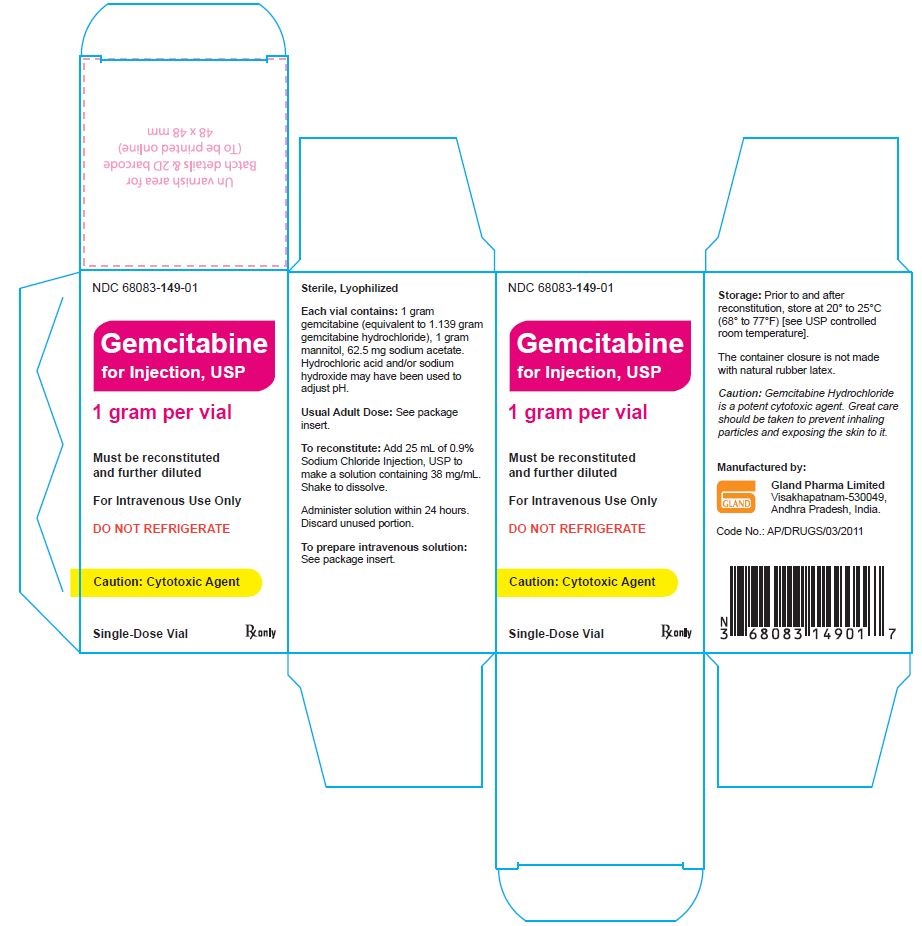
Gemcitabine-carton-label-1-g (Gemcitabine Carton Label 1 G)
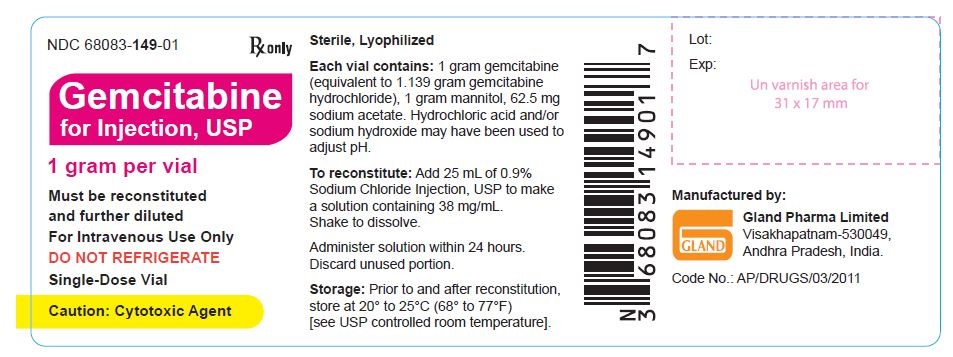
Gemcitabine is a cytotoxic agent that is available in a single-dose vial containing 1 gram of sterile, lyophilized powder. The vial must be reconstituted and diluted before intravenous use. The usual adult dose is specified in the package insert. The powder should be stored at 20-25°C and should not be refrigerated. Great care should be taken to prevent inhaling particles or exposing the skin to it. The manufacturer is Gland Pharma Limited based in India. NDC 68083-149-01.*
FDA Label Image

Gemcitabine-carton-label-200-mg (Gemcitabine Carton Label 200 mg)

Gemcitabine-carton-label-200-mg (Gemcitabine Carton Label 200 mg)
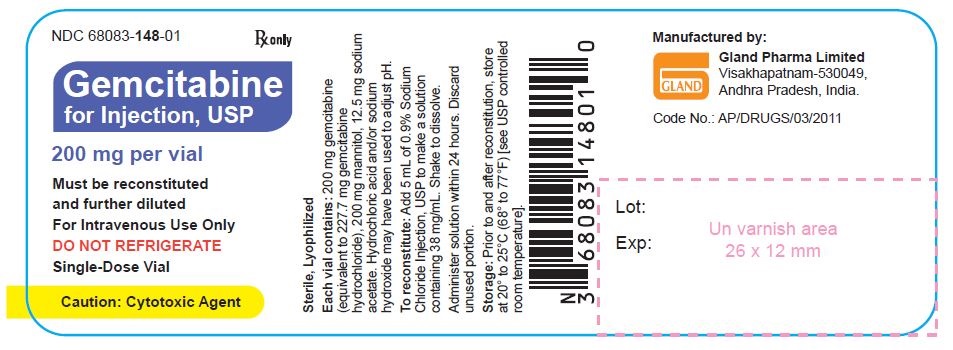
This is information about Gemcitabine, available in a single-dose vial containing 200mg of the drug, which must be reconstituted and diluted before administering intravenously within 24 hours. The drug should not be refrigerated and is a cytotoxic agent that requires careful handling to prevent inhalation or exposure to the skin. The vial contains 200mg of gemcitabine, 200mg mannitol, and 12.5mg sodium acetate. The usual adult dose details are provided in the package insert. The container closure is not made with natural rubber latex. The drug is made by Gland Pharma Limited in Visakhapatnam, India. Storage temperature requirements and code numbers are also provided.*
FDA Label Image

Gemcitabine-vial-label-1-g (Gemcitabine Vial Label 1 G)

Gemcitabine-vial-label-1-g (Gemcitabine Vial Label 1 G)
Beonly Gemcitabine for Injection, USP is a cytotoxic agent that comes in a sterile, lyophilized form in a 1 gram per vial. The vial must be reconstituted and further diluted with 0.9% Sodium Chioride Injection, USP to make a solution containing 38 mg/mL. This solution is for intravenous use only, and must not be refrigerated. Each vial contains 1 gram gemcitabine (equivalent to 1.139 gram gemcitabine hydrochoride), 1 gram mannitol, 62.5 mg sodium acetate. Hydrochloric acid and/or sodium hydroxide may have been used to adjust pH. Discard any unused portion and store the solution at 20° to 25°C (68° to 77°F) [see USP controlled room temperature]. NDC 68083-149-01 is manufactured by E Gland Pharma Limited in Andnra Pradesh, India.*
FDA Label Image

Gemcitabine-vial-label-200-mg (Gemcitabine Vial Label 200 mg)

Gemcitabine-vial-label-200-mg (Gemcitabine Vial Label 200 mg)
This is a product label of Gemcitabine for injection, USP manufactured by Gland Pharma Limited in Andhra Pradesh, India with a code number of AP/DRUGS/03/2011. Each vial contains 200 mg of Gemcitabine powder, which requires reconstitution and further dilution before intravenous use. The label warns not to refrigerate and states that it is a cytotoxic agent.*
FDA Label Image

Fig1 (Image1)

FDA Label Image

Fig2 (Image2)

Fig2 (Image2)
The text seems to be a part of a research study or clinical trial, comparing the efficacy of two treatments for cancer (Gemcitabine/Carboplatin and Carboplatin) in terms of progression-free survival. It gives the median progression-free survival of both treatments in months and mentions a log-rank p-value, indicating statistical significance. The text is not complete or clear enough to provide further information.*
FDA Label Image

Fig3 (Image3)

Fig3 (Image3)
This is a comparison of the efficacy of two drugs, Gemcitabine/Paclitaxel and Paclitaxel, in treating a documented disease progression. The study is based on a sample of 267 patients using Gemcitabine/Paclitaxel and 262 patients treated with Paclitaxel. The data suggests that patients treated with Gemcitabine/Paclitaxel had a longer time to documented disease progression of 5.2 months compared to Paclitaxel which was only 2.9 months. The log rank p-value was less than 0.0001, indicating that the difference in efficacy between the two drugs was significant.*
FDA Label Image

Fig4 (Image4)

FDA Label Image

Image5 (Image5)

* These product label images have been analyzed using experimental machine learning. Please verify findings with the primary label text.