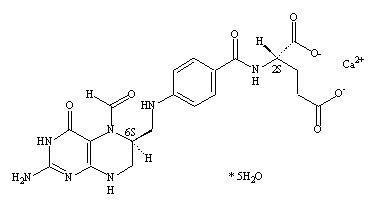
The recommendations for Levoleucovorin injection rescue are based on a methotrexate dose of 12 grams/m2 administered by intravenous infusion over 4 hours(see methotrexate package insert for full prescribing information).Levoleucovorin injection rescue at a dose of 7.5 mg(approximately 5 mg/m2)every 6 hours for 10 doses starts 24 hours after the beginning of the methotrexate infusion.
Serum creatinine and methotrexate levels should be determined at least once daily. Levoleucovorin injection administration, hydration, and urinary alkalinization (pH of 7.0 or greater) should be continued until the methotrexate level is below 5 x 10⁻⁸ M (0.05 micromolar). The Levoleucovorin injection dose should be adjusted or rescue extended based on the following guidelines.
Table 1 Guidelines for Levoleucovorin injection Dosage and Administration
Clinical Situation
| Laboratory Findings
| Levoleucovorin injection Dosage and Duration
|
Normal Methotrexate Elimination
| Serum methotrexate level approximately 10 micromolar at 24 hours after administration, 1 micromolar at 48 hours, and less than 0.2 micromolar at 72 hours
| 7.5 mg IV q 6 hours for 60 hours (10 doses starting at 24 hours after start of methotrexate infusion).
|
Delayed Late Methotrexate Elimination
| Serum methotrexate level remaining above 0.2 micromolar at 72 hours, and more than 0.05 micromolar at 96 hours after administration.
| Continue 7.5 mg IV q 6 hours, until methotrexate level is less than 0.05 micromolar.
|
Delayed Early Methotrexate Elimination and/or Evidence of Acute Renal Injury
| Serum methotrexate level of
50 micromolar or more at 24 hours, or 5 micromolar or more at 48 hours after administration, OR; a 100% or greater increase in serum creatinine level at 24 hours after methotrexate administration (e.g., an increase from 0.5 mg/dL to a level of 1 mg/dL or more).
| 75 mg IV q 3 hours until methotrexate level is less than 1 micromolar; then 7.5 mg IV q 3 hours until methotrexate level is less than 0.05 micromolar.
|
Patients who experience delayed early methotrexate elimination are likely to develop reversible renal failure. In addition to appropriate levoleucovorin injection therapy, these patients require continuing hydration and urinary alkalinization, and close monitoring of fluid and electrolyte status, until the serum methotrexate level has fallen to below 0.05 micromolar and the renal failure has resolved.
Some patients will have abnormalities in methotrexate elimination or renal function following methotrexate administration, which are significant but less severe than the abnormalities described in the table above. These abnormalities may or may not be associated with significant clinical toxicity. If significant clinical toxicity is observed, Levoleucovorin injection rescue should be extended for an additional 24 hours (total of 14 doses over 84 hours) in subsequent courses of therapy. The possibility that the patient is taking other medications which interact with methotrexate (e.g., medications which may interfere with methotrexate elimination or binding to serum albumin) should always be reconsidered when laboratory abnormalities or clinical toxicities are observed.
Delayed methotrexate excretion may be caused by accumulation in a third space fluid collection (i.e., ascites, pleural effusion), renal insufficiency, or inadequate hydration. Under such circumstances, higher doses of levoleucovorin injection or prolonged administration may be indicated.
Although levoleucovorin injection may ameliorate the hematologic toxicity associated with high-dose methotrexate, levoleucovorin injection has no effect on other established toxicities of methotrexate such as the nephrotoxicity resulting from drug and/or metabolite precipitation in the kidney.