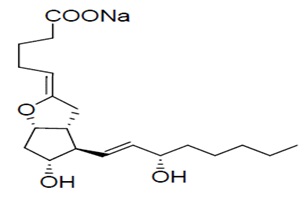
Acute Hemodynamic Effects: Acute intravenous infusions of epoprostenol for up to 15 minutes in patients with idiopathic or heritable PAH or PAH associated with scleroderma spectrum of diseases (PAH/SSD) produce dose-related increases in cardiac index (CI) and stroke volume (SV) and dose-related decreases in pulmonary vascular resistance (PVR), total pulmonary resistance (TPR), and mean systemic arterial pressure (SAPm). The effects of epoprostenol on mean pulmonary arterial pressure (PAPm) were variable and minor.
Chronic Infusion in Idiopathic or Heritable PAH:
Hemodynamic Effects: Chronic continuous infusions of epoprostenol in patients with idiopathic or heritable PAH were studied in 2 prospective, open, randomized trials of 8 and 12 weeks’ duration comparing epoprostenol plus conventional therapy to conventional therapy alone. Dosage of epoprostenol was determined as described in Dosage and Administration (2) and averaged 9.2 ng/kg/min at study's end. Conventional therapy varied among patients and included some or all of the following: anticoagulants in essentially all patients; oral vasodilators, diuretics, and digoxin in one half to two thirds of patients; and supplemental oxygen in about half the patients. Except for 2 New York Heart Association (NYHA) functional Class II patients, all patients were either functional Class III or Class IV. As results were similar in the 2 studies, the pooled results are described.
Chronic hemodynamic effects were generally similar to acute effects. Increases in CI, SV, and arterial oxygen saturation and decreases in PAPm, mean right atrial pressure (RAPm), TPR, and systemic vascular resistance (SVR) were observed in patients who received epoprostenol chronically compared to those who did not. Table 11 illustrates the treatment-related hemodynamic changes in these patients after 8 or 12 weeks of treatment.
Table 11: Hemodynamics during Chronic Administration of Epoprostenol in Patients with Idiopathic or Heritable PAH
Baseline
| Mean Change from Baseline at End of Treatment Period*
|
Hemodynamic
Parameter
| Epoprostenol
(N=52)
| Standard Therapy
(N=54)
| Epoprostenol
(N=48)
| Standard
Therapy
(N=41)
|
CI (L/min/m2)
| 2.0
| 2.0
| 0.3†
| -0.1
|
PAPm (mmHg)
| 60
| 60
| -5†
| 1
|
PVR (Wood U)
| 16
| 17
| -4†
| 1
|
SAPm (mmHg)
| 89
| 91
| -4
| -3
|
SV (mL/beat)
| 44
| 43
| 6†
| -1
|
TPR (Wood U)
| 20
| 21
| -5†
| 1
|
*At 8 weeks: Epoprostenol N=10, conventional therapy N=11 (N is the number of patients with hemodynamic data). At 12 weeks: Epoprostenol N=38, conventional therapy N=30 (N is the number of patients with hemodynamic data).
† Denotes statistically significant difference between Epoprostenol and conventional therapy groups.
CI=cardiac index, PAPm=mean pulmonary arterial pressure,
PVR=pulmonary vascular resistance, SAPm=mean systemic arterial pressure,
SV=stroke volume, TPR=total pulmonary resistance.
These hemodynamic improvements appeared to persist when epoprostenol was administered for at least 36 months in an open, nonrandomized study.
Clinical Effects: Statistically significant improvement was observed in exercise capacity, as measured by the 6-minute walk test in patients receiving continuous intravenous epoprostenol plus conventional therapy (N=52) for 8 or 12 weeks compared to those receiving conventional therapy alone (N=54). Improvements were apparent as early as the first week of therapy. Increases in exercise capacity were accompanied by statistically significant improvement in dyspnea and fatigue, as measured by the Chronic Heart Failure Questionnaire and the Dyspnea Fatigue Index.
Survival was improved in NYHA functional Class III and Class IV patients with idiopathic or heritable PAH treated with epoprostenol for 12 weeks in a multicenter, open, randomized, parallel study. At the end of the treatment period, 8 of 40 (20%) patients receiving conventional therapy alone died, whereas none of the 41 patients receiving epoprostenol died (p=0.003).
Chronic Infusion in PAH/Scleroderma Spectrum of Diseases (SSD)
Hemodynamic Effects: Chronic continuous infusions of epoprostenol in patients with PAH/SSD were studied in a prospective, open, randomized trial of 12 weeks' duration comparing epoprostenol plus conventional therapy (N=56) to conventional therapy alone (N=55). Except for 5 NYHA functional Class II patients, all patients were either functional Class III or Class IV. Dosage of epoprostenol was determined as described in Dosage and Administration (2) and averaged 11.2 ng/kg/min at study's end. Conventional therapy varied among patients and included some or all of the following: anticoagulants in essentially all patients, supplemental oxygen and diuretics in two thirds of the patients, oral vasodilators in 40% of the patients, and digoxin in a third of the patients. A statistically significant increase in CI, and statistically significant decreases in PAPm, RAPm, PVR, and SAPm after 12 weeks of treatment were observed in patients who received epoprostenol chronically compared to those who did not. Table 12 illustrates the treatment-related hemodynamic changes in these patients after 12 weeks of treatment.
Table 12: Hemodynamics during Chronic Administration of Epoprostenol in Patients with PAH/SSD
Baseline
| Mean Change from
Baseline at 12 Weeks
|
Hemodynamic
Parameter
| Epoprostenol
(N=56)
| Conventional
Therapy (N=55)
| Epoprostenol (N=50)
| Conventional
Therapy (N=48)
|
CI (L/min/m2)
| 1.9
| 2.2
| 0.5*
| -0.1
|
PAPm (mmHg)
| 51
| 49
| -5*
| 1
|
RAPm (mmHg) | 13
| 11
| -1*
| 1
|
PVR (Wood U)
| 14
| 11
| -5*
| 1
|
SAPm (mmHg)
| 93
| 89
| -8*
| -1
|
* Denotes statistically significant difference between Epoprostenol and conventional therapy groups (N is the number of patients with hemodynamic data).
CI=cardiac index, PAPm=mean pulmonary arterial pressure, RAPm=mean right atrial pressure,
PVR=pulmonary vascular resistance, SAPm=mean systemic arterial pressure.
Clinical Effects: Statistically significant improvement was observed in exercise capacity, as measured by the 6-minute walk, in patients receiving continuous intravenous epoprostenol plus conventional therapy for 12 weeks compared to those receiving conventional therapy alone. Improvements were apparent in some patients at the end of the first week of therapy. Increases in exercise capacity were accompanied by statistically significant improvements in dyspnea and fatigue, as measured by the Borg Dyspnea Index and Dyspnea Fatigue Index. At week 12, NYHA functional class improved in 21 of 51 (41%) patients treated with epoprostenol compared to none of the 48 patients treated with conventional therapy alone. However, more patients in both treatment groups (28/51 [55%] with epoprostenol and 35/48 [73%] with conventional therapy alone) showed no change in functional class, and 2/51 (4%) with epoprostenol and 13/48 (27%) with conventional therapy alone worsened. Of the patients randomized, NYHA functional class data at 12 weeks were not available for 5 patients treated with epoprostenol and 7 patients treated with conventional therapy alone.
No statistical difference in survival over 12 weeks was observed in PAH/SSD patients treated with epoprostenol as compared to those receiving conventional therapy alone. At the end of the treatment period, 4 of 56 (7%) patients receiving epoprostenol died, whereas 5 of 55 (9%) patients receiving conventional therapy alone died.
No controlled clinical trials with epoprostenol have been performed in patients with pulmonary hypertension associated with other diseases.