Conversion From Parenteral Morphine to Oral Morphine Sulfate: For conversion from parenteral to oral morphine sulfate, anywhere from 3 mg to 6 mg of oral morphine sulfate may be required to provide pain relief equivalent to 1 mg of parenteral morphine.
Conversion From Parenteral or Oral Non-Morphine Opioids to Oral Morphine Sulfate: In converting patients from other opioids to morphine sulfate, close observation and adjustment of dosage based upon the patient's response to morphine sulfate is imperative. Physicians and other healthcare professionals are advised to refer to published relative potency information, keeping in mind that conversion ratios are only approximate.
Conversion From Controlled-Release Oral Morphine to Oral Morphine Sulfate: For a given dose, the same total amount of morphine sulfate is available from Morphine Sulfate Oral Solution, Morphine Sulfate Tablets, and controlled-release and extended-release morphine capsules. The extended duration of release of morphine sulfate from controlled-release tablets or extended-release tablets results in reduced maximum and increased minimum plasma morphine sulfate concentrations than with shorter acting morphine sulfate products. Conversion from oral solution or immediate-release tablets to the same total daily dose of controlled-release tablets or extended-release tablets could lead to excessive sedation at peak serum levels. Therefore, dosage adjustment with close observation is necessary.
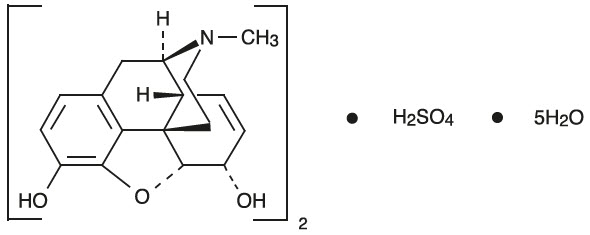
For the 10 mg per 5 mL or 20 mg per 5 mL strengths: Each 5 mL of clear/blue-green Morphine Sulfate Oral Solution contains morphine sulfate USP 10 mg or 20 mg. The concentration of the 10 mg per 5 mL solution is 2 mg/mL and the concentration of the 20 mg per 5 mL solution is 4 mg/mL.
For the 100 mg per 5 mL (20 mg/mL) strength: Each 5 mL of clear/colorless or clear/pink Morphine Sulfate Oral Solution contains morphine sulfate USP 100 mg. The concentration of these solutions is 20 mg/mL.
Effects on the Central Nervous System (CNS): The principal therapeutic action of morphine sulfate is analgesia. Other therapeutic effects of morphine sulfate include anxiolysis, euphoria and feelings of relaxation. Although the precise mechanism of the analgesic action is unknown, specific CNS opiate receptors and endogenous compounds with morphine sulfate-like activity have been identified throughout the brain and spinal cord and are likely to play a role in the expression and perception of analgesic effects. In common with other opioids, morphine sulfate causes respiratory depression, in part by a direct effect on the brainstem respiratory centers. Morphine sulfate and related opioids depress the cough reflex by direct effect on the cough center in the medulla.
Morphine sulfate causes miosis, even in total darkness.
Effects on the Gastrointestinal Tract and on Other Smooth Muscle: Gastric, biliary and pancreatic secretions are decreased by morphine sulfate. Morphine sulfate causes a reduction in motility and is associated with an increase in tone in the antrum of the stomach and duodenum. Digestion of food in the small intestine is delayed and propulsive contractions are decreased. Propulsive peristaltic waves in the colon are decreased, while tone is increased to the point of spasm. The end result may be constipation. Morphine sulfate can cause a marked increase in biliary tract pressure as a result of spasm of the sphincter of Oddi. Morphine sulfate may also cause spasm of the sphincter of the urinary bladder.
Effects on the Cardiovascular System: In therapeutic doses, morphine sulfate does not usually exert major effects on the cardiovascular system. Morphine sulfate produces peripheral vasodilation which may result in orthostatic hypotension and fainting. Release of histamine can occur, which may play a role in opioid-induced hypotension. Manifestations of histamine release and/or peripheral vasodilation may include pruritis, flushing, red eyes and sweating.
Endocrine System: Opioid agonists have been shown to have a variety of effects on the secretion of hormones. Opioids inhibit the secretion of ACTH, cortisol, and luteinizing hormone (LH) in humans. They also stimulate prolactin, growth hormone (GH) secretion, and pancreatic secretion of insulin and glucagon in humans and other species, rats and dogs. Thyroid stimulating hormone (TSH) has been shown to be both inhibited and stimulated by opioids.
Immune System: Opioids have been shown to have a variety of effects on components of the immune system in in vitro and animal models. The clinical significance of these findings is unknown.
Absorption: Morphine sulfate is about two-thirds absorbed from the gastrointestinal tract with the maximum analgesic effect occurring 60 minutes post-administration. The oral bioavailability of morphine sulfate is less than 40% and shows large inter-individual variability due to extensive pre-systemic metabolism.
Food Effects: Although the presence of a food effect was not assessed with morphine sulfate oral solution, significant food effect is not expected with a solution formulation.
Steady-State: Administration of the 30 mg Morphine Sulfate Tablet and 30 mg of Morphine Sulfate Oral Solution every six hours for 5 days resulted in a comparable 24-hour exposure (AUC). The steady-state levels were achieved within 48 hours for both tablets and solution. The mean steady state Cmax values were about 78 and 58 ng/mL for tablet and solution, respectively.
Distribution: Once absorbed, morphine sulfate is distributed to skeletal muscle, kidneys, liver, intestinal tract, lungs, spleen and brain. Although the primary site of action is the CNS, only small quantities cross the blood-brain barrier. Morphine sulfate also crosses the placental membranes and has been found in breast milk. The volume of distribution of morphine sulfate is approximately 1 to 6 L/kg, and morphine sulfate is 20 to 35% reversibly bound to plasma proteins.
Metabolism: The major pathway of morphine sulfate detoxification is conjugation, either with D-glucuronic acid to produce glucuronides or with sulfuric acid to produce morphine-3-etheral sulfate. While a small fraction (less than 5%) of morphine sulfate is demethylated, virtually all morphine sulfate is converted by hepatic metabolism to the 3- and 6-glucuronide metabolites (M3G and M6G; about 50% and 15%, respectively). M6G has been shown to have analgesic activity but crosses the blood-brain barrier poorly, while M3G has no significant analgesic activity.
Excretion: Most of a dose of morphine sulfate is excreted in urine as M3G and M6G, with elimination of morphine sulfate occurring primarily as renal excretion of M3G. Approximately 10% of the dose is excreted unchanged in urine. A small amount of glucuronide conjugates are excreted in bile, with minor enterohepatic recycling. Seven to 10% of administered morphine sulfate is excreted in the feces.
The mean adult plasma clearance is approximately 20 to 30 mL/min/kg. The effective terminal half-life of morphine sulfate after IV administration is reported to be approximately 2 hours. In some studies involving longer periods of plasma sampling, a longer terminal half-life of morphine sulfate of about 15 hours was reported.
Race: There may be some pharmacokinetic differences associated with race. In one published study, Chinese subjects given intravenous morphine sulfate had a higher clearance when compared to Caucasian subjects (1852 +/- 116 mL/min compared to 1495 +/- 80 mL/min).
Carcinogenesis: Studies in animals to evaluate the carcinogenic potential of morphine have not been conducted.
Mutagenesis: No formal studies to assess the mutagenic potential of morphine have been conducted. In the published literature, morphine was found to be mutagenic in vitro increasing DNA fragmentation in human T-cells. Morphine was reported to be mutagenic in the in vivo mouse micronucleus assay and positive for the induction of chromosomal aberrations in mouse spermatids and murine lymphocytes. Mechanistic studies suggest that the in vivo clastogenic effects reported with morphine in mice may be related to increases in glucocorticoid levels produced by morphine in this species. In contrast to the above positive findings, in vitro studies in the literature have also shown that morphine did not induce chromosomal aberrations in human leukocytes or translocations or lethal mutations in Drosophila.
Impairment of Fertility: No formal nonclinical studies to assess the potential of morphine to impair fertility have been conducted. Several nonclinical studies from the literature have demonstrated adverse effects on male fertility in the rat from exposure to morphine. One study in which male rats were administered morphine sulfate subcutaneously prior to mating (up to 30 mg/kg twice daily) and during mating (20 mg/kg twice daily) with untreated females, a number of adverse reproductive effects including reduction in total pregnancies, higher incidence of pseudopregnancies, and reduction in implantation sites were seen. Studies from the literature have also reported changes in hormonal levels (i.e. testosterone, luteinizing hormone, serum corticosterone) following treatment with morphine. These changes may be associated with the reported effects on fertility in the rat.
Morphine Sulfate Oral Solution
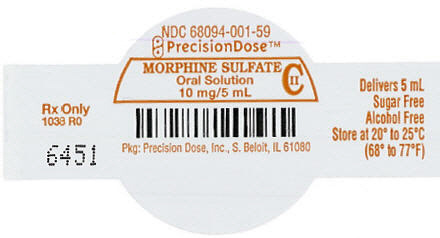
10 mg per 5 mL and 20 mg per 5 mL supplied as a clear blue-green solution available as follows:
10 mg per 5 mL Oral Solution
NDC 68094-001-62
5 mL per unit dose cup
Thirty (30) cups per shipper
100 mg per 5 mL supplied as a clear/colorless or clear/pink solution.
The clear/colorless solution is available in one strength as follows:
100 mg per 5 mL (20 mg/mL) Oral Solution (colorless formulation)
NDC 68094-754-58
0.5 mL per unit dose syringe
Fifty (50) syringes per shipper
NDC 68094-755-58
1 mL per unit dose syringe
Fifty (50) syringes per shipper
Distr. by:
West-Ward Pharmaceuticals Corp.
Eatontown, NJ 07724
Packaged by:
Precision Dose, Inc.
South Beloit, IL 61080
LI878 Rev. 03/17