Risk Summary
Limited available data with fenofibrate use in pregnant women are insufficient to determine a drug associated risk of major birth defects, miscarriage or adverse maternal or fetal outcomes. In animal reproduction studies, no evidence of embryo-fetal toxicity was observed with oral administration of fenofibrate in rats and rabbits during organogenesis at doses less than or equivalent to the maximum recommended clinical dose of 135 mg daily, based on body surface area (mg/m2). Adverse reproductive outcomes occurred at higher doses in the presence of maternal toxicity (see Data). Fenofibric acid tablets should be used during pregnancy only if the potential benefit justifies the potential risk to the fetus.
The estimated background risk of major birth defects and miscarriage for the indicated population is unknown. In the U.S. general population, the estimated background risk of major birth defects and miscarriage in clinically recognized pregnancies is 2-4% and 15-20%, respectively.
Data
Animal Data
In pregnant rats given oral dietary doses of 14, 127, and 361 mg/kg/day from gestation day 6-15 during the period of organogenesis, no adverse developmental findings were observed at 14 mg/kg/day (less than the clinical exposure at the maximum recommended human dose [MRHD] of 300 mg fenofibrate daily, equivalent to 135 mg daily, based on body surface area comparisons). Increased fetal skeletal malformations were observed at maternally toxic doses (361 mg/kg/day, corresponding to 12 times the clinical exposure at the MRHD) that significantly suppressed maternal body weight gain.
In pregnant rabbits given oral gavage doses of 15, 150, and 300 mg/kg/day from gestation day 6-18 during the period of organogenesis and allowed to deliver, no adverse developmental findings were observed at 15 mg/kg/day (a dose that approximates the clinical exposure at the MRHD, based on body surface area comparisons). Aborted litters were observed at maternally toxic doses (≥ 150 mg/kg/day, corresponding to ≥ 10 times the clinical exposure at the MRHD) that suppressed maternal body weight gain.
In pregnant rats given oral dietary doses of 15, 75, and 300 mg/kg/day from gestation day 15 through lactation day 21 (weaning), no adverse developmental effects were observed at 15 mg/kg/day (less than the clinical exposure at the MRHD, based on body surface area comparisons), despite maternal toxicity (decreased weight gain). Post-implantation loss was observed at ≥ 75 mg/kg/day (≥ 2 times the clinical exposure at the MRHD) in the presence of maternal toxicity (decreased weight gain). Decreased pup survival was noted at 300 mg/kg/day (10 times the clinical exposure at the MRHD), which was associated with decreased maternal body weight gain/maternal neglect.
Inactive Ingredients: Each tablet contains copovidone, crospovidone, magnesium stearate and microcrystalline cellulose.
Absorption
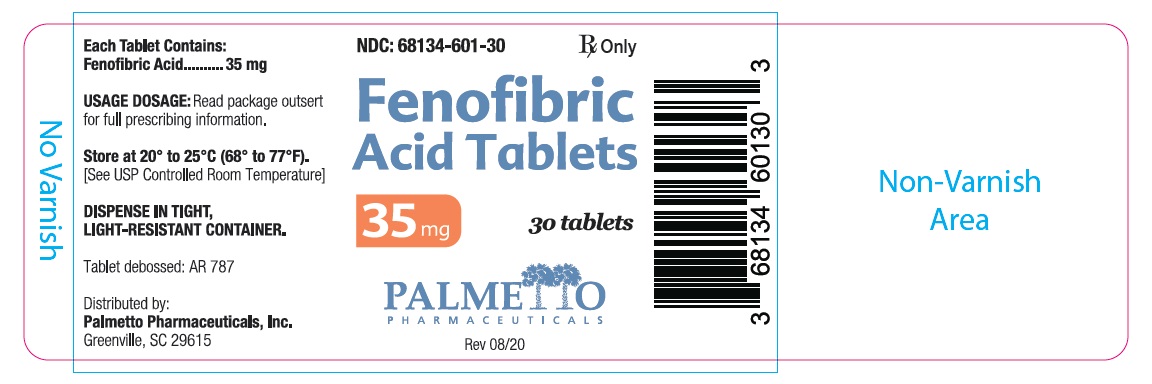
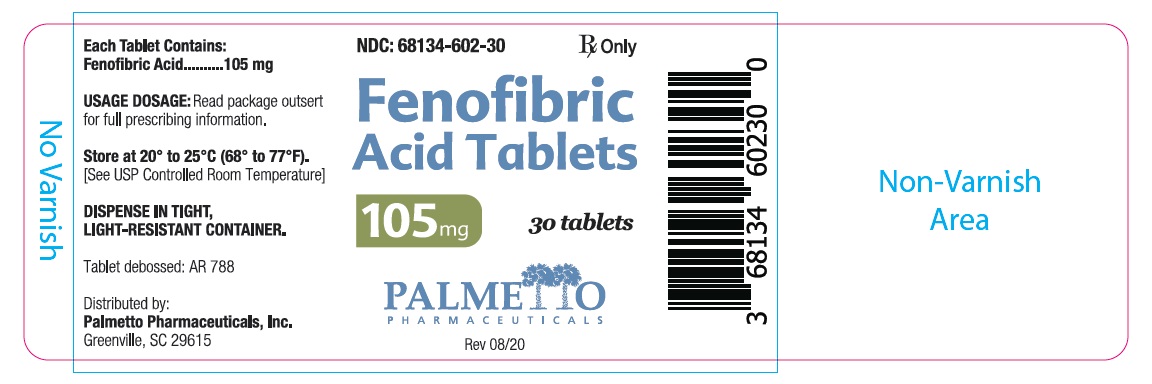
The absolute bioavailability of fenofibric acid tablets has not been determined as the compound is virtually insoluble in aqueous media suitable for injection. Following oral administration of fenofibric acid tablets in healthy volunteers, median peak plasma levels of fenofibric acid occur by approximately 2.5 hours after administration. Exposure after administration of 3 × 35 mg fenofibric acid tablets is comparable to 1 × 10⁵ mg fenofibric acid tablets.
A food-effect study involving administration of fenofibric acid tablets to healthy volunteers under fasting conditions and with a high-fat meal indicated that the Cmax was decreased by approximately 35% while the AUC remained unchanged. This decrease in exposure is not considered clinically significant, and therefore fenofibric acid tablets can be taken without regards to meals.
The extent and rate of absorption of fenofibric acid after administration of 105 mg fenofibric acid tablets are equivalent to those after administration of 145 mg fenofibrate tablets (TriCor®) under fasted conditions.
Distribution
Upon multiple dosing of fenofibrate, fenofibric acid steady state is achieved within 9 days. Plasma concentrations of fenofibric acid at steady state are slightly more than double those following a single dose. Serum protein binding was approximately 99% in normal and hyperlipidemic subjects.
Metabolism
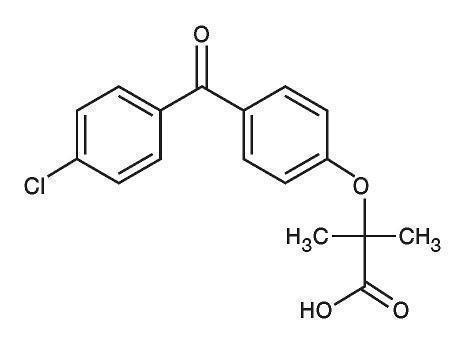
Fenofibric acid is primarily conjugated with glucuronic acid and then excreted in urine. A small amount of fenofibric acid is reduced at the carbonyl moiety to a benzhydrol metabolite which is, in turn, conjugated with glucuronic acid and excreted in urine.
In vitro and in vivo metabolism data indicate that fenofibric acid does not undergo oxidative metabolism (e.g. cytochrome P450) to a significant extent. The enzymes CYP1A2, CYP2A6, CYP2B6, CYP2C8, CYP2C9, CYP2C19, CYP2D6, CYP2E1, and CYP3A4 do not play a role in the metabolism of fenofibric acid.
Elimination
After absorption, fenofibric acid is eliminated with a half-life of approximately 20 hours, allowing once-daily dosing.
Specific Populations
Geriatrics: In five elderly volunteers 77 to 87 years of age, the oral clearance of fenofibric acid following a single oral dose of fenofibrate was 1.2 L/h, which compares to 1.1 L/h in young adults. This indicates that an equivalent dose of fenofibric acid tablets can be used in elderly subjects with normal renal function, without increasing accumulation of the drug or metabolites [see Use in Specific Populations (8.5) and Dosage and Administration (2.5)].
Pediatrics: The pharmacokinetics of fenofibric acid tablets has not been studied in pediatric populations.
Gender: No pharmacokinetic difference between males and females has been observed for fenofibrate.
Race: The influence of race on the pharmacokinetics of fenofibric acid has not been studied, however, fenofibric acid is not metabolized by enzymes known for exhibiting inter-ethnic variability.
Renal Impairment: The pharmacokinetics of fenofibric acid was examined in patients with mild, moderate, and severe renal impairment. Patients with severe renal impairment (Estimated glomerular filtration rate [eGFR]<30 mL/min/1.73m2) showed a 2.7-fold increase in exposure for fenofibric acid and increased accumulation of fenofibric acid during chronic dosing compared to that of healthy subjects. Patients with mild-to-moderate (eGFR 30 – 59 mL/min/1.73m2) renal impairment had similar exposure but an increase in the half-life for fenofibric acid compared to that of healthy subjects. Based on these findings, the use of fenofibric acid tablets should be avoided in patients who have severe renal impairment and dose reduction is required in patients with mild-to-moderate renal impairment.
Hepatic Impairment: No pharmacokinetic studies of fenofibric acid have been conducted in patients with hepatic impairment.
Drug-Drug Interactions: In vitro studies using human liver microsomes indicate that fenofibrate and fenofibric acid are not inhibitors of cytochrome (CYP) P450 isoforms CYP3A4, CYP2D6, CYP2E1, or CYP1A2. They are weak inhibitors of CYP2C8, CYP2C19 and CYP2A6, and mild-to-moderate inhibitors of CYP2C9 at therapeutic concentrations.
Table 2 describes the effects of co-administered drugs on fenofibric acid systemic exposure. Table 3 describes the effects of co-administered fenofibric acid on exposure to other drugs.
Table 2. Effects of Co-Administered Drugs on Fenofibric Acid Systemic Exposure from Fenofibric Acid Tablets or Fenofibrate Administration| Co-Administered Drug | Dosage Regimen of Co-Administered Drug | Dosage Regimen of Fenofibrate | Changes in Fenofibric Acid Exposure |
| AUC | Cmax |
| No dosing adjustment required for fenofibric acid tablets with the following co-administered drugs |
| Lipid-lowering agents |
| Atorvastatin | 20 mg once daily for 10 days | Fenofibrate 160 mg TriCor® (fenofibrate) oral tablet once daily for 10 days | ↓2% | ↓4% |
| Pravastatin | 40 mg as a single dose | Fenofibrate 3 × 67 mg
TriCor® (fenofibrate) oral micronized capsule as a single dose | ↓1% | ↓2% |
| Fluvastatin | 40 mg as a single dose | Fenofibrate 160 mg as a single dose | ↓2% | ↓10% |
| Anti-diabetic agents |
| Glimepiride | 1 mg as a single dose | Fenofibrate 145 mg once daily for 10 days | ↑1% | ↓1% |
| Metformin | 850 mg three times daily for 10 days | Fenofibrate 54 mg three times daily for 10 days | ↓9% | ↓6% |
| Rosiglitazone | 8 mg once daily for 5 days | Fenofibrate 145 mg once daily for 14 days | ↑10% | ↑3% |
Table 3. Effects of Fenofibric Acid Tablets or Fenofibrate Co-Administration on Systemic Exposure of Other Drugs| Dosage Regimen of Fenofibrate | Dosage Regimen of Co-Administered Drug | Change in Co-Administered Drug Exposure |
| Analyte | AUC | Cmax |
| No dosing adjustment required for these co-administered drugs with fenofibric acid tablets |
| Lipid-lowering agents |
| Fenofibrate 160 mg TriCor® (fenofibrate) oral tablet once daily for 10 days | Atorvastatin, 20 mg once daily for 10 days | Atorvastatin | ↓17% | 0% |
| Fenofibrate 3 × 67 mg
TriCor® (fenofibrate) oral micronized capsule as a single dose | Pravastatin, 40 mg as a single dose | Pravastatin | ↑13% | ↑13% |
| | 3α-hydroxyl-iso-pravastatin | ↑26% | ↑29% |
| Fenofibrate 160 mg once daily for 10 days | Pravastatin, 40 mg once daily for 10 days | Pravastatin | ↑28% | ↑36% |
| | 3α-hydroxyl-iso-pravastatin | ↑39% | ↑55% |
| Fenofibrate 160 mg as a single dose | Fluvastatin, 40 mg as a single dose | (+)-3R, 5S-Fluvastatin | ↑15% | ↑16% |
| Anti-diabetic agents |
| Fenofibrate 145 mg once daily for 10 days | Glimepiride, 1 mg as a single dose | Glimepiride | ↑35% | ↑18% |
| Fenofibrate 54 mg three times daily for 10 days | Metformin, 850 mg three times daily for 10 days | Metformin | ↑3% | ↑6% |
| Fenofibrate 145 mg once daily for 14 days | Rosiglitazone, 8 mg once daily for 5 days | Rosiglitazone | ↑6% | ↓1% |
| Anti-viral agents |
| Fenofibric acid tablets 105 mg once daily for 10 days | Efavirenz, 600 mg as a single dose | Efavirenz | ↓8% | ↑1% |
Two dietary carcinogenicity studies have been conducted in rats with fenofibrate. In the first 24-month study, Wistar rats were dosed with fenofibrate at 10, 45, and 200 mg/kg/day, approximately 0.3, 1, and 6 times the maximum recommended human dose (MRHD) of 300 mg fenofibrate daily, equivalent to 105 mg of fenofibric acid tablets daily, based on body surface area comparisons. At a dose of 200 mg/kg/day (at 6 times the MRHD), the incidence of liver carcinomas was significantly increased in both sexes. A statistically significant increase in pancreatic carcinomas was observed in males at 1 and 6 times the MRHD; an increase in pancreatic adenomas and benign testicular interstitial cell tumors was observed at 6 times the MRHD in males. In a second 24-month rat carcinogenicity study in a different strain of rats (Sprague-Dawley), doses of 10 and 60 mg/kg/day (0.3 and 2 times the MRHD) produced significant increases in the incidence of pancreatic acinar adenomas in both sexes and increases in testicular interstitial cell tumors in males at 2 times the MRHD.
A 117-week carcinogenicity study was conducted in rats comparing three drugs: fenofibrate 10 and 60 mg/kg/day (0.3 and 2 times the MRHD, based on body surface area comparisons), clofibrate (400 mg/kg/day; 2 times the human dose), and gemfibrozil (250 mg/kg/day; 2 times the human dose, based on mg/m2 surface area). Fenofibrate increased pancreatic acinar adenomas in both sexes. Clofibrate increased hepatocellular carcinoma and pancreatic acinar adenomas in males and hepatic neoplastic nodules in females. Gemfibrozil increased hepatic neoplastic nodules in males and females, while all three drugs increased testicular interstitial cell tumors in males.
In a 21-month study in CF-1 mice, fenofibrate 10, 45, and 200 mg/kg/day (approximately 0.2, 1, and 3 times the MRHD, based on body surface area comparisons) significantly increased the liver carcinomas in both sexes at 3 times the MRHD. In a second 18-month study at 10, 60, and 200 mg/kg/day, fenofibrate significantly increased the liver carcinomas in male mice and liver adenomas in female mice at 3 times the MRHD.
Electron microscopy studies have demonstrated peroxisomal proliferation following fenofibrate administration to the rat. An adequate study to test for peroxisome proliferation in humans has not been done, but changes in peroxisome morphology and numbers have been observed in humans after treatment with other members of the fibrate class when liver biopsies were compared before and after treatment in the same individual.
Fenofibrate has been demonstrated to be devoid of mutagenic potential in the following tests: Ames, mouse lymphoma, chromosomal aberration and unscheduled DNA synthesis in primary rat hepatocytes.
In fertility studies rats were given oral dietary doses of fenofibrate, males received 61 days prior to mating and females 15 days prior to mating through weaning which resulted in no adverse effect on fertility at doses up to 300 mg/kg/day (10 times the MRHD, based on body surface area comparisons).
TriCor® is a registered trademark of Abbott Laboratories.
Manufactured for: | Palmetto Pharmaceuticals, Inc. |
| Greenville, SC 29615 |
Revised 09/2019