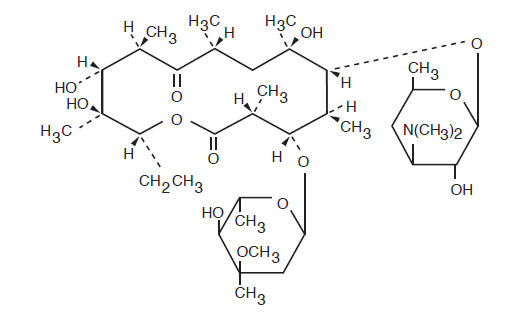
To reduce the development of drug-resistant bacteria and maintain the effectiveness of ERY-TAB and other antibacterial drugs, ERY-TAB should be used only to treat or prevent infections that are proven or strongly suspected to be caused by susceptible bacteria. When culture and susceptibility information are available, they should be considered in selecting or modifying antibacterial therapy. In the absence of such data, local epidemiology and susceptibility patterns may contribute to the empiric selection of therapy.
®®
ERY-TAB tablets are indicated in the treatment of infections caused by susceptible strains of the designated microorganisms in the diseases listed below:
®
Upper respiratory tract infections of mild to moderate degree caused by ; ; (when used concomitantly with adequate doses of sulfonamides, since many strains of are not susceptible to the erythromycin concentrations ordinarily achieved). (See appropriate sulfonamide labeling for prescribing information.)
Streptococcus pyogenesStreptococcus pneumoniaeHaemophilus influenzaeH. influenzae
Lower respiratory tract infections of mild to moderate severity caused by or .
Streptococcus pyogenesStreptococcus pneumoniae
Listeriosis caused by .
Listeria monocytogenes
Respiratory tract infections due to .
Mycoplasma pneumoniae
Skin and skin structure infections of mild to moderate severity caused by or (resistant staphylococci may emerge during treatment).
Streptococcus pyogenesStaphylococcus aureus
Pertussis (whooping cough) caused by . Erythromycin is effective in eliminating the organism from the nasopharynx of infected individuals, rendering them noninfectious. Some clinical studies suggest that erythromycin may be helpful in the prophylaxis of pertussis in exposed susceptible individuals.
Bordetella pertussis
Diphtheria: Infections due to , as an adjunct to antitoxin, to prevent establishment of carriers and to eradicate the organism in carriers.
Corynebacterium diphtheriae
Erythrasma: In the treatment of infections due to .
Corynebacterium minutissimum
Intestinal amebiasis caused by (oral erythromycins only). Extraenteric amebiasis requires treatment with other agents.
Entamoeba histolytica
Acute pelvic inflammatory disease caused by : Erythrocin Lactobionate-I.V. (erythromycin lactobionate for injection, USP) followed by erythromycin base orally, as an alternative drug in treatment of acute pelvic inflammatory disease caused by in female patients with a history of sensitivity to penicillin. Patients should have a serologic test for syphilis before receiving erythromycin as treatment of gonorrhea and a follow-up serologic test for syphilis after 3 months.
Neisseria gonorrhoeae®N. gonorrhoeae
Erythromycins are indicated for treatment of the following infections caused by : conjunctivitis of the newborn, pneumonia of infancy, and urogenital infections during pregnancy. When tetracyclines are contraindicated or not tolerated, erythromycin is indicated for the treatment of uncomplicated urethral, endocervical, or rectal infections in adults due to .
Chlamydia trachomatisChlamydia trachomatis
When tetracyclines are contraindicated or not tolerated, erythromycin is indicated for the treatment of nongonococcal urethritis caused by .
Ureaplasma urealyticum
Primary syphilis caused by . Erythromycin (oral forms only) is an alternative choice of treatment for primary syphilis in patients allergic to the penicillins. In treatment of primary syphilis, spinal fluid should be examined before treatment and as part of the follow-up after therapy.
Treponema pallidum
Legionnaires' Disease caused by . Although no controlled clinical efficacy studies have been conducted, and limited preliminary clinical data suggest that erythromycin may be effective in treating Legionnaires' Disease.
Legionella pneumophilain vitro