Other
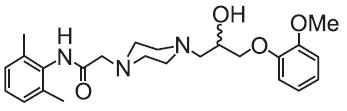
Ranolazine extended-release tablets are indicated for the treatment of chronic angina.
Ranolazine extended-release tablets may be used with beta-blockers, nitrates, calcium channel blockers, anti-platelet therapy, lipid-lowering therapy, ACE inhibitors, and angiotensin receptor blockers.
Ranolazine extended-release tablets are supplied as film-coated, oval-shaped, extended-release tablets in the following strengths:
- 500 mg tablets are orange, debossed with "L31" on one side and "LU" on other side
- 1000 mg tablets are yellow, debossed with "L32" on one side and "LU" on other side
- Taking strong inhibitors of CYP3A [see DRUG INTERACTIONS (7.1)]
- Taking inducers of CYP3A [see DRUG INTERACTIONS (7.1)]
- With liver cirrhosis [see USE IN SPECIFIC POPULATIONS (8.6)]
- 500 mg tablets are orange, debossed with "L31" on one side and "LU" on other side
- 1000 mg tablets are yellow, debossed with "L32" on one side and "LU" on other side
- Inform patients that ranolazine extended-release tablets should not be used with drugs that are strong CYP3A inhibitors (e.g., ketoconazole, clarithromycin, nefazodone, ritonavir) [(see CONTRAINDICATIONS (4), DRUG INTERACTIONS (7.1)].
- Inform patients that ranolazine extended-release tablets should not be used with drugs that are inducers of CYP3A (e.g., rifampin, rifabutin, rifapentine, barbiturates, carbamazepine, phenytoin, St. John's wort) [(see CONTRAINDICATIONS (4), DRUG INTERACTIONS (7.1)].
- Inform patients that ranolazine extended-release tablets should not be used in patients with liver cirrhosis [(see CONTRAINDICATIONS (4), USE IN SPECIFIC POPULATIONS (8.6)].
- Advise patients to inform their physician if they are receiving drugs that are moderate CYP3A inhibitors (e.g., diltiazem, verapamil, erythromycin) [see DRUG INTERACTIONS (7)].
- Advise patients to inform their physician if they are receiving drugs that are P-gp inhibitors (e.g., cyclosporine) [see DRUG INTERACTIONS (7)].
- Advise patients to limit grapefruit juice or grapefruit products when taking ranolazine extended-release tablets [see DRUG INTERACTIONS (7)].
- Inform patients that ranolazine extended-release tablets may produce changes in the electrocardiogram (QTc interval prolongation) [see WARNINGS AND PRECAUTIONS (5.1)].
- Advise patients to inform their physician of any personal or family history of QTc prolongation, congenital long QT syndrome, or if they are receiving drugs that prolong the QTc interval such as Class Ia (e.g., quinidine) or Class III (e.g., dofetilide, sotalol, amiodarone) antiarrhythmic agents, erythromycin, and certain antipsychotics (e.g., thioridazine, ziprasidone) [see WARNINGS AND PRECAUTIONS (5.1)].
- Inform patients that ranolazine extended-release tablets may cause dizziness and lightheadedness. Patients should know how they react to ranolazine extended-release tablets before they operate an automobile or machinery, or engage in activities requiring mental alertness or coordination [see ADVERSE REACTIONS (6.1)]
- Advise patients to contact their physician if they experience fainting spells while taking ranolazine extended-release tablets.
- Instruct patients to swallow ranolazine extended-release tablets whole, with or without meals, and not to crush, break, or chew tablets. Inform patients that if a dose is missed, to take the usual dose at the next scheduled time. The next dose should not be doubled. Inform patients that doses of ranolazine extended-release tablets higher than 1000 mg twice daily should not be used [see DOSAGE AND ADMINISTRATION (2)].
- Advise patients to inform their physician of any other medications taken concurrently with ranolazine extended-release tablets, including over-the-counter medications.
Ranolazine is contraindicated in patients:
Ranolazine extended-release tablets are supplied as film-coated, oval-shaped, extended-release tablets in the following strengths:
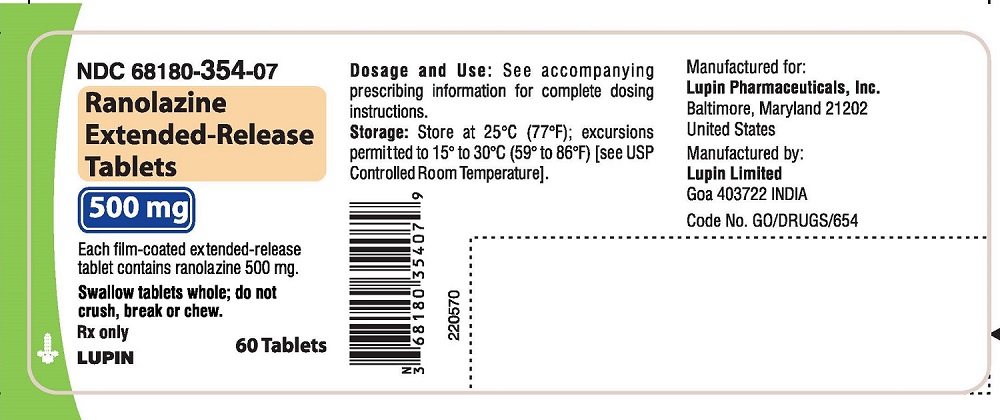
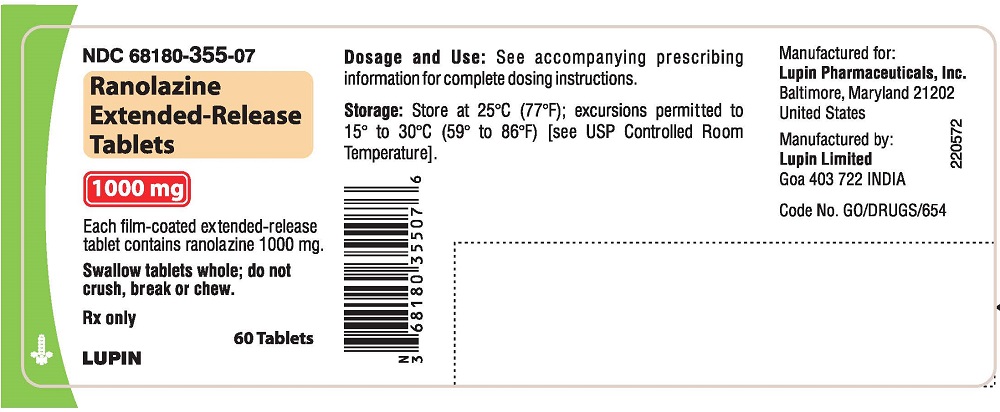
Ranolazine extended-release tablets are available in:
| Strength | NDC Code | |
| Bottles of 60 | 500 mg | 68180-354-07 |
| Bottles of 500 | 500 mg | 68180-354-02 |
| Bottles of 60 | 1000 mg | 68180-355-07 |
| Bottles of 500 | 1000 mg | 68180-355-02 |
Store at 25°C (77°F); excursions permitted to 15° to 30°C (59° to 86°F) [see USP Controlled Room Temperature].
Advise the patient to read the FDA-approved patient labeling (Patient Information).
Inform patients that ranolazine extended-release tablets will not abate an acute angina episode.
Strong CY3PA Inhibitors, CYP3A Inducers, Liver Cirrhosis
Moderate CYP3A Inhibitors, P-gp Inhibitors, Grapefruit Products
QT Interval Prolongation
Use in Patients with Renal Impairment
Patients with severe renal impairment may be at risk of renal failure while on ranolazine extended-release tablets. Advise patients to inform their physician if they have impaired renal function before or while taking ranolazine extended-release tablets [see WARNINGS AND PRECAUTIONS (5.2)].
Dizziness, Fainting
Administration
Residual Inert Matrix Tablet
Patients receiving ranolazine extended-release tablets may notice an inert matrix passing in the stool. Patients should be informed that the active medication has already been absorbed by the time the patient sees the inert matrix tablet.
Manufactured for:
Lupin Pharmaceuticals, Inc.
Baltimore, Maryland 21202
United States
Manufactured by:
Lupin Limited
Goa - 403 722
INDIA.
Revised: October 2020 ID#: 266269