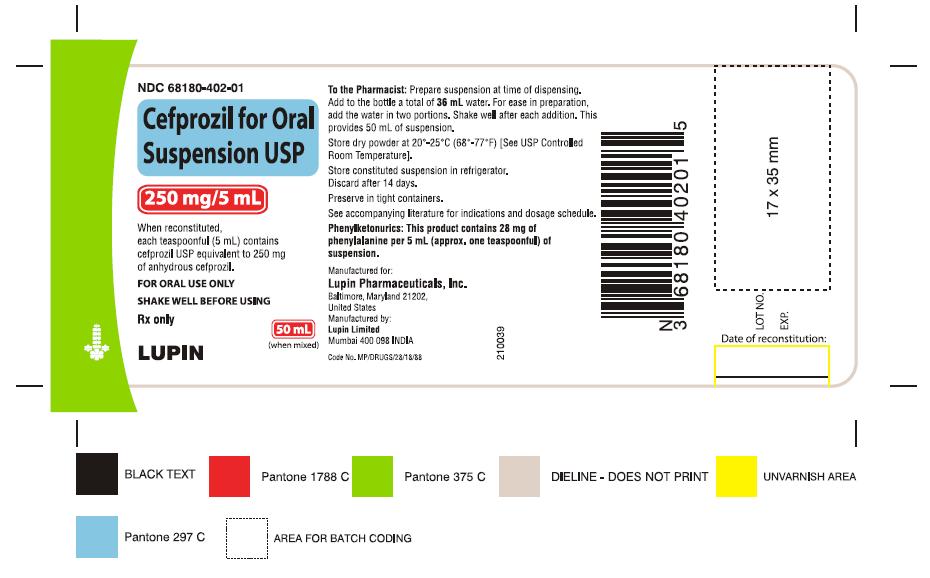
Other
To reduce the development of drug-resistant bacteria and maintain the effectiveness of cefprozil for oral suspension and other antibacterial drugs, cefprozil for oral suspension should be used only to treat or prevent infections that are proven or strongly suspected to be caused by bacteria.
Cefprozil is a semi-synthetic broad-spectrum cephalosporin antibiotic.
Cefprozil is a cis and trans isomeric mixture (≥90% cis). The chemical name for the monohydrate is (6R,7R)-7-[(R)-2-Amino-2-(p-hydroxyphenyl)acetamido]-8-oxo-3-propenyl-5-thia-1-azabicyclo[4.2.0]oct-2-ene-2-carboxylic acid monohydrate, and the structural formula is:
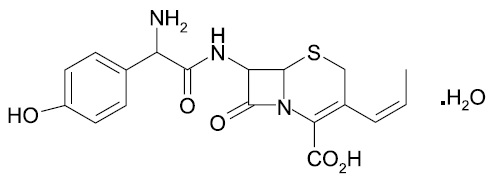
Image (396227ec 84a8 48c7 9f12 59eb0dd2b40f 01)
Cefprozil is a white to yellowish powder with a molecular formula for the monohydrate of C18H19N3O5S.H2O and a molecular weight of 407.45.
Cefprozil for oral suspension is intended for oral administration.
Cefprozil for oral suspension contains cefprozil equivalent to 125 mg or 250 mg of anhydrous cefprozil per 5 mL constituted suspension. In addition, the oral suspension contains the following inactive ingredients: aspartame, bubble gum flavor, anhydrous citric acid, colloidal silicon dioxide, FD&C Red No. 40 Aluminum Lake, glycine, microcrystalline cellulose and sodium carboxymethylcellulose, sodium benzoate, sodium chloride and sucrose.
The pharmacokinetic data were derived from the capsule formulation; however, bioequivalence has been demonstrated for the oral solution, capsule, tablet, and suspension formulations under fasting conditions.
Following oral administration of cefprozil to fasting subjects, approximately 95% of the dose was absorbed. The average plasma half-life in normal subjects was 1.3 hours, while the steady-state volume of distribution was estimated to be 0.23 L/kg. The total body clearance and renal clearance rates were approximately 3 mL/min/kg and 2.3 mL/min/kg, respectively.
Average peak plasma concentrations after administration of 250 mg, 500 mg, or 1 g doses of cefprozil to fasting subjects were approximately 6.1, 10.5, and 18.3 mcg/mL, respectively, and were obtained within 1.5 hours after dosing. Urinary recovery accounted for approximately 60% of the administered dose. (See Table.)
| Dosage (mg) | Mean Plasma Cefprozil Concentrations (mcg/mL) Data represent mean values of 12 healthy volunteers. | 8 hour Urinary Excretion (%) | ||
| Peak appx.1.5 h | 4 h | 8 h | ||
| 250 mg | 6.1 | 1.7 | 0.2 | 60% |
| 500 mg | 10.5 | 3.2 | 0.4 | 62% |
| 1000 mg | 18.3 | 8.4 | 1.0 | 54% |
During the first 4-hour period after drug administration, the average urine concentrations following 250 mg, 500 mg, and 1 g doses were approximately 700 mcg/mL, 1000 mcg/mL, and 2900 mcg/mL, respectively.
Administration of cefprozil with food did not affect the extent of absorption (AUC) or the peak plasma concentration (Cmax) of cefprozil. However, there was an increase of 0.25 to 0.75 hours in the time to maximum plasma concentration of cefprozil (Tmax).
The bioavailability of the capsule formulation of cefprozil was not affected when administered 5 minutes following an antacid.
Plasma protein binding is approximately 36% and is independent of concentration in the range of 2 mcg/mL to 20 mcg/mL.
There was no evidence of accumulation of cefprozil in the plasma in individuals with normal renal function following multiple oral doses of up to 1000 mg every 8 hours for 10 days.
In patients with reduced renal function, the plasma half-life may be prolonged up to 5.2 hours depending on the degree of the renal dysfunction. In patients with complete absence of renal function, the plasma half-life of cefprozil has been shown to be as long as 5.9 hours. The half-life is shortened during hemodialysis. Excretion pathways in patients with markedly impaired renal function have not been determined. (See PRECAUTIONS and DOSAGE AND ADMINISTRATION.)
In patients with impaired hepatic function, the half-life increases to approximately 2 hours. The magnitude of the changes does not warrant a dosage adjustment for patients with impaired hepatic function.
Healthy geriatric volunteers (≥65years old) who received a single 1 g dose of cefprozil had 35% to 60% higher AUC and 40% lower renal clearance values compared with healthy adult volunteers 20 to 40 years of age. The average AUC in young and elderly female subjects was approximately 15% to 20% higher than in young and elderly male subjects. The magnitude of these age- and gender-related changes in the pharmacokinetics of cefprozil is not sufficient to necessitate dosage adjustments.
Adequate data on CSF levels of cefprozil are not available.
Comparable pharmacokinetic parameters of cefprozil are observed between pediatric patients (6 months to 12 years) and adults following oral administration of selected matched doses. The maximum concentrations are achieved at 1to 2 hours after dosing. The plasma elimination half-life is approximately 1.5 hours. In general, the observed plasma concentrations of cefprozil in pediatric patients at the 7.5, 15, and 30 mg/kg doses are similar to those observed within the same time frame in normal adult subjects at the 250, 500, and 1000 mg doses, respectively. The comparative plasma concentrations of cefprozil in pediatric patients and adult subjects at the equivalent dose level are presented in the table below.
| Mean (SD) Plasma Cefprozil Concentrations (mcg/mL) | ||||||
an=11 bn=5 cn=9 dn=11 | ||||||
| Population | Dose | 1 h | 2 h | 4 h | 6 h | T½ (h) |
| children (n=18) | 7.5 mg/kg | 4.70 (1.57) | 3.99 (1.24) | 0.91 (0.30) | 0.23 a (0.13) | 0.94 (0.32) |
| adults (n=12) | 250 mg | 4.82 (2.13) | 4.92 (1.13) | 1.70b (0.53) | 0.53 (0.17) | 1.28 (0.34) |
| children (n=19) | 15 mg/kg | 10.86 (2.55) | 8.47 (2.03) | 2.75 (1.07) | 0.61c (0.27) | 1.24 (0.43) |
| adults (n=12) | 500 mg | 8.39 (1.95) | 9.42 (0.98) | 3.18d (0.76) | 1.00d (0.24) | 1.29 (0.14) |
| children (n=10) | 30 mg/kg | 16.69 (4.26) | 17.61 (6.39) | 8.66 (2.70) | -- | 2.06 (0.21) |
| adults (n=12) | 1000 mg | 11.99 (4.67) | 16.95 (4.07) | 8.36 (4.13) | 2.79 (1.77) | 1.27 (0.12) |
Cefprozil for oral suspension is indicated for the treatment of patients with mild to moderate infections caused by susceptible strains of the designated microorganisms in the conditions listed below:
Cefprozil is contraindicated in patients with known allergy to the cephalosporin class of antibiotics.
BEFORE THERAPY WITH CEFPROZIL IS INSTITUTED, CAREFUL INQUIRY SHOULD BE MADE TO DETERMINE WHETHER THE PATIENT HAS HAD PREVIOUS HYPERSENSITIVITY REACTIONS TO CEFPROZIL, CEPHALOSPORINS, PENICILLINS, OR OTHER DRUGS. IF THIS PRODUCT IS TO BE GIVEN TO PENICILLIN-SENSITIVE PATIENTS, CAUTION SHOULD BE EXERCISED BECAUSE CROSS-SENSITIVITY AMONG ß-LACTAM ANTIBIOTICS HAS BEEN CLEARLY DOCUMENTED AND MAY OCCUR IN UP TO 10% OF PATIENTS WITH A HISTORY OF PENICILLIN ALLERGY. IF AN ALLERGIC REACTION TO CEFPROZIL OCCURS, DISCONTINUE THE DRUG. SERIOUS ACUTE HYPERSENSITIVITY REACTIONS MAY REQUIRE TREATMENT WITH EPINEPHRINE AND OTHER EMERGENCY MEASURES, INCLUDING OXYGEN, INTRAVENOUS FLUIDS, INTRAVENOUS ANTIHISTAMINES, CORTICOSTEROIDS, PRESSOR AMINES, AND AIRWAY MANAGEMENT, AS CLINICALLY INDICATED.
Clostridium difficile associated diarrhea (CDAD) has been reported with use of nearly all antibacterial agents, including cefprozil, and may range in severity from mild diarrhea to fatal colitis. Treatment with antibacterial agents alters the normal flora of the colon leading to overgrowth of C. difficile.
C. difficile produces toxins A and B which contribute to the development of CDAD. Hypertoxin-producing strains of C. difficile cause increased morbidity and mortality, as these infections can be refractory to antimicrobial therapy and may require colectomy. CDAD must be considered in all patients who present with diarrhea following antibiotic use. Careful medical history is necessary since CDAD has been reported to occur over two months after the administration of antibacterial agents.
If CDAD is suspected or confirmed, ongoing antibiotic use not directed against C. difficile may need to be discontinued. Appropriate fluid and electrolyte management, protein supplementation, antibiotic treatment of C. difficile, and surgical evaluation should be instituted as clinically indicated.
The adverse reactions to cefprozil are similar to those observed with other orally administered cephalosporins. Cefprozil was usually well tolerated in controlled clinical trials. Approximately 2% of patients discontinued cefprozil therapy due to adverse events.
The most common adverse effects observed in patients treated with cefprozil are:
Manufactured for: Manufactured by
Lupin Pharmaceuticals, Inc. Lupin Limited
Baltimore, Maryland 21202 Mandideep 462046
United States INDIA
Revised: January 2017 ID#: 250341