Other
Donepezil hydrochloride tablet is indicated for the treatment of dementia of the Alzheimer's type. Efficacy has been demonstrated in patients with mild, moderate, and severe Alzheimer's disease.
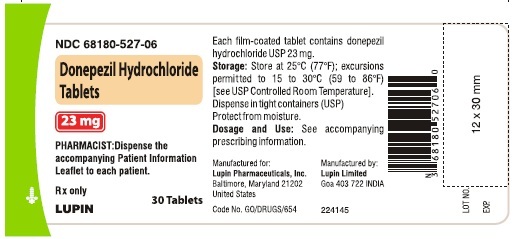
Donepezil hydrochloride tablets are supplied as film-coated, round tablets containing 23 mg of donepezil hydrochloride.
Donepezil hydrochloride tablets, 23 mg are reddish brown, round, film coated tablets debossed with 'G52' on one side and 'LU' on the other side.
Donepezil hydrochloride is contraindicated in patients with known hypersensitivity to donepezil hydrochloride or to piperidine derivatives.
The following serious adverse reactions are described below and elsewhere in the labeling:
- Cardiovascular Conditions [see Warnings and Precautions (5.2) ].
- Nausea and Vomiting [see Warnings and Precautions (5.3) ].
- Peptic Ulcer Disease and GI Bleeding [see Warnings and Precautions (5.4) ].
- Weight Loss [see Warnings and Precautions (5.5) ].
- Genitourinary Conditions [see Warnings and Precautions (5.6) ].
- Neurological Conditions: Seizures [see Warnings and Precautions (5.7) ].
- Pulmonary Conditions [see Warnings and Precautions (5.8) ].
- surgery
- medical procedures
- dental surgery or procedures.
- Give donepezil hydrochloride tablets exactly as prescribed by the doctor. Do not stop donepezil hydrochloride tablets or change the dose yourself. Talk with the doctor first.
- Give donepezil hydrochloride tablets one time each day. Donepezil hydrochloride tablets can be taken with or without food.
- Donepezil hydrochloride 23 mg tablets should be swallowed whole without the tablets being split, crushed, or chewed.
- If you miss giving the patient a dose of donepezil hydrochloride tablets, just wait. Give only the next dose at the usual time. Do not give 2 doses at the same time.
- If donepezil hydrochloride tablet is missed for 7 days or more, talk with the doctor before starting again.
- If the patient takes too much donepezil hydrochloride tablets at one time, call the doctor or poison control center, or go to the emergency room right away.
- slow heartbeat and fainting. This happens more often in people with heart problems. Call the doctor right away if the patient faints while taking donepezil hydrochloride tablets.
- more stomach acid. This raises the chance of ulcers and bleeding, especially when taking donepezil hydrochloride tablets 23 mg. The risk is higher for patients who had ulcers, or take aspirin or other NSAIDs.
- worsening of lung problems in people with asthma or other lung disease.
- seizures.
- difficulty passing urine.
- fainting.
- heartburn or stomach pain that is new or won't go away.
- nausea or vomiting, blood in the vomit, dark vomit that looks like coffee grounds.
- bowel movements or stools that look like black tar.
- new or worse asthma or breathing problems.
- seizures.
- difficulty passing urine.
- anausea
- diarrhea
- not sleeping well
- vomiting
- muscle cramps
- feeling tired
- not wanting to eat
Table 3 lists adverse reactions that occurred in at least 2% of patients in pooled placebo-controlled trials who received either donepezil hydrochloride 5 mg or 10 mg and for which the rate of occurrence was greater for patients treated with donepezil hydrochloride than with placebo. In general, adverse reactions occurred more frequently in female patients and with advancing age.
| Table 3. Adverse Reactions in Pooled Placebo-Controlled Clinical Trials in Mild to Moderate Alzheimer’s Disease | ||
| Adverse Reaction | Placebo (n=355) % | Donepezil Hydrochloride (n=747) % |
| Percent of Patients with any Adverse Reaction | 72 | 74 |
| Nausea | 6 | 11 |
| Diarrhea | 5 | 10 |
| Headache | 9 | 10 |
| Insomnia | 6 | 9 |
| Pain, various locations | 8 | 9 |
| Dizziness | 6 | 8 |
| Accident | 6 | 7 |
| Muscle Cramps | 2 | 6 |
| Fatigue | 3 | 5 |
| Vomiting | 3 | 5 |
| Anorexia | 2 | 4 |
| Ecchymosis | 3 | 4 |
| Abnormal Dreams | 0 | 3 |
| Depression | <1 | 3 |
| Weight Loss | 1 | 3 |
| Arthritis | 1 | 2 |
| Frequent Urination | 1 | 2 |
| Somnolence | <1 | 2 |
| Syncope | 1 | 2 |
Severe Alzheimer's Disease (Donepezil Hydrochloride 5mg/day and 10 mg/day)
Donepezil hydrochloride has been administered to over 600 patients with severe Alzheimer's disease during clinical trials of at least 6 months duration, including three double-blind, placebo-controlled trials, two of which had an open label extension.
Adverse Reactions Leading to Discontinuation:
The rates of discontinuation from controlled clinical trials of donepezil hydrochloride due to adverse reactions for the donepezil hydrochloride patients were approximately 12% compared to 7% for placebo patients. The most common adverse reactions leading to discontinuation, defined as those occurring in at least 2% of donepezil hydrochloride patients and at twice or more the incidence seen in placebo, were anorexia (2% vs. 1% placebo), nausea (2% vs. <1% placebo), diarrhea (2% vs. 0% placebo), and urinary tract infection (2% vs. 1% placebo).
Most Common Adverse Reactions:
The most common adverse reactions, defined as those occurring at a frequency of at least 5% in patients receiving donepezil hydrochloride and at twice or more the placebo rate, are largely predicted by donepezil hydrochloride's cholinomimetic effects. These include diarrhea, anorexia, vomiting, nausea, and ecchymosis. These adverse reactions were often transient, resolving during continued donepezil hydrochloride treatment without the need for dose modification.
Table 4 lists adverse reactions that occurred in at least 2% of patients in pooled placebo-controlled trials who received donepezil hydrochloride 5 mg or 10 mg and for which the rate of occurrence was greater for patients treated with donepezil hydrochloride than with placebo.
| Table 4. Adverse Reactions in Pooled Controlled Clinical Trials in Severe Alzheimer’s Disease | ||
| Body System/Adverse Reaction | Placebo (n=392) % | Donepezil Hydrochloride (n=501) % |
| Percent of Patients with any Adverse Reaction | 73 | 81 |
| Accident | 12 | 13 |
| Infection | 9 | 11 |
| Diarrhea | 4 | 10 |
| Anorexia | 4 | 8 |
| Vomiting | 4 | 8 |
| Nausea | 2 | 6 |
| Insomnia | 4 | 5 |
| Ecchymosis | 2 | 5 |
| Headache | 3 | 4 |
| Hypertension | 2 | 3 |
| Pain | 2 | 3 |
| Back Pain | 2 | 3 |
| Eczema | 2 | 3 |
| Hallucinations | 1 | 3 |
| Hostility | 2 | 3 |
| Increase in Creatine Phosphokinase | 1 | 3 |
| Nervousness | 2 | 3 |
| Fever | 1 | 2 |
| Chest Pain | <1 | 2 |
| Confusion | 1 | 2 |
| Dehydration | 1 | 2 |
| Depression | 1 | 2 |
| Dizziness | 1 | 2 |
| Emotional Lability | 1 | 2 |
| Hemorrhage | 1 | 2 |
| Hyperlipemia | <1 | 2 |
| Personality Disorder | 1 | 2 |
| Somnolence | 1 | 2 |
| Syncope | 1 | 2 |
| Urinary Incontinence | 1 | 2 |
Moderate to Severe Alzheimer's Disease Tablets (Donepezil Hydochloride 23 mg/day)
Donepezil hydrochloride 23 mg/day has been administered to over 1300 individuals globally in clinical trials. Approximately 1050 of these patients have been treated for at least three months and more than 950 patients have been treated for at least six months. The range of patient exposure was from 1 to over 500 days.
Adverse Reactions Leading to Discontinuation:
The rate of discontinuation from a controlled clinical trial of donepezil hydrochloride 23 mg/day due to adverse reactions was higher (19%) than for the 10 mg/day treatment group (8%). The most common adverse reactions leading to discontinuation, defined as those occurring in at least 1% of patients and greater than those occurring with 10 mg/day are shown in Table 5.
| Table 5. Most Common Adverse Reactions Leading to Discontinuation in Patients with Moderate to Severe Alzheimer’s Disease | ||
| Adverse Reaction | 23 mg/day Donepezil Hydrochloride (n=963) % | 10 mg/day Donepezil Hydrochloride (n=471) % |
| Vomiting | 3 | 0 |
| Diarrhea | 2 | 0 |
| Nausea | 2 | 0 |
| Dizziness | 1 | 0 |
The majority of discontinuations due to adverse reactions in the 23 mg group occurred during the first month of treatment.
Most Common Adverse Reactions with Donepezil Hydrochloride Tablets 23 mg/day:
The most common adverse reactions, defined as those occurring at a frequency of at least 5%, include nausea, diarrhea, vomiting, and anorexia.
Table 6 lists adverse reactions that occurred in at least 2% of patients who received 23 mg/day of donepezil hydrochloride and at a higher frequency than those receiving 10 mg/day of donepezil hydrochloride in a controlled clinical trial that compared the two doses. In this study, there were no important differences in the type of adverse reactions in patients taking donepezil hydrochloride with or without memantine.
| Table 6. Adverse Reactions in a Controlled Clinical Trial in Moderate to Severe Alzheimer’s Disease | ||
| Adverse Reaction | 23 mg/day Donepezil Hydrochloride (n=963) % | 10 mg/day Donepezil Hydrochloride (n=471) % |
| Percent of Patients with any Adverse Reaction | 74 | 64 |
| Nausea | 12 | 3 |
| Vomiting | 9 | 3 |
| Diarrhea | 8 | 5 |
| Anorexia | 5 | 2 |
| Dizziness | 5 | 3 |
| Weight Loss | 5 | 3 |
| Headache | 4 | 3 |
| Insomnia | 3 | 2 |
| Urinary incontinence | 3 | 1 |
| Asthenia | 2 | 1 |
| Contusion | 2 | 0 |
| Fatigue | 2 | 1 |
| Somnolence | 2 | 1 |
Tell the doctor about all the medicines the patient takes, including prescription and non-prescription medicines, vitamins, and herbal products. Donepezil hydrochloride and other medicines may affect each other.
Be particularly sure to tell the doctor if the patient takes aspirin or medicines called nonsteroidal anti-inflammatory drugs (NSAIDs). There are many NSAID medicines, both prescription and non-prescription. Ask the doctor or pharmacist if you are not sure if any of the patient's medicines are NSAIDs. Taking NSAIDs and donepezil hydrochloride together may make the patient more likely to get stomach ulcers.
Donepezil hydrochloride taken with certain medicines used for anesthesia may cause side effects. Tell the responsible doctor or dentist that the patient takes donepezil hydrochloride before the patient has:
Know the medicines that the patient takes. Keep a list of all the patient's medicines. Show it to the doctor or pharmacist before the patient starts a new medicine.
How should the patient take donepezil hydrochloride tablets?
What are the possible side effects of donepezil hydrochloride tablets?
Donepezil hydrochloride tablets may cause the following serious side effects:
Call the doctor right away if the patient has:
The most common side effects of donepezil hydrochloride tablets are:
These side effects may get better after the patient takes donepezil hydrochloride tablets for a while. This is not a complete list of side effects with donepezil hydrochloride tablets. For more information, ask the doctor or pharmacist.
Call your doctor for medical advice about side effects. You may report side effects to FDA at 1-800-FDA-1088.You may also report side effect to Lupin Pharmaceuticals Inc. at 1-800-399-2561.
How should donepezil hydrochloride tablets be stored?
Store donepezil hydrochloride tablets at 25°C (77°F); excursions permitted to 15 to 30°C (59 to 86°F) [see USP Controlled Room Temperature]. Protect from moisture.
Keep donepezil hydrochloride tablets and all medicines out of the reach of children.
General information about donepezil hydrochloride tablets
Medicines are sometimes prescribed for conditions that are not mentioned in this Patient Information Leaflet. Do not use donepezil hydrochloride tablets for a condition for which it was not prescribed. Do not give donepezil hydrochloride tablets to people other than the patient, even if they have the same symptoms as the patient, as it may harm them.
This leaflet summarizes the most important information about donepezil hydrochloride tablets. If you would like more information talk with the patient's doctor. You can ask your pharmacist or doctor for information about donepezil hydrochloride tablets that is written for health professionals.
For more information, go to www.lupinpharmaceuticals.com or call Lupin Pharmaceuticals, Inc. at 1-800-399-2561
What are the ingredients in donepezil hydrochloride tablets?
Active Ingredient: Donepezil Hydrochloride
Inactive Ingredients: colloidal silicon dioxide, hydroxypropyl cellulose, hypromellose, lactose monohydrate, magnesium stearate, sodium starch glycolate. The film coating includes hypromellose, iron oxide red, polyethylene glycol, talc and titanium dioxide.
Manufactured for:
Lupin Pharmaceuticals, Inc.
Baltimore, Maryland 21202
United States.
Manufactured by:
Lupin Limited
Goa 403 722
INDIA.
October 2015 ID#: 242731