Other
- When pregnancy is detected, discontinue trandolapril tablets as soon as possible.
- Drugs that act directly on the renin-angiotensin system can cause injury and death to the developing fetus (See WARNINGS:Fetal Toxicity) .
Trandolapril is the ethyl ester prodrug of a nonsulfhydryl angiotensin converting enzyme (ACE) inhibitor, trandolaprilat. Trandolapril is chemically described as (2S,3aR,7aS)-1-[(S)-N-[(S)-1-Carboxy-3-phenylpropyl] alanyl] hexahydro-2-indolinecarboxylic acid, 1-ethyl ester. Its empirical formula is C24H34N2O5 and its structural formula is
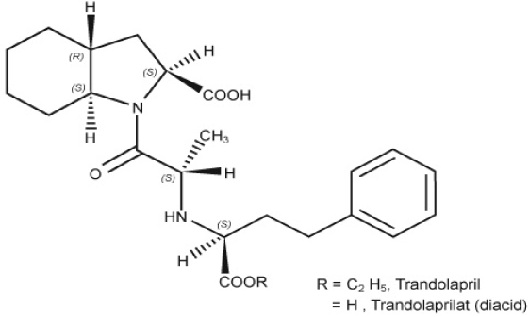
Image (5694dfc5 E7e8 4a6e 88d7 11e4b4b30fe3 01)
M.W.=430.54
Melting Point=125°C
Trandolapril is a white or almost white powder that is soluble (>100 mg/mL) in chloroform, dichloromethane, and methanol. Trandolapril tablets USP contain 1 mg, 2 mg, or 4 mg of trandolapril for oral administration. Each tablet also contains croscarmellose sodium, hypromellose, lactose monohydrate, povidone, starch (corn starch), sodium stearyl fumarate, red iron oxide or yellow iron oxide.
Trandolapril tablets are contraindicated in patients who are hypersensitive to this product, in patients with hereditary/idiopathic angioedema and in patients with a history of angioedema related to previous treatment with an ACE inhibitor.
Do not co-administer aliskiren with trandolapril tablets in patients with diabetes (see PRECAUTIONS, Drug Interactions).
Trandolapril tablets are contraindicated in combination with a neprilysin inhibitor (e.g., sacubitril). Do not administer trandolapril tablets within 36 hours of switching to or from sacubitril/valsartan, a neprilysin inhibitor (see WARNINGS).
Doses of 0.8 mg/kg/day (9.4 mg/m2/day) in rabbits, 1000 mg/kg/day (7000 mg/m2/day) in rats, and 25 mg/kg/day (295 mg/m2/day) in cynomolgus monkeys did not produce teratogenic effects. These doses represent 10 and 3 times (rabbits), 1250 and 2564 times (rats), and 312 and 108 times (monkeys) the maximum projected human dose of 4 mg based on body-weight and body-surface-area, respectively assuming a 50 kg woman.
Dual Blockade of the Renin-Angiotensin System (RAS)
Dual blockade of the RAS with angiotensin receptor blockers, ACE inhibitors, or aliskiren is associated with increased risks of hypotension, hyperkalemia, and changes in renal function (including acute renal failure) compared to monotherapy. Most patients receiving the combination of two RAS inhibitors do not obtain any additional benefit compared to monotherapy. In general, avoid combined use of RAS inhibitors. Closely monitor blood pressure, renal function and electrolytes in patients on trandolapril tablets and other agents that affect the RAS.
Do not co-administer aliskiren with trandolapril tablets in patients with diabetes. Avoid use of aliskiren with trandolapril tablets in patients with renal impairment (GFR <60 mL/min).
Concomitant Diuretic Therapy
As with other ACE inhibitors, patients on diuretics, especially those on recently instituted diuretic therapy, may experience an excessive reduction of blood pressure after initiation of therapy with trandolapril tablets. The possibility of exacerbation of hypotensive effects with trandolapril tablets may be minimized by either discontinuing the diuretic or cautiously increasing salt intake prior to initiation of treatment with trandolapril tablets. If it is not possible to discontinue the diuretic, the starting dose of trandolapril should be reduced. (see DOSAGE AND ADMINISTRATION.)
Agents Increasing Serum Potassium
Trandolapril can attenuate potassium loss caused by thiazide diuretics and increase serum potassium when used alone. Use of potassium-sparing diuretics (spironolactone, triamterene, or amiloride), potassium supplements, or potassium-containing salt substitutes concomitantly with ACE inhibitors can increase the risk of hyperkalemia. If concomitant use of such agents is indicated, they should be used with caution and with appropriate monitoring of serum potassium. (see PRECAUTIONS.)
Antidiabetic Agents
Concomitant use of ACE inhibitors and antidiabetic medicines (insulin or oral hypoglycemic agents) may cause an increased blood glucose lowering effect with greater risk of hypoglycemia.
Lithium
Increased serum lithium levels and symptoms of lithium toxicity have been reported in patients receiving concomitant lithium and ACE inhibitor therapy. These drugs should be coadministered with caution, and frequent monitoring of serum lithium levels is recommended. If a diuretic is also used, the risk of lithium toxicity may be increased.
Non-Steroidal Anti-Inflammatory Agents including Selective Cyclooxygenase-2 Inhibitors (COX-2 Inhibitors)
In patients who are elderly, volume-depleted (including those on diuretic therapy), or with compromised renal function, co-administration of NSAIDs, including selective COX-2 inhibitors, with ACE inhibitors, including trandolapril, may result in deterioration of renal function, including possible acute renal failure. These effects are usually reversible. Monitor renal function periodically in patients receiving trandolapril and NSAID therapy.
The antihypertensive effect of ACE inhibitors, including trandolapril may be attenuated by NSAIDs.
Gold
Nitritoid reactions (symptoms include facial flushing, nausea, vomiting and hypotension) have been reported rarely in patients on therapy with injectable gold (sodium aurothiomalate) and concomitant ACE inhibitor therapy including trandolapril tablets.
Mammalian Target of Rapamycin (mTOR) Inhibitors
Patients taking concomitant mTOR inhibitor (e.g., temsirolimus, sirolimus, everolimus) therapy may be at increased risk for angioedema (see WARNINGS – Head and Neck Angioedema).
Neprilysin Inhibitor
Patients taking concomitant neprilysin inhibitors (e.g., sacubitril) may be at increased risk for angioedema (see WARNINGS).
Other
No clinically significant pharmacokinetic interaction has been found between trandolaprilat and food, cimetidine, digoxin, or furosemide.
The anticoagulant effect of warfarin was not significantly changed by trandolapril.
The hypotensive effect of certain inhalation anesthetics may be enhanced by ACE inhibitors including trandolapril. (see PRECAUTIONS-Surgery/Anesthesia.)
Carcinogenesis, Mutagenesis, Impairment of Fertility
Long-term studies were conducted with oral trandolapril administered by gavage to mice (78 weeks) and rats (104 and 106 weeks). No evidence of carcinogenic potential was seen in mice dosed up to 25 mg/kg/day (85 mg/m2/day) or rats dosed up to 8 mg/kg/day (60 mg/m2/day). These doses are 313 and 32 times (mice), and 100 and 23 times (rats) the maximum recommended human daily dose (MRHDD) of 4 mg based on body-weight and body-surface-area, respectively assuming a 50 kg individual. The genotoxic potential of trandolapril was evaluated in the microbial mutagenicity (Ames) test, the point mutation and chromosome aberration assays in Chinese hamster V79 cells, and the micronucleus test in mice. There was no evidence of mutagenic or clastogenic potential in these in vitro and in vivo assays.
Reproduction studies in rats did not show any impairment of fertility at doses up to 100 mg/kg/day (710 mg/m2/day) of trandolapril, or 1250 and 260 times the MRHDD on the basis of body-weight and body-surface-area, respectively.
Nursing Mothers
Radiolabeled trandolapril or its metabolites are secreted in rat milk. Trandolapril tablets should not be administered to nursing mothers.
Geriatric Use
In placebo-controlled studies of trandolapril tablets, 31.1% of patients were 60 years and older, 20.1% were 65 years and older, and 2.3% were 75 years and older. No overall differences in effectiveness or safety were observed between these patients and younger patients. (Greater sensitivity of some older individual patients cannot be ruled out).
Pediatric Use
Neonates with a history of in utero exposure to trandolapril tablets:
If oliguria or hypotension occurs, direct attention toward support of blood pressure and renal perfusion. Exchange transfusions or dialysis may be required as a means of reversing hypotension and/or substituting for disordered renal function.
The safety and effectiveness of trandolapril tablets in pediatric patients have not been established.
The safety experience in U.S. placebo-controlled trials included 1069 hypertensive patients, of whom 832 received trandolapril tablets. Nearly 200 hypertensive patients received trandolapril tablets for over one year in open-label trials. In controlled trials, withdrawals for adverse events were 2.1% on placebo and 1.4% on trandolapril tablets. Adverse events considered at least possibly related to treatment occurring in 1% of trandolapril tablets-treated patients and more common on trandolapril tablets than placebo, pooled for all doses, are shown below, together with the frequency of discontinuation of treatment because of these events.
| Occurring at 1% or greater | ||
| TRANDOLAPRIL TABLETS (N=832) % Incidence (% Discontinuance) | PLACEBO (N=237) % Incidence (% Discontinuance) | |
| Cough | 1.9 (0.1) | 0.4 (0.4) |
| Dizziness | 1.3 (0.2) | 0.4 (0.4) |
| Diarrhea | 1.0 (0.0) | 0.4 (0.0) |
Headache and fatigue were all seen in more than 1% of trandolapril tablets-treated patients but were more frequently seen on placebo. Adverse events were not usually persistent or difficult to manage.
Another potentially important adverse experience, eosinophilic pneumonitis, has been attributed to other ACE inhibitors.
No data are available with respect to overdosage in humans. The oral LD50 of trandolapril in mice was 4875 mg/Kg in males and 3990 mg/Kg in females. In rats, an oral dose of 5000 mg/Kg caused low mortality (1 male out of 5; 0 females). In dogs, an oral dose of 1000 mg/Kg did not cause mortality and abnormal clinical signs were not observed. In humans, the most likely clinical manifestation would be symptoms attributable to severe hypotension. Symptoms also expected with ACE inhibitors are hypotension, hyperkalemia, and renal failure.
Laboratory determinations of serum levels of trandolapril and its metabolites are not widely available, and such determinations have, in any event, no established role in the management of trandolapril overdose. No data are available to suggest that physiological maneuvers (e.g., maneuvers to change the pH of the urine) might accelerate elimination of trandolapril and its metabolites. Trandolaprilat is removed by hemodialysis. Angiotensin II could presumably serve as a specific antagonist antidote in the setting of trandolapril overdose, but angiotensin II is essentially unavailable outside of scattered research facilities. Because the hypotensive effect of trandolapril is achieved through vasodilation and effective hypovolemia, it is reasonable to treat trandolapril overdose by infusion of normal saline solution.
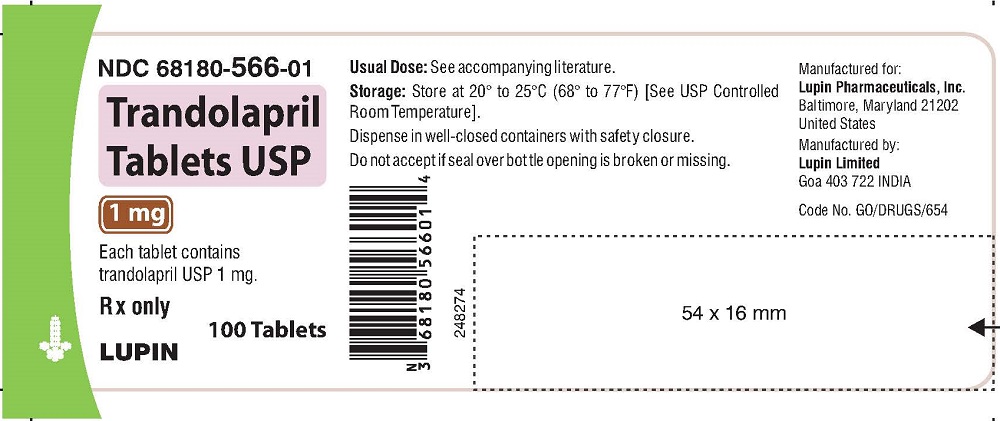
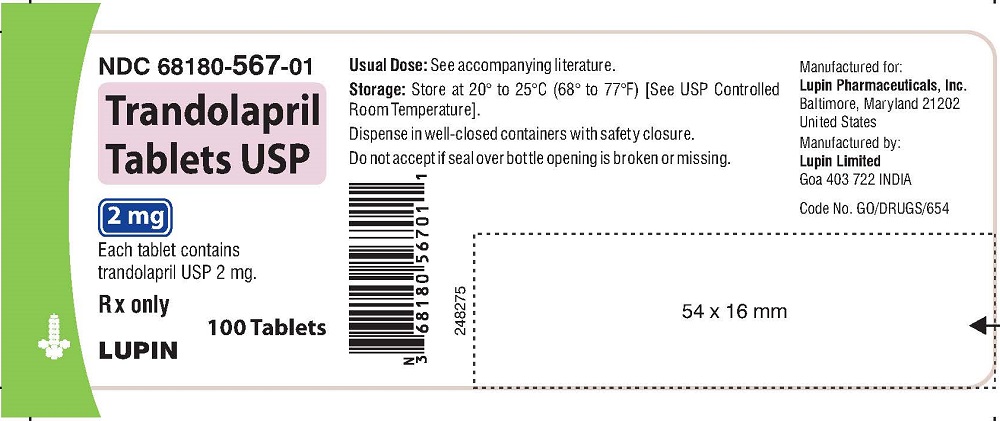
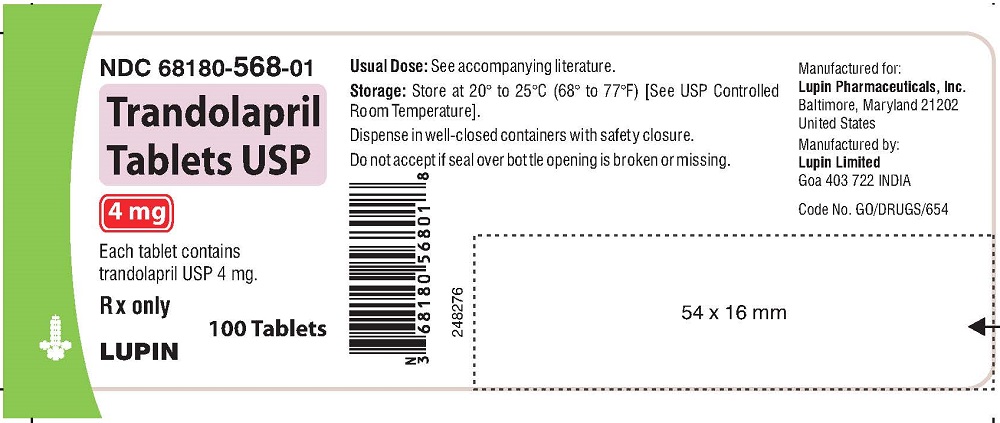
Trandolapril tablets USP are supplied as follows:
1 mg tablet - Pink, round, biconvex, uncoated tablets, debossed with 'L' and 'U' on either side of the breakline on one side and 'H01' on the other side.
NDC 68180-566-01 - bottles of 100
2 mg tablet - Yellow, round, biconvex, uncoated tablets, debossed with 'LU' on one side and 'H02' on the other side.
NDC 68180-567-01 - bottles of 100
4 mg tablet - Brick red colored, round, biconvex, uncoated tablets, debossed with 'LU' on one side and 'H03' on the other side.
NDC 68180-568-01 - bottles of 100
Dispense in well-closed container with safety closure.
Storage: Store at 20° to 25°C (68° to 77°F) [See USP Controlled Room Temperature].
Manufactured for:
Lupin Pharmaceuticals, Inc.
Baltimore, Maryland 21202
United States
Manufactured by:
Lupin Limited
Goa 403 722
INDIA.
Revised: November 2017 ID#: 253460