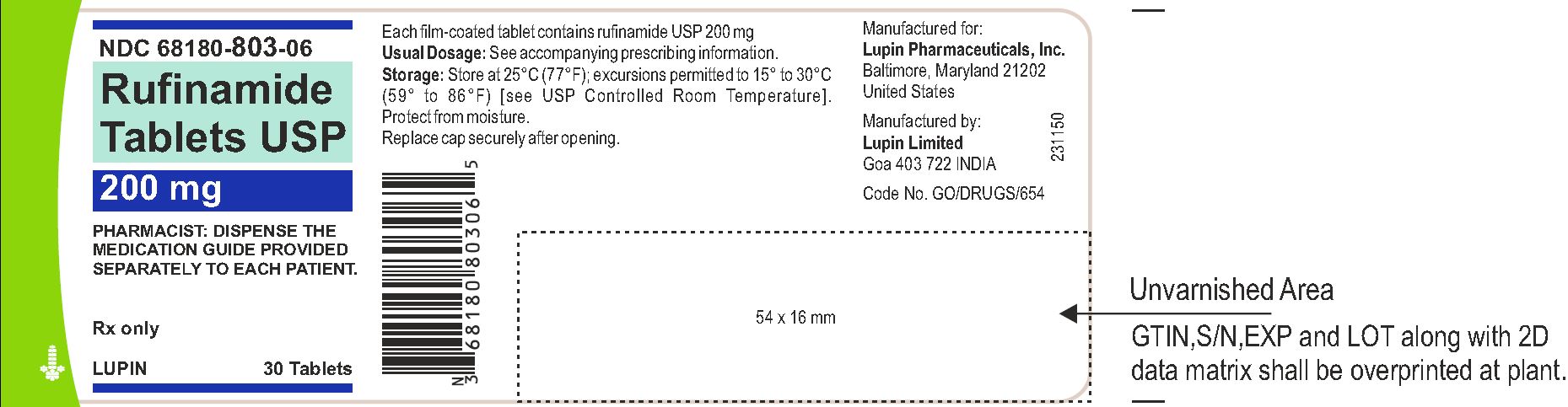
Other
Rufinamide tablets USP are indicated for adjunctive treatment of seizures associated with Lennox-Gastaut Syndrome in pediatric patients 1 year of age and older and in adults.
Functional scoring.
100 mg Strength: Pink, oblong shaped, film-coated, with a score on both sides, and debossed with 'L', 'U' on each side of the score on one side and 'P', '71' on each side of the score on the other side.
200 mg Strength: Pink, oblong shaped, film-coated, with a score on both sides, and debossed with 'L', 'U' on each side of the score on one side and 'P', '72' on each side of the score on the other side.
400 mg Strength: Pink, oblong shaped, film-coated, with a score on both sides, and debossed with 'L', 'U' on each side of the score on one side and 'P', '73' on each side of the score on the other side.
Rufinamide tablets are contraindicated in patients with Familial Short QT syndrome [see WARNINGS AND PRECAUTIONS (5.3)].
The following serious adverse reactions are described below and elsewhere in the labeling:
- Suicidal Behavior and Ideation [see WARNINGS AND PRECAUTIONS (5.1)]
- Central Nervous System Reactions [see WARNINGS AND PRECAUTIONS (5.2)]
- QT Shortening [see WARNINGS AND PRECAUTIONS (5.3)]
- Multi-Organ Hypersensitivity/ Drug Reaction with Eosinophilia and Systemic Symptoms (DRESS) [see WARNINGS AND PRECAUTIONS (5.4)]
- Leukopenia [see WARNINGS AND PRECAUTIONS (5.7)]
- Advise patients to take rufinamide tablets with food[see DOSAGE AND ADMINISTRATION (2.2)] .
- Inform female patients of childbearing age that the concurrent use of rufinamide tablets with hormonal contraceptives may render this method of contraception less effective. Recommend patients use additional non-hormonal forms of contraception when using rufinamide tablets [see DRUG INTERACTIONS (7.3) and USE IN SPECIFIC POPULATIONS (8.3)] .
- Inform patients that alcohol in combination with rufinamide tablets may cause additive central nervous system effects.
Because strategies for the management of overdose are continually evolving, it is advisable to contact a Certified Poison Control Center to determine the latest recommendations for the management of an overdose of any drug.
One overdose of 7200 mg per day rufinamide was reported in an adult during the clinical trials. The overdose was associated with no major signs or symptoms, no medical intervention was required, and the patient continued in the study at the target dose.
Treatment or Management of Overdose:
There is no specific antidote for overdose with rufinamide. If clinically indicated, elimination of unabsorbed drug should be attempted by induction of emesis or gastric lavage. Usual precautions should be observed to maintain the airway. General supportive care of the patient is indicated including monitoring of vital signs and observation of the clinical status of the patient.
Hemodialysis:
Standard hemodialysis procedures may result in limited clearance of rufinamide. Although there is no experience to date in treating overdose with hemodialysis, the procedure may be considered when indicated by the patient's clinical state.
Advise the patient to read the FDA-approved patient labeling (Medication Guide and Instructions for Use).
Administration Information
Suicidal Thinking and Behavior
Inform patients, their caregivers, and families that antiepileptic drugs increase the risk of suicidal thoughts and behavior, and should be advised of the need to be alert for the emergence or worsening of the signs and symptoms of depression, any unusual changes in mood or behavior, or the emergence of suicidal thoughts, behavior or thoughts about self-harm. Behaviors of concern should be reported immediately to healthcare providers [see WARNINGS AND PRECAUTIONS (5.1)].
Central Nervous System Reactions
Inform patients about the potential for somnolence or dizziness and advise them not to drive or operate machinery until they have gained sufficient experience on rufinamide tablets to gauge whether it adversely affects their mental and/or motor performance [see WARNINGS AND PRECAUTIONS (5.2)].
Multi-Organ Hypersensitivity Reactions
Advise patients to notify their physician if they experience a rash associated with fever [see WARNINGS AND PRECAUTIONS (5.4)].
Drug Interactions
Pregnancy
Advise patients to notify their physician if they become pregnant or intend to become pregnant during therapy. Encourage patients to enroll in the North American Antiepileptic Drug Pregnancy Registry if they become pregnant. To enroll, patients can call the toll free number 1-888-233-2334 [see USE IN SPECIFIC POPULATIONS (8.1)].
Breast-feeding
Advise patients to notify their physician if they are breast-feeding or intend to breast-feed [see USE IN SPECIFIC POPULATIONS (8.2)].
The brands listed are trademarks of their respective owners and are not trademarks of Lupin Pharmaceuticals, Inc. The makers of these brands are not affiliated with and do not endorse Lupin Pharmaceuticals, Inc. or its products.
Manufactured for:
Lupin Pharmaceuticals, Inc.
Baltimore, Maryland 21202
United States
Manufactured by:
Lupin Limited
Goa 403 722
INDIA
Revised: March 2022 ID#: 242203