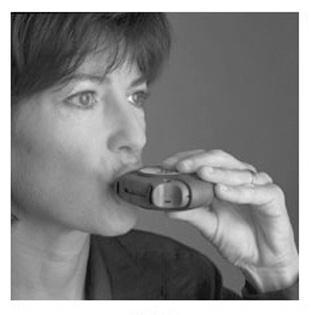
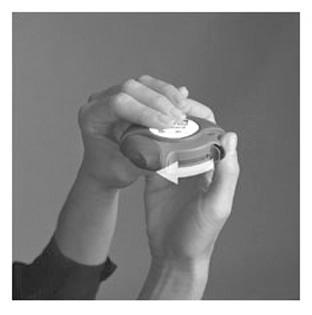
The initial studies supporting the approval of SEREVENT DISKUS for the treatment of asthma did not require the regular use of inhaled corticosteroids. However, for the treatment of asthma, SEREVENT DISKUS is currently indicated only as concomitant therapy with an inhaled corticosteroid [see Indications and Usage (1.1)].
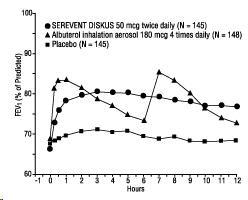
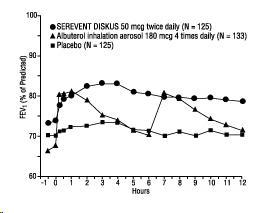
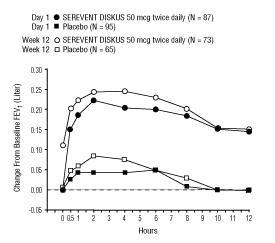
Adult and Adolescent Patients Aged 12 Years and Older: In 2 randomized double-blind studies, SEREVENT DISKUS was compared with albuterol inhalation aerosol and placebo in adolescent and adult patients with mild-to-moderate asthma (protocol defined as 50% to 80% predicted FEV1, actual mean of 67.7% at baseline), including patients who did and who did not receive concurrent inhaled corticosteroids. The efficacy of SEREVENT DISKUS was demonstrated over the 12-week period with no change in effectiveness over this time period (see Figure 1). There were no gender- or age-related differences in safety or efficacy. No development of tachyphylaxis to the bronchodilator effect was noted in these studies. FEV1 measurements (mean change from baseline) from these two 12-week studies are shown in Figure 1 for both the first and last treatment days.
First Treatment Day
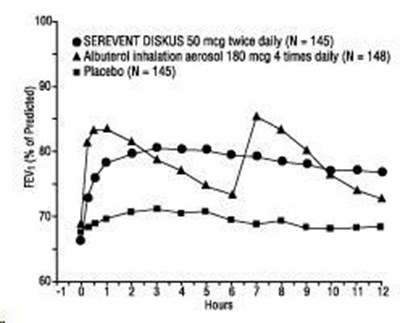
Figure 1. Serial 12-hour Fev1 From Two 12-week Clinical Trials In Patients With Asthma First Treatment Day (42aa9a5a C1f5 41ae Ba72 E9a46db63786 02)
Last Treatment Day (Week 12)
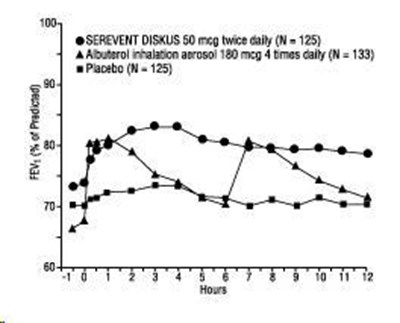
Last Treatment Day (week 12) (42aa9a5a C1f5 41ae Ba72 E9a46db63786 03)
Table 4 shows the treatment effects seen during daily treatment with SEREVENT DISKUS for 12 weeks in adolescent and adult patients with mild-to-moderate asthma.
Table 4. Daily Efficacy Measurements in Two 12-Week Clinical Trials (Combined Data)| Parameter | Time | Placebo | SEREVENT DISKUS | Albuterol Inhalation Aerosol |
| No. of randomized subjects | | 152 | 149 | 148 |
| Mean AM peak expiratory flow (L/min) | Baseline 12 weeks | 394 | 395 | 394 |
| 396 | 427a | 394 |
| Mean % days with no asthma symptoms | Baseline 12 weeks | 14 | 13 | 12 |
| 20 | 33 | 21 |
| Mean % nights with no awakenings | Baseline 12 weeks | 70 | 63 | 68 |
| 73 | 85a | 71 |
| Rescue medications (mean no. of inhalations per day) | Baseline 12 weeks | 4.2 | 4.3 | 4.3 |
| 3.3 | 1.6b | 2.2 |
| Asthma exacerbations (%) | | 14 | 15 | 16 |
aStatistically superior to placebo and albuterol (p<0.001).
bStatistically superior to placebo (p<0.001).
Maintenance of efficacy for periods up to 1 year has been documented.
SEREVENT DISKUS and SEREVENT Inhalation Aerosol were compared with placebo in 2 additional randomized double-blind clinical trials in adolescent and adult patients with mild-to-moderate asthma. SEREVENT DISKUS 50 mcg and SEREVENT Inhalation Aerosol 42 mcg, both administered twice daily, produced significant improvements in pulmonary function compared with placebo over the 12-week period. While no statistically significant differences were observed between the active treatments for any of the efficacy assessments or safety evaluations performed, there were some efficacy measures on which the metered-dose inhaler appeared to provide better results. Similar findings were noted in 2 randomized, single-dose, crossover comparisons of SEREVENT DISKUS and SEREVENT Inhalation Aerosol for the prevention of EIB. Therefore, while SEREVENT DISKUS was comparable to SEREVENT Inhalation Aerosol in clinical trials in mild-to-moderate patients with asthma, it should not be assumed that they will produce clinically equivalent outcomes in all patients.
Patients on Concomitant Inhaled Corticosteroids: In 4 clinical trials in adult and adolescent patients with asthma (N = 1,922), the effect of adding SEREVENT Inhalation Aerosol to inhaled corticosteroid therapy was evaluated over a 24-week treatment period. The studies compared the addition of salmeterol therapy to an increase (at least doubling) of the inhaled corticosteroid dose.
Two randomized, double-blind, controlled, parallel-group clinical trials (N = 997) enrolled patients (aged 18 to 82 years) with persistent asthma who were previously maintained but not adequately controlled on inhaled corticosteroid therapy. During the 2-week run-in period, all patients were switched to beclomethasone dipropionate (BDP) 168 mcg twice daily. Patients still not adequately controlled were randomized to either the addition of SEREVENT Inhalation Aerosol 42 mcg twice daily or an increase of BDP to 336 mcg twice daily. As compared with the doubled dose of BDP, the addition of SEREVENT Inhalation Aerosol resulted in statistically significantly greater improvements in pulmonary function and asthma symptoms, and statistically significantly greater reduction in supplemental albuterol use. The percent of patients who experienced asthma exacerbations overall was not different between groups (i.e., 16.2% in the group receiving SEREVENT Inhalation Aerosol versus 17.9% in the higher-dose beclomethasone dipropionate group).
Two randomized, double-blind, controlled, parallel-group clinical trials (N = 925) enrolled patients (aged 12 to 78 years) with persistent asthma who were previously maintained but not adequately controlled on prior asthma therapy. During the 2- to 4-week run-in period, all patients were switched to fluticasone propionate 88 mcg twice daily. Patients still not adequately controlled were randomized to either the addition of SEREVENT Inhalation Aerosol 42 mcg twice daily or an increase of fluticasone propionate to 220 mcg twice daily. As compared with the increased (2.5 times) dose of fluticasone propionate, the addition of SEREVENT Inhalation Aerosol resulted in statistically significantly greater improvements in pulmonary function and asthma symptoms, and statistically significantly greater reductions in supplemental albuterol use. Fewer patients receiving SEREVENT Inhalation Aerosol experienced asthma exacerbations than those receiving the higher dose of fluticasone propionate (8.8% versus 13.8%).
Table 5 shows the treatment effects seen during daily treatment with SEREVENT Inhalation Aerosol for 24 weeks in adolescent and adult patients with mild-to-moderate asthma.
Onset of Action: During the initial treatment day in several multiple-dose clinical trials with SEREVENT DISKUS in patients with asthma, the median time to onset of clinically significant bronchodilatation (≥15% improvement in FEV1) ranged from 30 to 48 minutes after a 50-mcg dose.
One hour after a single dose of 50 mcg of SEREVENT DISKUS, the majority of patients had ≥15% improvement in FEV1. Maximum improvement in FEV1 generally occurred within 180 minutes, and clinically significant improvement continued for 12 hours in most patients.
Pediatric Patients: In a randomized, double-blind, controlled study (N = 449), 50 mcg of SEREVENT DISKUS was administered twice daily to pediatric patients with asthma who did and who did not receive concurrent inhaled corticosteroids. The efficacy of salmeterol inhalation powder was demonstrated over the 12-week treatment period with respect to periodic serial PEF (36% to 39% postdose increase from baseline) and FEV1 (32% to 33% postdose increase from baseline). Salmeterol was effective in demographic subgroup analyses (gender and age) and was effective when coadministered with other inhaled asthma medications such as short-acting bronchodilators and inhaled corticosteroids. A second randomized, double-blind, placebo-controlled study (N = 207) with 50 mcg of salmeterol inhalation powder via an alternate device supported the findings of the trial with the DISKUS.
Salmeterol Multi-center Asthma Research Trial: The SMART study was a randomized double-blind study that enrolled LABA-naive patients with asthma (average age of 39 years; 71% Caucasian, 18% African American, 8% Hispanic) to assess the safety of salmeterol (SEREVENT Inhalation Aerosol) 42 mcg twice daily over 28 weeks compared with placebo when added to usual asthma therapy.
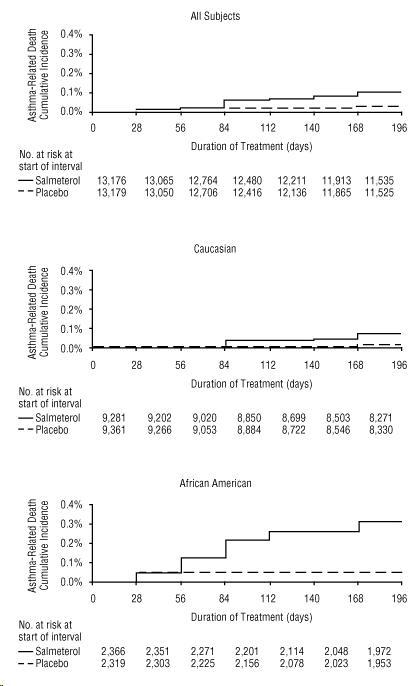
A planned interim analysis was conducted when approximately half of the intended number of patients had been enrolled (N = 26,355), which led to premature termination of the study. The results of the interim analysis showed that patients receiving salmeterol were at increased risk for fatal asthma events (see Table 5 and Figure 2). In the total population, a higher rate of asthma-related death occurred in patients treated with salmeterol than those treated with placebo (0.10% versus 0.02%, relative risk: 4.37 [95% CI: 1.25, 15.34]).
Post-hoc subpopulation analyses were performed. In Caucasians, asthma-related death occurred at a higher rate in patients treated with salmeterol than in patients treated with placebo (0.07% versus 0.01%, relative risk: 5.82 [95% CI: 0.70, 48.37]). In African Americans also, asthma-related death occurred at a higher rate in patients treated with salmeterol than those treated with placebo (0.31% versus 0.04%, relative risk: 7.26 [95% CI: 0.89, 58.94]). Although the relative risks of asthma-related death were similar in Caucasians and African Americans, the estimate of excess deaths in patients treated with salmeterol was greater in African Americans because there was a higher overall rate of asthma-related death in African American patients (see Table 5).
Post-hoc analyses in pediatric patients aged 12 to 18 years were also performed. Pediatric patients accounted for approximately 12% of patients in each treatment arm. Respiratory-related death or life-threatening experience occurred at a similar rate in the salmeterol group (0.12% [2/1,653]) and the placebo group (0.12% [2/1,622]; relative risk: 1.0 [95% CI: 0.1, 7.2]). All-cause hospitalization, however, was increased in the salmeterol group (2% [35/1,653]) versus the placebo group (<1% [16/1,622]; relative risk: 2.1 [95% CI: 1.1, 3.7]).
The data from the SMART study are not adequate to determine whether concurrent use of inhaled corticosteroids or other long-term asthma control therapy mitigates the risk of asthma-related death.
Table 5: Asthma-Related Deaths in the 28-Week Salmeterol Multi-center Asthma Research Trial (SMART) | Salmeterol n (%a) | Placebo n (%a) | Relative Riskb (95% Confidence Interval) | Excess Deaths Expressed per 10,000 Patientsc (95% Confidence Interval) |
| Total Populationd | | | | |
| Salmeterol: N = 13,176 | 13 (0.10%) | | 4.37 (1.25, 15.34) | 8 (3, 13) |
| Placebo: N = 13,179 | | 3 (0.02%) | | |
| Caucasian | | | | |
| Salmeterol: N = 9,281 | 6 (0.07%) | | 5.82 (0.70, 48.37) | 6 (1, 10) |
| Placebo: N = 9,361 | | 1 (0.01%) | | |
| African American | | | | |
| Salmeterol: N = 2,366 | 7 (0.31%) | | 7.26 (0.89, 58.94) | 27 (8, 46) |
| Placebo: N = 2,319 | | 1 (0.04%) | | |
aLife-table 28-week estimate, adjusted according to the patients’ actual lengths of exposure to study treatment to account for early withdrawal of patients from the study.
bRelative risk is the ratio of the rate of asthma-related death in the salmeterol group and the rate in the placebo group. The relative risk indicates how many more times likely an asthma-related death occurred in the salmeterol group than in the placebo group in a 28-week treatment period.
c Estimate of the number of additional asthma-related deaths in patients treated with salmeterol in SMART, assuming 10,000 patients received salmeterol for a 28-week treatment period. Estimate calculated as the difference between the salmeterol and placebo groups in the rates of asthma-related death multiplied by 10,000.
dThe Total Population includes the following ethnic origins listed on the case report form: Caucasian, African American, Hispanic, Asian, and “Other.” In addition, the Total Population includes those patients whose ethnic origin was not reported. The results for Caucasian and African American subpopulations are shown above. No asthma-related deaths occurred in the Hispanic (salmeterol n = 996, placebo n = 999), Asian (salmeterol n = 173, placebo n = 149), or “Other” (salmeterol n = 230, placebo n = 224) subpopulations. One asthma-related death occurred in the placebo group in the subpopulation whose ethnic origin was not reported (salmeterol n = 130, placebo n = 127).
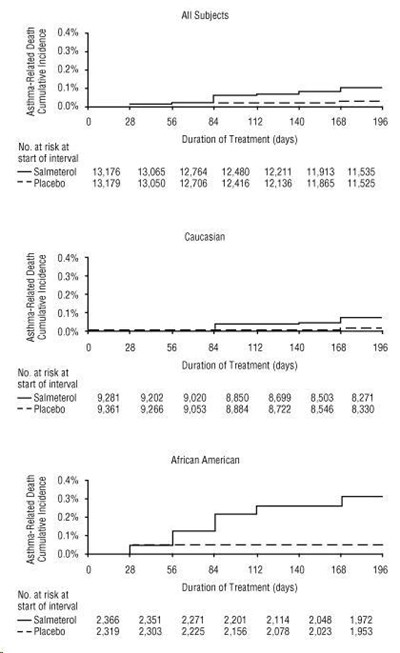
Figure 2. Cumulative Incidence Of Asthma-related Deaths In The 28-week Salmeterol Multi-center Asthma Research Trial (smart), By Duration Of Treatment (42aa9a5a C1f5 41ae Ba72 E9a46db63786 04)