Other
Estrogen Plus Progestin Therapy
Cardiovascular Disorders and Probable Dementia
The Women's Health Initiative (WHI) estrogen plus progestin substudy reported increased risks of pulmonary embolism (PE), deep vein thrombosis (DVT), stroke, and myocardial infarction (MI) in postmenopausal women (50 to 79 years of age) during 5.6 years of treatment with daily oral conjugated estrogens (CE) [0.625 mg] combined with medroxyprogesterone acetate (MPA) [2.5 mg], relative to placebo [see Warnings and Precautions (5.1), and Clinical Studies (14.4)].
The WHI Memory Study (WHIMS) estrogen plus progestin ancillary study of WHI reported an increased risk of developing probable dementia in postmenopausal women 65 years of age and older during 4 years of treatment with daily CE (0.625 mg) combined with MPA (2.5 mg), relative to placebo. It is unknown whether this finding applies to younger postmenopausal women [see Warnings and Precautions (5.3), Use in Specific Populations (8.5), and Clinical Studies (14.5)].
Do not use estrogen plus progestogen therapy for the prevention of cardiovascular disease or dementia [see Warnings and Precautions (5.1, 5.3), and Clinical Studies (14.4, 14.5)].
Breast Cancer
The WHI estrogen plus progestin substudy demonstrated an increased risk of invasive breast cancer [see Warnings and Precautions (5.2), and Clinical Studies (14.4)].
Only daily oral 0.625 mg CE and 2.5 mg MPA were studied in the estrogen plus progestin substudy of the WHI. Therefore, the relevance of the WHI findings regarding adverse cardiovascular events, dementia and breast cancer to lower CE plus other MPA doses, other routes of administration, or other estrogen plus progestogen products is not known. Without such data, it is not possible to definitively exclude these risks or determine the extent of these risks for other products. Discuss with your patient the benefits and risks of estrogen plus progestogen therapy, taking into account her individual risk profile.
Prescribe estrogens with or without progestogens at the lowest effective doses and for the shortest duration consistent with treatment goals and risks for the individual woman.
Estrogen-Alone Therapy
Endometrial Cancer
There is an increased risk of endometrial cancer in a woman with a uterus who uses unopposed estrogens. Adding a progestogen to estrogen therapy has been shown to reduce the risk of endometrial hyperplasia, which may be a precursor to endometrial cancer. Perform adequate diagnostic measures, including directed or random endometrial sampling when indicated, to rule out malignancy in postmenopausal women with undiagnosed persistent or recurring abnormal genital bleeding [see Warnings and Precautions (5.2)].
Cardiovascular Disorders and Probable Dementia
The WHI estrogen-alone substudy reported increased risks of stroke and DVT in postmenopausal women (50 to 79 years of age) during 7.1 years of treatment with daily oral CE (0.625 mg)-alone, relative to placebo [see Warnings and Precautions (5.1), and Clinical Studies (14.4)].
The WHIMS estrogen-alone ancillary study of WHI reported an increased risk of developing probable dementia in postmenopausal women 65 years of age and older during 5.2 years of treatment with daily CE (0.625 mg)-alone, relative to placebo. It is unknown whether this finding applies to younger postmenopausal women [see Warnings and Precautions (5.3), Use in Specific Populations (8.5), and Clinical Studies (14.5)].
Do not use estrogen-alone therapy for the prevention of cardiovascular disease or dementia [see Warnings and Precautions (5.1, 5.3), and Clinical Studies (14.4, 14.5)].
Only daily oral 0.625 mg CE was studied in the estrogen-alone substudy of the WHI. Therefore, the relevance of the WHI findings regarding adverse cardiovascular events and dementia to lower CE doses, other routes of administration, or other estrogen-alone products is not known. Without such data, it is not possible to definitively exclude these risks or determine the extent of these risks for other products. Discuss with your patient the benefits and risks of estrogen-alone therapy, taking into account her individual risk profile.
Prescribe estrogens with or without progestogens at the lowest effective doses and for the shortest duration consistent with treatment goals and risks for the individual woman.
Stroke
The WHI estrogen plus progestin substudy reported a statistically significant increased risk of stroke in women 50 to 79 years of age receiving daily CE (0.625 mg) plus MPA (2.5 mg) compared to women in the same age group receiving placebo (33 versus 25 strokes per 10,000 women-years, respectively) [see Clinical Studies (14.4)]. The increase in risk was demonstrated after the first year and persisted.1 Immediately discontinue estrogen with or without progestogen therapy if a stroke occurs or is suspected.
The WHI estrogen-alone substudy reported a statistically significant increased risk of stroke in women 50 to 79 years of age receiving daily CE (0.625 mg)-alone compared to women in the same age group receiving placebo (45 versus 33 strokes per 10,000 women-years, respectively).
The increase in risk was demonstrated in year 1 and persisted [see Clinical Studies (14.4)]. Immediately discontinue estrogen-alone therapy if a stroke occurs or is suspected.
Subgroup analyses of women 50 to 59 years of age suggest no increased risk of stroke for those women receiving CE (0.625 mg)-alone versus those receiving placebo (18 versus 21 per 10,000 women-years).1
Coronary Heart Disease
The WHI estrogen plus progestin substudy reported an increased risk (not statistically significant) of coronary heart disease (CHD) events (defined as nonfatal MI, silent MI, or CHD death) in those women receiving daily CE (0.625 mg) plus MPA (2.5 mg) compared to women receiving placebo (41 versus 34 per 10,000 women-years).1 An increase in relative risk was demonstrated in year 1, and a trend toward decreasing relative risk was reported in years 2 through 5 [see Clinical Studies (14.4)].
The WHI estrogen-alone substudy reported no overall effect on CHD events in women receiving estrogen-alone compared to placebo2 [see Clinical Studies (14.4)].
Subgroup analyses of women 50 to 59 years of age, who were less than 10 years since menopause, suggest a reduction (not statistically significant) of CHD events in those women receiving CE (0.625 mg)-alone compared to placebo (8 versus 16 per 10,000 women-years).1
In postmenopausal women with documented heart disease (n=2,763), average 66.7 years of age, in a controlled clinical trial of secondary prevention of cardiovascular disease (Heart and Estrogen/Progestin Replacement Study; HERS), treatment with daily CE (0.625 mg) plus MPA (2.5 mg) demonstrated no cardiovascular benefit. During an average follow-up of 4.1 years, treatment with CE plus MPA did not reduce the overall rate of CHD events in postmenopausal women with established CHD. There were more CHD events in the CE plus MPA-treated group than in the placebo group in year 1, but not during the subsequent years. Two thousand three hundred and twenty-one (2,321) women from the original HERS trial agreed to participate in an open label extension of the original HERS, HERS II. Average follow-up in HERS II was an additional 2.7 years, for a total of 6.8 years overall. Rates of CHD events were comparable among women in the CE plus MPA group and the placebo group in HERS, HERS II, and overall.
Venous Thromboembolism
The WHI estrogen plus progestin substudy reported a statistically significant 2-fold greater rate of VTE (DVT and PE) in women receiving daily CE (0.625 mg) plus MPA (2.5 mg) compared to women receiving placebo (35 versus 17 per 10,000 women-years). Statistically significant increases in risk for both DVT (26 versus 13 per 10,000 women-years) and PE (18 versus 8 per 10,000 women-years) were also demonstrated. The increase in VTE risk was demonstrated during the first year and persisted3 [see Clinical Studies (14.4)]. Immediately discontinue estrogen plus progestogen therapy if a VTE occurs or is suspected.
In the WHI estrogen-alone substudy, the risk of VTE was increased for women receiving daily CE (0.625 mg)-alone compared to placebo (30 versus 22 per 10,000 women-years), although only the increased risk of DVT reached statistical significance (23 versus 15 per 10,000 women-years). The increase in VTE risk was demonstrated during the first 2 years4 [see Clinical Studies (14.4)]. Immediately discontinue estrogen-alone therapy if a VTE occurs or is suspected.
If feasible, discontinue estrogens at least 4 to 6 weeks before surgery of the type associated with an increased risk of thromboembolism, or during periods of prolonged immobilization.
Breast Cancer
After a mean follow-up of 5.6 years, the WHI substudy of daily CE (0.625 mg) plus MPA (2.5 mg) reported an increased risk of invasive breast cancer in women who took daily CE plus MPA compared to placebo. In this substudy, prior use of estrogen-alone or estrogen plus progestin therapy was reported by 26% of the women. The relative risk of invasive breast cancer was 1.24, and the absolute risk was 41 versus 33 cases per 10,000 women-years, for CE plus MPA compared with placebo. Among women who reported prior use of hormone therapy, the relative risk of invasive breast cancer was 1.86, and the absolute risk was 46 versus 25 cases per 10,000 women-years, for CE plus MPA compared with placebo. Among women who reported no prior use of hormone therapy, the relative risk of invasive breast cancer was 1.09, and the absolute risk was 40 versus 36 cases per 10,000 women-years for CE plus MPA compared with placebo. In the same substudy, invasive breast cancers were larger, were more likely to be node positive, and were diagnosed at a more advanced stage in the CE (0.625 mg) plus MPA (2.5 mg) group compared with the placebo group. Metastatic disease was rare, with no apparent difference between the two groups. Other prognostic factors, such as histologic subtype, grade and hormone receptor status did not differ between the groups5 [see Clinical Studies (14.4)].
The WHI substudy of daily CE (0.625 mg)-alone provided information about breast cancer in estrogen-alone users. In the WHI estrogen-alone substudy, after an average follow-up of 7.1 years, daily CE-alone was not associated with an increased risk of invasive breast cancer [relative risk (RR) 0.80] compared to placebo6 [see Clinical Studies (14.4)].
Consistent with the WHI clinical trials, observational studies have also reported an increased risk of breast cancer with estrogen plus progestin therapy, and a smaller increase in the risk for breast cancer with estrogen-alone therapy, after several years of use. One large meta-analysis of prospective cohort studies reported increased risks that were dependent upon duration of use and could last up to >10 years after discontinuation of estrogen plus progestin therapy and estrogen-alone therapy. Extension of the WHI trials also demonstrated increased breast cancer risk associated with estrogen plus progestin therapy. Observational studies also suggest that the risk of breast cancer was greater, and became apparent earlier, with estrogen plus progestin therapy as compared to estrogen-alone therapy. These studies have not generally found significant variation in the risk of breast cancer among different estrogen plus progestin combinations, doses, or routes of administration.
The use of estrogen-alone and estrogen plus progestin therapy has been reported to result in an increase in abnormal mammograms requiring further evaluation.
In a one-year trial, among 1,684 women who received a combination of estradiol plus progesterone (1 mg estradiol plus 100 mg progesterone or 0.5 mg estradiol plus 100 mg progesterone or 0.5 mg estradiol plus 50 mg progesterone or 0.25 mg estradiol plus 50 mg progesterone) or placebo (n=151), six new cases of breast cancer were diagnosed, two of which occurred among the group of 424 women treated with BIJUVA (estradiol and progesterone) capsules, 0.5 mg/100 mg, and two of which occurred among the group of 415 women treated with BIJUVA (estradiol and progesterone) capsules, 1 mg/100 mg. No new cases of breast cancer were diagnosed in the group of 151 women treated with placebo.
All women should receive yearly breast examinations by a healthcare provider and perform monthly breast self-examinations. In addition, mammography examinations should be scheduled based on patient age, risk factors, and prior mammogram results.
Endometrial Cancer
Endometrial hyperplasia (a possible precursor of endometrial cancer) has been reported to occur at a rate of approximately 1 percent or less with BIJUVA (estradiol and progesterone) capsules, 0.5 mg/100 mg or 1 mg/100 mg.
An increased risk of endometrial cancer has been reported with the use of unopposed estrogen therapy in a woman with a uterus. The reported endometrial cancer risk among unopposed estrogen users is about 2- to 12-fold greater than in non-users and appears dependent on duration of treatment and on estrogen dose. Most studies show no significant increased risk associated with use of estrogens for less than 1 year. The greatest risk appears associated with prolonged use, with an increased risk of 15- to 24-fold for 5 to 10 years or more, and this risk has been shown to persist for at least 8 to 15 years after estrogen therapy is discontinued.
Clinical surveillance of all women using estrogen-alone or estrogen plus progestogen therapy is important. Perform adequate diagnostic measures, including directed or random endometrial sampling when indicated, to rule out malignancy in postmenopausal women with undiagnosed persistent or recurring abnormal genital bleeding with unknown etiology.
There is no evidence that the use of natural estrogens results in a different endometrial risk profile than synthetic estrogens of equivalent estrogen dose. Adding a progestogen to estrogen therapy in postmenopausal women has been shown to reduce the risk of endometrial hyperplasia, which may be a precursor to endometrial cancer.
Ovarian Cancer
The CE plus MPA substudy of WHI reported that estrogen plus progestin increased the risk of ovarian cancer. After an average follow-up of 5.6 years, the relative risk for ovarian cancer for CE plus MPA versus placebo was 1.58 (95% confidence interval [CI], 0.77 to 3.24), but it was not statistically significant. The absolute risk for CE plus MPA versus placebo was 4 versus 3 cases per 10,000 women-years.7
A meta-analysis of 17 prospective and 35 retrospective epidemiology studies found that women who used hormonal therapy for menopausal symptoms had an increased risk for ovarian cancer. The primary analysis, using case-control comparisons, included 12,110 cancer cases from the 17 prospective studies. The relative risks associated with current use of hormonal therapy was 1.41 (95% CI, 1.32 to 1.50); there was no difference in the risk estimates by duration of the exposure (less than 5 years [median of 3 years] vs. greater than 5 years [median of 10 years] of use before the cancer diagnosis). The relative risk associated with combined current and recent use (discontinued use within 5 years before cancer diagnosis) was 1.37 (95% CI, 1.27 to 1.48), and the elevated risk was significant for both estrogen-alone and estrogen plus progestin products. The exact duration of hormone therapy use associated with an increased risk of ovarian cancer, however, is unknown.
Gastrointestinal disorders
Abdominal pain and discomfort, abdominal distention, diarrhea, nausea, vomiting.
General disorders and administration site conditions
Fatigue, feeling abnormal, malaise.
Investigations
Weight increased.
Metabolism and nutrition disorders
Fluid retention.
Musculoskeletal and connective tissue disorders
Muscle spasms, pain in extremity.
Nervous system disorders
Dizziness, headache, somnolence.
Psychiatric disorders
Insomnia, sleep disorder.
Reproductive system and breast disorders
Breast pain, breast tenderness, uterine bleeding.
Skin and subcutaneous tissue disorders
Night sweats, pruritus.
Vascular disorders
Hot flush.
Risk Summary
BIJUVA is not indicated for use in pregnancy. There are no data with the use of BIJUVA in pregnant women, however, epidemiologic studies and meta-analyses have not found an increased risk of genital or non-genital birth defects (including cardiac anomalies and limb-reduction defects) following exposure to combined hormonal contraceptives (estrogens and progestins) before conception or during early pregnancy.
In the U.S. general population, the estimated background risk of major birth defects and miscarriage in clinically recognized pregnancies is 2% to 4% and 15% to 20%, respectively.
Risk Summary
Estrogens plus progestogens are present in human milk and can reduce milk production in breast-feeding females. This reduction can occur at any time but is less likely to occur once breast-feeding is well-established. The developmental and health benefits of breastfeeding should be considered along with the mother's clinical need for BIJUVA and any potential adverse effects on the breastfed child from BIJUVA or from the underlying maternal condition.
The Women's Health Initiative Studies
In the WHI estrogen plus progestin substudy (daily CE [0.625 mg] plus MPA [2.5 mg] versus placebo), there was a higher relative risk of nonfatal stroke and invasive breast cancer in women greater than 65 years of age [see Clinical Studies (14.4)].
In the WHI estrogen-alone substudy (daily CE [0.625 mg]-alone versus placebo), there was a higher relative risk of stroke in women greater than 65 years of age [see Clinical Studies (14.4)].
The Women's Health Initiative Memory Study
In the WHIMS ancillary studies of postmenopausal women 65 to 79 years of age, there was an increased risk of developing probable dementia in women receiving estrogen plus progestin or estrogen-alone when compared to placebo [see Warnings and Precautions (5.3), and Clinical Studies (14.5)].
Since both ancillary studies were conducted in women 65 to 79 years of age, it is unknown whether these findings apply to younger postmenopausal women8 [see Warnings and Precautions (5.3), and Clinical Studies (14.5)].
Absorption
The oral absorption of both estradiol and progesterone is subject to first-pass metabolism. After multiple doses of BIJUVA (estradiol and progesterone) capsules administered with food, the tmax (the time at which the maximum concentration is attained) for estradiol is approximately 3 to 6 hours and approximately 3 hours for progesterone (Figure 1, Figure 2, and Table 2, below). Steady state for both estradiol and progesterone components of BIJUVA, as well as estradiol's main metabolite, estrone, is achieved within seven days. A dose-dependent increase in AUC0-t and Cmax of estradiol and a slightly more than proportionality increase in AUC0-t and Cmax of estrone were observed when the dose of estradiol was increased from 0.5 mg/day to 1 mg/day (Table 2).
Figure 1: Mean Steady-State Serum Estradiol Concentrations Following Daily Oral Administration of 0.5 mg Estradiol/100 mg Progesterone or 1 mg Estradiol/100 mg Progesterone with Food (Baseline Adjusted, at Day 7)
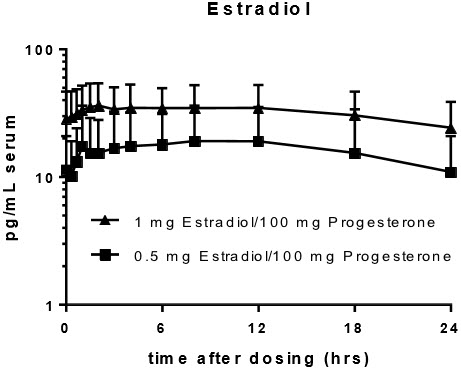
Figure 1 (Bijuva 03)
Figure 2: Mean Steady-State Serum Progesterone Concentrations Following Daily Oral Administration of 0.5 mg Estradiol/100 mg Progesterone or 1 mg Estradiol/100 mg Progesterone with Food (Baseline Adjusted, at Day 7)
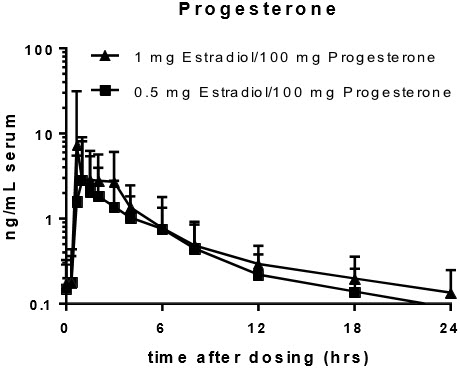
Figure 2 (Bijuva 04)
| Dosage Strength (estradiol/progesterone) | BIJUVA 0.5 mg/100 mg Mean (SD) | BIJUVA 1 mg/100 mg Mean (SD) | ||
|---|---|---|---|---|
| Abbreviations: AUC0-τ = area under the concentration vs time curve within the dosing interval at steady-state, Cavg = average concentration at steady-state, Cmax = maximum concentration, SD = standard deviation, tmax = time to maximum concentration, t½ = half-life | ||||
| Estradiol | N | N | ||
| AUC0-τ (pg∙h/mL) | 17 | 386.8 (356.6) | 20 | 772.4 (384.1) |
| Cmax (pg/mL) | 17 | 23.95 (16.86) | 20 | 42.27 (18.60) |
| Cavg (pg/mL) | 17 | 16.64 (14.50) | 19 | 33.99 (14.53) |
| tmax (h) Median and range | 17 | 6.00 (0.00 – 12.00) | 19 | 3.00 (0.67 – 18.03) |
| t½ (h) Effective t½. Calculated as 24∙ln(2)/ ln (accumulation ratio/(accumulation ratio-1)) for subjects with accumulation ratio >1. | 11 | 28.01 (9.99) | 19 | 26.47 (14.61) |
| Estrone | ||||
| AUC0-τ (pg∙h/mL) | 17 | 1981 (976.0) | 20 | 4594 (2138) |
| Cmax (pg/mL) | 17 | 108.0 (48.58) | 20 | 238.5 (100.4) |
| Cavg (pg/mL) | 17 | 82.81 (40.80) | 20 | 192.1 (89.43) |
| tmax (h) | 17 | 11.98 (2.00 – 18.00) | 20 | 5.00 (1.50 – 12.00) |
| t½ (h) | 17 | 20.46 (5.61) | 19 | 22.37 (7.64) |
| Progesterone | ||||
| AUC0-τ (ng∙h/mL) | 17 | 12.19 (11.01) | 20 | 18.05 (15.58) |
| Cmax (ng/mL) | 17 | 4.40 (5.72) | 20 | 11.31 (23.10) |
| Cavg (ng/mL) | 17 | 0.55 (0.45) | 20 | 0.76 (0.65) |
| tmax (h) | 17 | 2.00 (0.67 – 8.00) | 20 | 2.51 (0.67 – 6.00) |
| t½ (h) | 13 | 8.77 (2.78) | 18 | 9.98 (2.57) |
Food Effect
Concomitant food ingestion increased the AUC and Cmax of the progesterone component of BIJUVA relative to a fasting state when administered at a dose of 100 mg. In a study where BIJUVA was administered to postmenopausal women at a dose of 1 mg estradiol/100 mg progesterone within 30 minutes of starting a high-fat meal, the Cmax and AUC of progesterone were 162% and 79% higher, respectively, relative to the fasting state and the median tmax of progesterone was delayed from 2 hours to 3 hours. Concomitant food ingestion had no effect on the AUC of the estradiol component of BIJUVA but decreased Cmax by approximately 54% and delayed median tmax from 1 hour to 12 hours.
Distribution
Estradiol
The distribution of exogenous estrogens is similar to that of endogenous estrogens. Estrogens are widely distributed in the body and are generally found in higher concentrations in the sex hormone target organs. Estrogens circulating in the blood largely are bound to SHBG and albumin.
Progesterone
Progesterone is approximately 96% to 99% bound to serum proteins, primarily to serum albumin (50% to 54%) and transcortin (43% to 48%).
Elimination
Following repeat dosing with BIJUVA (estradiol and progesterone) capsules, 0.5 mg/100 mg or 1 mg/100 mg, the half-life of estradiol was 28 ± 10 hours and 26 ± 15 hours, respectively, and the half-life of progesterone was 9 ± 3 hours and 10 ± 3 hours, respectively (Table 2).
Metabolism
Estradiol
Exogenous estrogens are metabolized in the same manner as endogenous estrogens. Circulating estrogens exist in a dynamic equilibrium of metabolic interconversions. These transformations take place mainly in the liver. Estradiol is converted reversibly to estrone, and both can be converted to estriol, the major urinary metabolite. Estrogens also undergo enterohepatic recirculation via sulfate and glucuronide conjugation in the liver, biliary secretion of conjugates into the intestine, and hydrolysis in the intestine followed by reabsorption. In postmenopausal women, a significant portion of the circulating estrogens exist as sulfate conjugates, especially estrone sulfate, which serves as a circulating reservoir for the formation of more active estrogens.
Progesterone
Progesterone is metabolized primarily by the liver largely to pregnanediols and pregnanolones. Pregnanediols and pregnanolones are conjugated in the liver to glucuronide and sulfate metabolites. Progesterone metabolites, which are excreted in the bile, may be deconjugated and may be further metabolized in the intestine via reduction, dehydroxylation, and epimerization.
Excretion
Estradiol
Estradiol, estrone, and estriol are excreted in the urine along with glucuronide and sulfate conjugates.
Progesterone
The glucuronide and sulfate conjugates of pregnanediol and pregnanolone are excreted in the bile and urine. Progesterone metabolites are eliminated mainly by the kidneys. Progesterone metabolites which are excreted in the bile may undergo enterohepatic recycling or may be excreted in the feces.
WHI Estrogen Plus Progestin Substudy
The WHI estrogen plus progestin substudy was stopped early. According to the predefined stopping rule, after an average follow-up of 5.6 years of treatment, the increased risk of invasive breast cancer and cardiovascular events exceeded the specified benefits included in the "global index." The absolute excess risk of events included in the "global index" was 19 per 10,000 women-years.
For those outcomes included in the WHI "global index" that reached statistical significance after 5.6 years of follow-up, the absolute excess risks per 10,000 women-years in the group treated with CE plus MPA were 7 more CHD events, 8 more strokes, 10 more PEs, and 8 more invasive breast cancers, while the absolute risk reductions per 10,000 women-years were 6 fewer colorectal cancers and 5 fewer hip fractures.
Results of the CE plus MPA substudy, which included 16,608 women (average 63 years of age, range 50 to 79; 83.9% White, 6.8% Black, 5.4% Hispanic, 3.9% Other) are presented in Table 6. These results reflect centrally adjudicated data after an average follow-up of 5.6 years.
| Event | Relative Risk CE/MPA vs Placebo (95% nCI Nominal confidence intervals unadjusted for multiple looks and multiple comparisons. ) | CE/MPA n=8,506 | Placebo n=8,102 |
|---|---|---|---|
| Absolute Risk per 10,000 Women-Years | |||
| CHD events | 1.23 (0.99-1.53) | 41 | 34 |
| Non-fatal MI | 1.28 (1.00-1.63) | 31 | 25 |
| CHD death | 1.10 (0.70-1.75) | 8 | 8 |
| All Strokes | 1.31 (1.03-1.68) | 33 | 25 |
| Ischemic stroke | 1.44 (1.09-1.90) | 26 | 18 |
| Deep vein thrombosis Not included in "global index." | 1.95 (1.43-2.67) | 26 | 13 |
| Pulmonary embolism | 2.13 (1.45-3.11) | 18 | 8 |
| Invasive breast cancer Includes metastatic and non-metastatic breast cancer with the exception of in situ cancer. | 1.24 (1.01-1.54) | 41 | 33 |
| Colorectal cancer | 0.61 (0.42-0.87) | 10 | 16 |
| Endometrial cancer | 0.81 (0.48-1.36) | 6 | 7 |
| Cervical cancer | 1.44 (0.47-4.42) | 2 | 1 |
| Hip fracture | 0.67 (0.47-0.96) | 11 | 16 |
| Vertebral fractures | 0.65 (0.46-0.92) | 11 | 17 |
| Lower arm/wrist fractures | 0.71 (0.59-0.85) | 44 | 62 |
| Total fractures | 0.76 (0.69-0.83) | 152 | 199 |
| Overall Mortality All deaths, except from breast or colorectal cancer, definite or probable CHD, PE or cerebrovascular disease. | 1.00 (0.83-1.19) | 52 | 52 |
| Global Index A subset of the events was combined in a "global index," defined as the earliest occurrence of CHD events, invasive breast cancer, stroke, PE, colorectal cancer, hip fracture, or death due to other causes. | 1.13 (1.02-1.25) | 184 | 165 |
Timing of the initiation of estrogen plus progestin therapy relative to the start of menopause may affect the overall risk benefit profile. The WHI estrogen plus progestin substudy stratified by age showed in women 50-59 years of age, a non-significant trend toward reduced risk for overall mortality [hazard ratio (HR) 0.69 (95 percent CI, 0.44 to 1.07)].
WHI Estrogen-Alone Substudy
The WHI estrogen-alone substudy was stopped early because an increased risk of stroke was observed, and it was deemed that no further information would be obtained regarding the risks and benefits of estrogen-alone in predetermined primary endpoints.
Results of the estrogen-alone substudy, which included 10,739 women (average 63 years of age, range 50 to 79; 75.3% White, 15.1% Black, 6.1% Hispanic, 3.6% percent Other) after an average follow-up of 7.1 years, are presented in Table 7.
| Event | Relative Risk CE vs Placebo (95% nCI Nominal confidence intervals unadjusted for multiple looks and multiple comparisons. ) | CE n=5,310 | Placebo n=5,429 |
|---|---|---|---|
| Absolute Risk per 10,000 Women-Years | |||
| CHD events Results are based on centrally adjudicated data for an average follow-up of 7.1 years. | 0.95 (0.78-1.16) | 54 | 57 |
| Non-fatal MI | 0.91 (0.73-1.14) | 40 | 43 |
| CHD death | 1.01 (0.71-1.43) | 16 | 16 |
| All Strokes | 1.33 (1.05-1.68) | 45 | 33 |
| Ischemic stroke | 1.55 (1.19-2.01) | 38 | 25 |
| Deep vein thrombosis Not included in "global index." | 1.47 (1.06-2.06) | 23 | 15 |
| Pulmonary embolism | 1.37 (0.90-2.07) | 14 | 10 |
| Invasive breast cancer | 0.80 (0.62-1.04) | 28 | 34 |
| Colorectal cancer | 1.08 (0.75-1.55) | 17 | 16 |
| Hip fracture | 0.65 (0.45-0.94) | 12 | 19 |
| Vertebral fractures | 0.64 (0.44-0.93) | 11 | 18 |
| Lower arm/wrist fractures | 0.58 (0.47-0.72) | 35 | 59 |
| Total fractures | 0.71 (0.64-0.80) | 144 | 197 |
| Death due to other causes Results are based on an average follow-up of 6.8 years. ,All deaths, except from breast or colorectal cancer, definite or probable CHD, PE or cerebrovascular disease. | 1.08 (0.88-1.32) | 53 | 50 |
| Overall mortality | 1.04 (0.88-1.22) | 79 | 75 |
| Global Index A subset of the events was combined in a "global index," defined as the earliest occurrence of CHD events, invasive breast cancer, stroke, pulmonary embolism, colorectal cancer, hip fracture, or death due to other causes. | 1.02 (0.92-1.13) | 206 | 201 |
For those outcomes included in the WHI "global index" that reached statistical significance, the absolute excess risk per 10,000 women-years in the group treated with CE-alone was 12 more strokes while the absolute risk reduction per 10,000 women-years was 7 fewer hip fractures.9 The absolute excess risk of events included in the "global index" was a non-significant 5 events per 10,000 women-years. There was no difference between the groups in terms of all-cause mortality.
No overall difference for primary CHD events (nonfatal MI, silent MI, and CHD death) and invasive breast cancer incidence in women receiving CE-alone compared with placebo was reported in final centrally adjudicated results from the estrogen-alone substudy, after an average follow-up of 7.1 years.
Centrally adjudicated results for stroke events from the estrogen-alone substudy, after an average follow-up of 7.1 years, reported no significant difference in distribution of stroke subtype or severity, including fatal strokes, in women receiving CE-alone compared to placebo. Estrogen-alone increased the risk for ischemic stroke, and this excess risk was present in all subgroups of women examined.10
Timing of the initiation of estrogen-alone therapy relative to the start of menopause may affect the overall risk benefit profile. The WHI estrogen-alone substudy, stratified by age, showed in women 50-59 years of age a non-significant trend toward reduced risk for CHD [HR 0.63 (95% CI, 0.36 to 1.09)] and overall mortality [HR 0.71 (95% CI, 0.46 to 1.11)].
Vaginal Bleeding
Inform postmenopausal women to report any vaginal bleeding to their healthcare provider as soon as possible [see Warnings and Precautions (5.2)].
Possible Serious Adverse Reactions with Estrogen Plus Progestogen Therapy
Inform postmenopausal women of possible serious adverse reactions of estrogen plus progestogen therapy including cardiovascular disorders, malignant neoplasms, and probable dementia [see Warnings and Precautions (5.1, 5.2, 5.3)].
Possible Common Adverse Reactions with Estrogen Plus Progestogen Therapy
Inform postmenopausal women of possible less serious but common adverse reactions of estrogen plus progestogen therapy such as breast tenderness, headache, nausea, vaginal bleeding, vaginal discharge, and pelvic pain [see Adverse Reactions (6.1)].
Missed Evening Dose of BIJUVA
Advise the woman that if she misses her evening dose, she should take the dose with food as soon as she can, unless it is within two hours of the next evening dose.