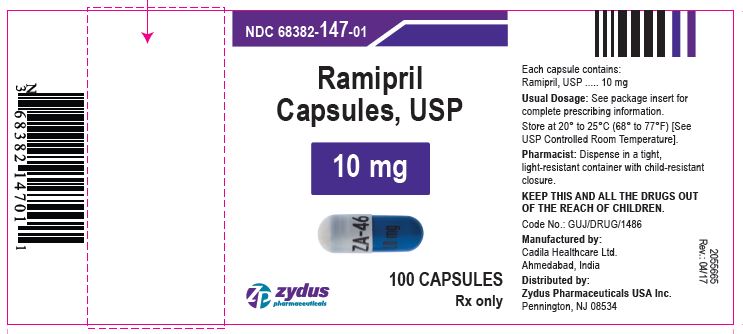
Other
- When pregnancy is detected, discontinue ramipril as soon as possible (5.6).
- Drugs that act directly on the renin-angiotensin system can cause injury and death to the developing fetus (5.6).
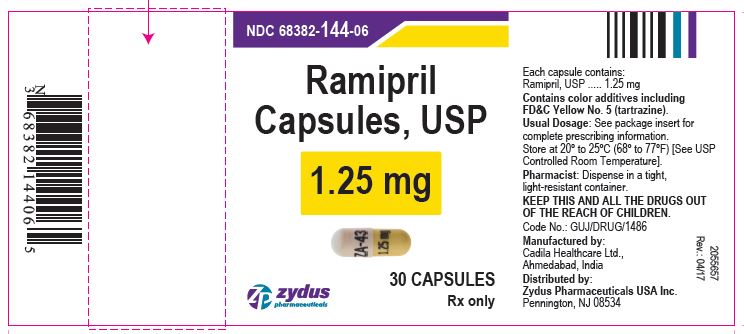
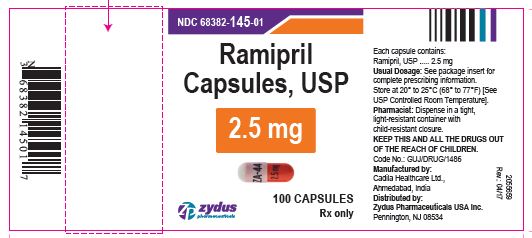
Ramipril capsules, USP are supplied as hard gelatin capsules containing 1.25 mg, 2.5 mg, 5 mg, and 10 mg of ramipril.
The 1.25 mg capsule contains FD&C Yellow #5 (tartrazine) which may cause allergic-type reactions (including bronchial asthma) in certain susceptible persons. Although the overall incidence of FD&C Yellow No.5 (tartrazine) sensitivity in the general population is low, it is frequently seen in patients who also have aspirin hypersensitivity.
Single oral doses of ramipril in rats and mice of 10 g/kg to 11 g/kg resulted in significant lethality. In dogs, oral doses as high as 1 g/kg induced only mild gastrointestinal distress. Limited data on human overdosage are available. The most likely clinical manifestations would be symptoms attributable to hypotension.
Laboratory determinations of serum levels of ramipril and its metabolites are not widely available, and such determinations have, in any event, no established role in the management of ramipril overdose.
No data are available to suggest physiological maneuvers (e.g., maneuvers to change the pH of the urine) that might accelerate elimination of ramipril and its metabolites. Similarly, it is not known which, if any, of these substances can be effectively removed from the body by hemodialysis.
Angiotensin II could presumably serve as a specific antagonist-antidote in the setting of ramipril overdose, but angiotensin II is essentially unavailable outside of scattered research facilities. Because the hypotensive effect of ramipril is achieved through vasodilation and effective hypovolemia, it is reasonable to treat ramipril overdose by infusion of normal saline solution.
Ramipril is a 2-aza-bicyclo [3.3.0]-octane-3-carboxylic acid derivative. Ramipril, USP is a white to almost white crystalline powder. It is freely soluble in methanol and sparingly soluble in water. Ramipril melts between 105°C and 112° C.
Ramipril’s chemical name is (2S, 3aS, 6aS)-1[(S)-N-[(S)-1-Carboxy-3-phenylpropyl]alanyl] octahydrocyclopenta [b]pyrrole-2-carboxylic acid, 1 -ethyl ester; its structural formula is:
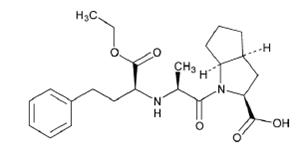
Structured Product Formula For Ramipril (9eac2e75 3766 4394 A435 547cdc840b42 01)
Its molecular formula is C23H32N2O5, and its molecular weight is 416.5.
Ramiprilat, the diacid metabolite of ramipril, is a non-sulfhydryl angiotensin converting enzyme inhibitor. Ramipril is converted to ramiprilat by hepatic cleavage of the ester group.
Each ramipril capsule, USP intended for oral administration contains 1.25 mg or 2.5 mg or 5 mg or 10 mg of ramipril, USP. In addition, each capsule contains the following inactive ingredients: gelatin, pregelatinized starch and titanium dioxide. Additionally each 1.25 mg capsule shell contains: FD&C red # 40, FD&C yellow # 5 and FD&C yellow # 6, 2.5 mg capsule shell contains: D&C yellow # 10 and FD&C red # 40, 5 mg capsule shell contains: FD&C blue # 1, FD&C red # 40 and FD&C yellow # 6 and 10 mg capsule shell contains:, D&C red # 28, D&C yellow # 10 and FD&C blue # 1. The capsule is printed with black pharmaceutical ink which contains black iron oxide as a coloring agent.
Manufactured by:
Cadila Healthcare Ltd.
Ahmedabad, India
Distributed by:
Zydus Pharmaceuticals (USA) Inc.
Pennington, NJ 08534
Rev.: 09/20