Other
Memantine hydrochloride extended-release capsules are indicated for the treatment of moderate to severe dementia of the Alzheimer's type.
Each capsule contains 7 mg, 14 mg, 21 mg or 28 mg of memantine hydrochloride.
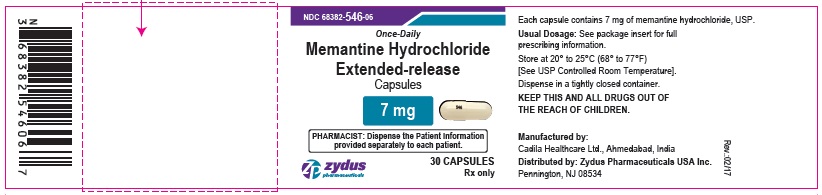
- Memantine hydrochloride extended-release capsules, 7 mg are white to off-white pellets filled in size '4' hard gelatin capsules with white opaque cap imprinted with '546' in black ink and white opaque body.
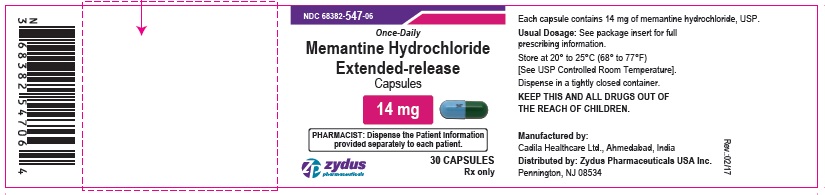
- Memantine hydrochloride extended-release capsules, 14 mg are white to off-white pellets filled in size '4' hard gelatin capsules with light blue opaque cap imprinted with '547' in black ink and green opaque body.
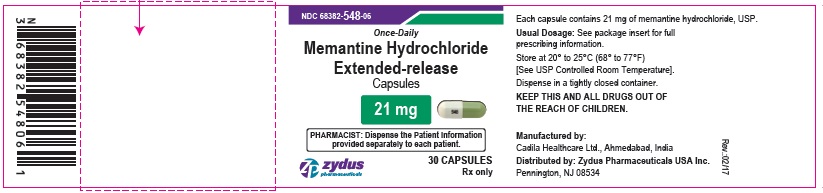
- Memantine hydrochloride extended-release capsules, 21 mg are white to off-white pellets filled in size '4' hard gelatin capsules with white opaque cap imprinted with '548' in black ink and green opaque body.
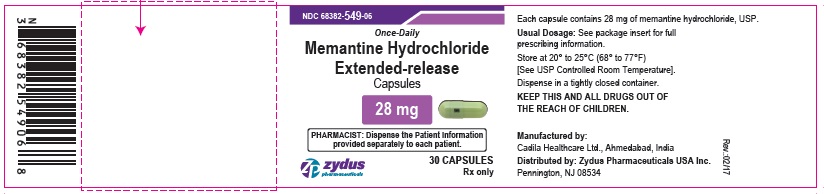
- Memantine hydrochloride extended-release capsules, 28 mg are white to off-white pellets filled in size '3' hard gelatin capsules with light green opaque cap imprinted with '549' in black ink and light green opaque body.
Memantine hydrochloride is contraindicated in patients with known hypersensitivity to memantine hydrochloride or to any excipients used in the formulation.
Signs and symptoms most often accompanying overdosage with other formulations of memantine in clinical trials and from worldwide marketing experience, alone or in combination with other drugs and/or alcohol, include agitation, asthenia, bradycardia, confusion, coma, dizziness, ECG changes, increased blood pressure, lethargy, loss of consciousness, psychosis, restlessness, slowed movement, somnolence, stupor, unsteady gait, visual hallucinations, vertigo, vomiting, and weakness. The largest known ingestion of memantine worldwide was 2 grams in an individual who took memantine in conjunction with unspecified antidiabetic medications. This person experienced coma, diplopia, and agitation, but subsequently recovered.
One patient participating in a memantine hydrochloride clinical trial unintentionally took 112 mg of memantine hydrochloride daily for 31 days and experienced an elevated serum uric acid, elevated serum alkaline phosphatase, and low platelet count.
Fatal outcome has been very rarely been reported with memantine, and the relationship to memantine was unclear.
Because strategies for the management of overdose are continually evolving, it is advisable to contact a poison control center to determine the latest recommendations for the management of an overdose of any drug. As in any cases of overdose, general supportive measures should be utilized, and treatment should be symptomatic. Elimination of memantine can be enhanced by acidification of urine.
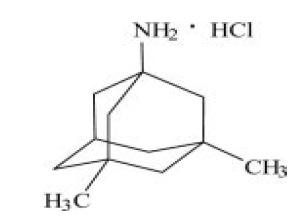
Memantine hydrochloride is an orally active NMDA receptor antagonist. The chemical name for memantine hydrochloride is 1-amino-3,5-dimethyladamantane hydrochloride with the following structural formula:
Memantine HCl Er Capsules (Ad59ebbd 2896 48a1 A53c 719c04593a9a 01)
The molecular formula is C12H21N•HCl and the molecular weight is 215.8. Memantine hydrochloride, USP occurs as white to off-white powder. It is slightly soluble in water.
Memantine hydrochloride extended-release capsules intended for oral administration contain 7 mg, 14 mg, 21 mg, or 28 mg of memantine hydrochloride. In addition, each capsule contains the following inactive ingredients: ethyl cellulose, gelatin, hypromellose, sodium lauryl sulfate, sugar spheres, talc, triethyl citrate and titanium dioxide. Additionally capsule shell of 14 mg contains FD&C blue 1, FD&C red 3, FD&C yellow 6 and iron oxide yellow. Capsule shell of 21 mg and 28 mg contains FD&C blue 2 and iron oxide yellow. The capsule shell is printed with black pharmaceutical ink which contains following ingredients: butyl alcohol, dehydrated alcohol, iron oxide black, isopropyl alcohol, potassium hydroxide, propylene glycol, shellac, strong ammonia solution and purified water.
The effectiveness of memantine hydrochloride as a treatment for patients with moderate to severe Alzheimer's disease was based on the results of a doubleblind, placebo-controlled trial.
24 week Study of memantine hydrochloride extended-release capsules
This was a randomized doubleblind clinical investigation in outpatients with moderate to severe Alzheimer's disease (diagnosed by DSM-IV criteria and NINCDS-ADRDA criteria for AD with a Mini Mental State Examination (MMSE) score ≥ 3 and ≤ 14 at Screening and Baseline) receiving acetylcholinesterase inhibitor (AChEI) therapy at a stable dose for 3 months prior to screening. The mean age of patients participating in this trial was 76.5 years with a range of 49-97 years. Approximately 72% of patients were female and 94% were Caucasian.
Study Outcome Measures
The effectiveness of memantine hydrochloride was evaluated in this study using the co-primary efficacy parameters of Severe Impairment Battery (SIB) and the Clinician's Interview-Based Impression of Change (CIBIC-Plus).
The ability of memantine hydrochloride to improve cognitive performance was assessed with the Severe Impairment Battery (SIB), a multi-item instrument that has been validated for the evaluation of cognitive function in patients with moderate to severe dementia. The SIB examines selected aspects of cognitive performance, including elements of attention, orientation, language, memory, visuospatial ability, construction, praxis, and social interaction. The SIB scoring range is from 0 to 100, with lower scores indicating greater cognitive impairment.
The ability of memantine hydrochloride to produce an overall clinical effect was assessed using a Clinician's Interview Based Impression of Change that required the use of caregiver information, the CIBIC-Plus. The CIBIC-Plus is not a single instrument and is not a standardized instrument like the ADCS-ADL or SIB. Clinical trials for investigational drugs have used a variety of CIBIC formats, each different in terms of depth and structure. As such, results from a CIBIC-Plus reflect clinical experience from the trial or trials in which it was used and cannot be compared directly with the results of CIBIC-Plus evaluations from other clinical trials. The CIBIC-Plus used in this trial was a structured instrument based on a comprehensive evaluation at baseline and subsequent time-points of four domains: general (overall clinical status), functional (including activities of daily living), cognitive, and behavioral. It represents the assessment of a skilled clinician using validated scales based on his/her observation during an interview with the patient, in combination with information supplied by a caregiver familiar with the behavior of the patient over the interval rated. The CIBIC-Plus is scored as a seven point categorical rating, ranging from a score of 1, indicating "marked improvement" to a score of 4, indicating "no change" to a score of 7, indicating "marked worsening." The CIBIC-Plus has not been systematically compared directly to assessments not using information from caregivers (CIBIC) or other global methods.
Study Results
In this study, 677 patients were randomized to one of the following 2 treatments: memantine hydrochloride 28 mg/day or placebo while still receiving an AChEI (either donepezil, galantamine, or rivastigmine).
Effects on Severe Impairment Battery (SIB)
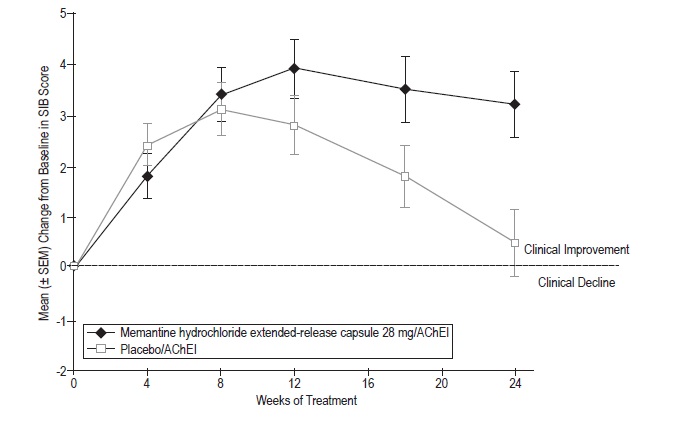
Figure 1 shows the time course for the change from baseline in SIB score for the two treatment groups completing the 24 weeks of the study. At 24 weeks of treatment, the mean difference in the SIB change scores for the memantine hydrochloride 28 mg/AChEI-treated (combination therapy) patients compared to the patients on placebo/AChEI (monotherapy) was 2.6 units. Using an LOCF analysis, memantine hydrochloride 28 mg/AChEI treatment was statistically significantly superior to placebo/AChEI.
Memantine HCl Er Capsules (Ad59ebbd 2896 48a1 A53c 719c04593a9a 02)
Figure 1: Time course of the change from baseline in SIB score for patients completing 24 weeks of treatment.
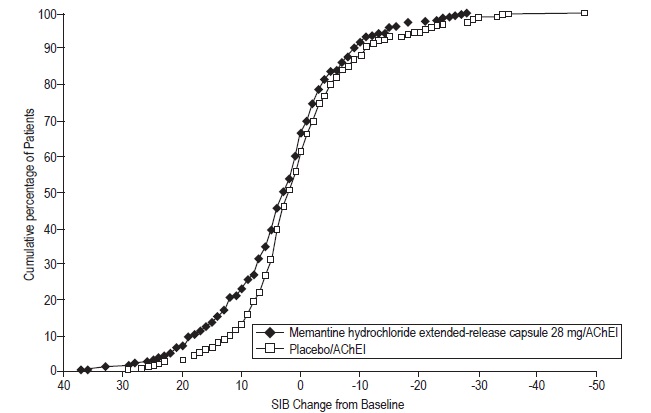
Figure 2 shows the cumulative percentages of patients from each treatment group who had attained at least the measure of improvement in SIB score shown on the X axis. The curves show that both patients assigned to memantine hydrochloride 28 mg/AChEI and placebo/AChEI have a wide range of responses, but that the memantine hydrochloride 28 mg/AChEI group is more likely to show an improvement or a smaller decline.
Memantine HCl Er Capsules (Ad59ebbd 2896 48a1 A53c 719c04593a9a 03)
Figure 2: Cumulative percentage of patients completing 24 weeks of doubleblind treatment with specified changes from baseline in SIB scores.
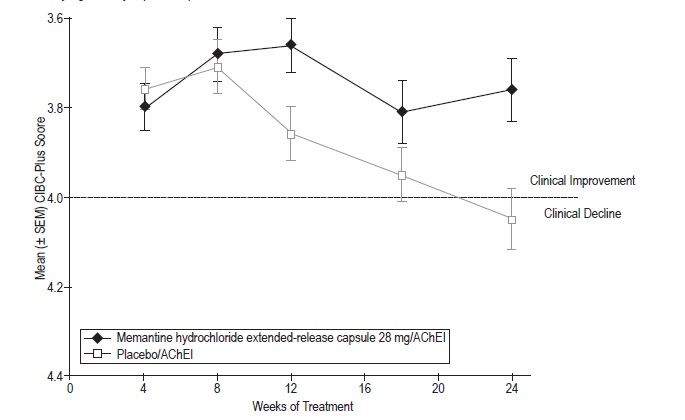
Figure 3 shows the time course for the CIBIC-Plus score for patients in the two treatment groups completing the 24 weeks of the study. At 24 weeks of treatment, the mean difference in the CIBIC-Plus scores for the memantine hydrochloride 28 mg/AChEI-treated patients compared to the patients on placebo/AChEI was 0.3 units. Using an LOCF analysis, memantine hydrochloride 28 mg/AChEI treatment was statistically significantly superior to placebo/AChEI.
Memantine HCl Er Capsules (Ad59ebbd 2896 48a1 A53c 719c04593a9a 04)
Figure 3: Time course of the CIBIC-Plus score for patients completing 24 weeks of treatment.
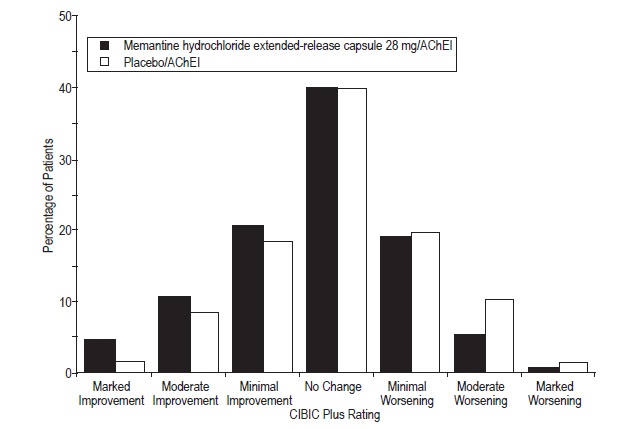
Figure 4 is a histogram of the percentage distribution of CIBIC-Plus scores attained by patients assigned to each of the treatment groups who completed 24 weeks of treatment.
Memantine HCl Er Capsules (Ad59ebbd 2896 48a1 A53c 719c04593a9a 05)
Figure 4: Distribution of CIBIC-Plus ratings at week 24
Memantine hydrochloride extended-release capsules, 7 mg are white to off-white pellets filled in size '4' hard gelatin capsules with white opaque cap imprinted with '546' in black ink and white opaque body and are supplied as follows:
NDC 68382-546-06 in bottle of 30 capsules
NDC 68382-546-16 in bottle of 90 capsules
NDC 68382-546-77 in unit-dose blister cartons of 100 (10 x 10) unit-dose capsules
Memantine hydrochloride extended-release capsules, 14 mg are white to off-white pellets filled in size '4' hard gelatin capsules with light blue opaque cap imprinted with '547' in black ink and green opaque body and are supplied as follows:
NDC 68382-547-06 in bottle of 30 capsules
NDC 68382-547-16 in bottle of 90 capsules
NDC 68382-547-77 in unit-dose blister cartons of 100 (10 x 10) unit-dose capsules
Memantine hydrochloride extended-release capsules, 21 mg are white to off-white pellets filled in size '4' hard gelatin capsules with white opaque cap imprinted with '548' in black ink and green opaque body and are supplied as follows:
NDC 68382-548-06 in bottle of 30 capsules
NDC 68382-548-16 in bottle of 90 capsules
NDC 68382-548-77 in unit-dose blister cartons of 100 (10 x 10) unit-dose capsules
Memantine hydrochloride extended-release capsules, 28 mg are white to off-white pellets filled in size '3' hard gelatin capsules with light green opaque cap imprinted with '549' in black ink and light green opaque body and are supplied as follows:
NDC 68382-549-06 in bottle of 30 capsules
NDC 68382-549-16 in bottle of 90 capsules
NDC 68382-549-77 in unit-dose blister cartons of 100 (10 x 10) unit-dose capsules
Storage
Store at 20° to 25°C (68° to 77°F) [See USP Controlled Room Temperature].
Dispense in a tightly closed container.
Manufactured by:
Cadila Healthcare Ltd.
Ahmedabad, India
Distributed by:
Zydus Pharmaceuticals USA Inc.
Pennington, NJ 08534
Rev.: 03/15
Revision Date: 2015/03/25
Manufactured by:
Cadila Healthcare Ltd.
Ahmedabad, India
Distributed by:
Zydus Pharmaceuticals USA Inc.
Pennington, NJ 08534
Rev.: 03/15
Revision Date: 2015/03/25