ADVERSE REACTIONS
Lisinopril Tablets have been found to be generally well tolerated in controlled clinical trials involving 1969 patients with hypertension or heart failure. For the most part, adverse experiences were mild and transient.
Hypertension
In clinical trials in patients with hypertension treated with Lisinopril Tablets, discontinuation of therapy due to clinical adverse experiences occurred in 5.7% of patients. The overall frequency of adverse experiences could not be related to total daily dosage within the recommended therapeutic dosage range.
For adverse experiences occurring in greater than 1% of patients with hypertension treated with Lisinopril Tablets or Lisinopril Tablets plus hydrochlorothiazide in controlled clinical trials, and more frequently with Lisinopril Tablets and/or Lisinopril Tablets plus hydrochlorothiazide than placebo, comparative incidence data are listed in the table below:
PERCENT OF PATIENTS IN CONTROLLED STUDIES
| LISINOPRIL
TABLETS
11=1349)
Incidence
| LISINOPRIL TABLETS/
Hydrochlorothiazide
(n=629)
Incidence
| LISINOPRIL TABLETS/
Hydrochlorothiazide
(n=629)
Incidence
|
| (discontinuation)
| (discontinuation)
| (discontinuation)
|
Body as a Whole
Fatigue
Asthenia
Orthostatic Effects
Cardiovascular
| 2.5 (0.3)
1.3 (0.5)
1.2 (0.0)
| 4.0 (0.5)
2.1 (0.2)
3.5 (0.2)
| 1.0 (0.0)
1.0 (0.0)
1.0 (0.0)
|
Hypotension
Digestive
Diarrhea
Nausea
Vomiting
Dyspepsia
Muscoloskeletal
Muscle Cramps
Nervous/Psychiatric
Headache
Dizziness
Paresthesia
Decreased Libido
Vertigo
Respiratory
Cough
Upper Respiratory Infection
Common Cold
Nasal Congestion
Influenza
Skin
Rash
Urogenital
Impotence
| 1.2 (0.5)
2.7 (0.2)
2.0 (0.4)
1.1 (0.2)
0.9 (0.0)
0.5 (0.0)
5.7 (0.2)
5.4 (0.4)
0.8 (0.1)
0.4 (0.1)
0.2 (0.1)
3.5 (0.7)
2.1 (0.1)
1.1 (0.1)
0.4 (0.1)
0.3 (0.1)
1.3 (0.4)
1.0 (0.4)
| 1.6 (0.5)
2.7 (0.3)
2.5 (0.2)
1.4 (0.1)
1.9 (0.0)
2.9 (0.8)
4.5 (0.5)
9.2 (1.0)
2.1 (0.2)
1.3 (0.1)
1.1 (0.2)
4.6 (0.8)
2.7 (0 1)
1.3 (0.1)
1.3 (0.1)
1.1 (0.1)
1.6 (0.2)
1.6 (0.5)
| 0.5 (0.5)
2.4 (0.0)
2.4 (0.0)
0.5 (0.0)
0.0 (0.0)
0.5 (0.0)
1.9 (0.0)
1.9 (0.0)
0.0 (0.0)
0.0 (0.0)
0.0 (0.0)
1.0 (0.0)
0.0 (0.0)
0.0 (0.0)
0.0 (0.0)
0.0 (0.0)
0.5 (0.5)
0.0 (0.0)
|
Chest pain and back pain were also seen, but were more common on placebo than lisinopril.
Heart Failure
In patients with heart failure treated with lisinopril for up to four years, discontinuation of therapy due to clinical adverse experiences occurred in 11.0% of patients. In controlled studies in patients with heart failure, therapy was discontinued in 8.1% of patients treated with lisinopril for 12 weeks, compared to 7.7% of patients treated with placebo for 12 weeks.
The following table lists those adverse experiences which occurred in greater than 1% of patients with heart failure treated with lisinopril or placebo for up to 12 weeks in controlled clinical trials, and more frequently on lisinopril than placebo.
| LISINOPRIL
| Controlled Trials
Placebo
|
Body as a Whole
Chest Pain
Abdominal Pain
Cardiovascular
Hypotension
Digestive
Diarrhea
Nervous/Psychiatric
Dizziness
Headache
Respiratory
Upper Respiratory Infection
Skin
Rash
| (n=407)
Incidence
(discontinuation)
12 weeks
3.4 (0.2)
2.2 (0.7)
4.4 (1.7)
3.7 (0.5)
11.8 (1.2}
4.4 (0.2)
1.5 (0.0)
1.7 (0.5)
| (n-155)
Incidence
(discontinuation)
12 weeks
1.3 (0.0)
1.9 (0.0)
0.6 (0.6)
1.7 (0.5)
4.5 (1.3)
3.9 (0.0)
1.3 (0.0)
0.6 (0.6)
|
Also observed at greater than 1% with Lisinopril Tablets but more frequent or as frequent on placebo than Lisinopril Tablets in controlled trials
were asthenia, angina pectoris, nausea, dyspnea, cough, and pruritus.
Worsening of heart failure, anorexia, increased salivation, muscle cramps, back pain, myalgia, depression, chest sound abnormalities, and pulmonary edema were also seen in controlled clinical trials, but were more common on placebo than Lisinopril Tablets.
In the two-dose ATLAS trial in heart failure patients, withdrawals due to adverse events were not different between the low and high groups, either in total number of discontinuation (17-18%) or in rare specific events (less than1%). The following adverse events, mostly related to ACE inhibition, were reported more commonly in the high dose group
% of patients
Events
| High Dose
(N=1568)
| Low Dose
(N=1596)
|
Dizziness
| 18.9
| 12.1
|
Hypotension
| 10.8
| 6.7
|
Creatinine increased
| 9.9
| 7.0
|
Hyperkalemia
| 6.4
| 3.5
|
NPNi increased
| 9.2
| 6.5
|
Syncope
| 7.0
| 5.1
|
i NPN = non-protein nitrogen
| i NPN = non-protein nitrogen
| i NPN = non-protein nitrogen
|
Acute Myocardial Infarction:
In the GISSI-3 trial, in patients treated with Lisinopril Tablets for six weeks following acute myocardial infarction, discontinuation of therapy occurred in 17.6% of patients.
Patients treated with Lisinopril Tablets had a significantly higher incidence of hypotension and renal dysfunction compared with patients not taking Lisinopril Tablets.
In the GISSI-3 trial, hypotension (9.7%), renal dysfunction (2.0%), cough (0.5%), post-infarction angina (0.3%), skin rash and generalized edema (0.01%), and angioedema (0.01%) resulted in withdrawal of treatment. In elderly patients treated with Lisinopril Tablets, discontinuation due to renal dysfunction was 4.2%.
Other clinical adverse experiences occurring in 0.3% to 1.0% of patients with hypertension or heart failure treated with Lisinopril Tablets in controlled clinical trials and rarer, serious, possibly drug-related events reported in uncontrolled studies or marketing experience are listed below, and within each category are in order of decreasing severity:
Body as a Whole:
Anaphylactoid reactions (see WARNINGS, Anaphylactoid and Possibly Related Reactions), syncope, orthostatic effects, chest discomfort, pain, pelvic pain, flank pain, edema, facial edema, virus infection, fever, chills, malaise.
Cardiovascular:
Cardiac arrest; myocardial infarction or cerebrovascular accident possibly secondary to excessive hypotension in high risk patients (see WARNINGS, Hypotension); pulmonary embolism and infarction, arrhythmias (including ventricular tachycardia, atrial tachycardia, atrial fibrillation, bradycardia and premature ventricular contractions), palpitations, transient ischemic attacks, paroxysmal nocturnal dyspnea, orthostatic hypotension, decreased blood pressure, peripheral edema, vasculitis.
Digestive:
Pancreatitis, hepatitis (hepatocellular or cholestatic jaundice) (see WARNINGS, Hepatic Failure), vomiting, gastritis, dyspepsia, heartburn, gastrointestinal cramps, constipation, flatulence, dry mouth.
Hematologic:
Rare cases of bone marrow depression, hemolytic anemia, leukopenia/neutropenia and thrombocytopenia.
Endocrine:
Diabetes mellitus, inappropriate antidiuretic hormone secretion.
Metabolic:
Weight loss, dehydration, fluid overload, gout, weight gain.
Cases of hypoglycemia in diabetic patients on oral antidiabetic agents or insulin have been reported in post-marketing experience (see PRECAUTIONS, Drug Interactions).
Musculoskeletal:
Arthritis, arthralgia, neck pain, hip pain, low back pain, joint pain, leg pain, knee pain, shoulder pain, arm pain, lumbago.
Nervous System/Psychiatric:
Stroke, ataxia, memory impairment, tremor, peripheral neuropathy (e.g., dysesthesia), spasm, paresthesia, confusion, insomnia, somnolence, hypersomnia, irritability, nervousness and mood alterations (including depressive symptoms).
Respiratory System:
Malignant lung neoplasms, hemoptysis, pulmonary infiltrates, bronchospasm, asthma, pleural effusion, pneumonia, eosinophilic pneumonitis, bronchitis, wheezing, orthopnea, painful respiration, epistaxis, laryngitis, sinusitis, pharyngeal pain, pharyngitis, rhinitis, rhinorrhea.
Skin:
Urticaria, alopecia, herpes zoster, photosensitivity, skin lesions, skin infections, pemphigus, erythema, flushing, diaphoresis, cutaneous pseudolymphoma. Other severe skin reactions have been reported rarely, including toxic epidermal necrolysis and Stevens-Johnson Syndrome; causal relationship has not been established.
Special Senses:
Visual loss, diplopia, blurred vision, tinnitus, photophobia, taste disturbances, olfactory disturbance.
Urogenital System:
Acute renal failure, oliguria, anuria, uremia, progressive azotemia, renal dysfunction, (see PRECAUTIONS and DOSAGE AND ADMINISTRATION), pyelonephritis, dysuria, urinary tract infection, breast pain.
Miscellaneous:
A symptom complex has been reported which may include a positive ANA, an elevated erythrocyte sedimentation rate, arthralgia/arthritis, myalgia, fever, vasculitis, eosinophilia and leukocytosis. Rash, photosensitivity or other dermatological manifestations may occur alone or in combination with these symptoms.
Angioedema:
Angioedema has been reported in patients receiving Lisinopril Tablets with an incidence higher in Black than in non-Black patients.
Angioedema associated with laryngeal edema may be fatal. If angioedema of the face, extremities, lips, tongue, glottis and/or larynx occurs, treatment with Lisinopril Tablets should be discontinued and appropriate therapy instituted immediately. (See WARNINGS.)
In rare cases, intestinal angioedema has been reported in post marketing experience.
Hypotension:
In hypertensive patients, hypotension occurred in 1.2% and syncope occurred in 0.1% of patients with an incidence higher in Black than in non-Black patients. Hypotension or syncope was a cause of discontinuation of therapy in 0.5% of hypertensive patients. In patients with heart failure, hypotension occurred in 5.3% and syncope occurred in 1.8% of patients. These adverse experiences were possibly dose related (see above data from ATLAS Trial) and caused discontinuation of therapy in 1.8% of these patients in the symptomatic trials. In patients treated with Lisinopril Tablets for six weeks after acute myocardial infarction, hypotension (systolic blood pressure £100 mmHg) resulted in discontinuation of therapy in 9.7% of the patients. (See WARNINGS.)
Fetal/Neonatal Morbidity and Mortality:
See WARNINGS, Fetal/Neonatal Morbidity and Mortality.
Cough:
See PRECAUTIONS - Cough
Pediatric Patients:
No relevant differences between the adverse experience profile for pediatric patients and that previously reported for adult patients were identified.
Clinical Laboratory Test Findings
Serum Electrolytes:
Hyperkalemia (See PRECAUTIONS), hyponatremia.
Creatinine, Blood Urea Nitrogen:
Minor increases in blood urea nitrogen and serum creatinine, reversible upon discontinuation of therapy, were observed in about
2.0% of patients with essential hypertension treated with Lisinopril Tablets alone. Increases were more common in patients receiving
concomitant diuretics and in patients with renal artery stenosis. (See PRECAUTIONS.) Reversible minor increases in blood urea
nitrogen and serum creatinine were observed in approximately 11.6% of patients with heart failure on concomitant diuretic therapy.
Frequently, these abnormalities resolved when the dosage of the diuretic was decreased.
Liver Function Tests:
Rarely, elevations of liver enzymes and/or serum bilirubin have occurred. (See WARNINGS, Hepatic Failure.)
In hypertensive patients, 2.0% discontinued therapy due to laboratory adverse experiences, principally elevations in blood urea
nitrogen (0.6%), serum creatinine (0.5%) and serum potassium (0.4%).
In the heart failure trials, 3.4% of patients discontinued therapy due to laboratory adverse experiences; 1.8% due to elevations in blood
urea nitrogen and/or creatinine and 0.6% due to elevations in serum potassium.
In the myocardial infarction trial, 2.0% of patients receiving Lisinopril Tablets discontinued therapy due to renal dysfunction (increasing creatinine concentration to over 3 mg/dL or a doubling or more of the baseline serum creatinine concentration); le ss than 1.0% of patients discontinued therapy due to other laboratory adverse experiences: 0.1% with hyperkalemia and less than 0.1% withhepatic enzyme alterations.
To report SUSPECTED ADVERSE REACTIONS, contact West-ward Pharmaceutical Corp. at 1-877-233 2001 or the FDA at 1-800-FDA-1088 or www.fda.gov/medwatch.
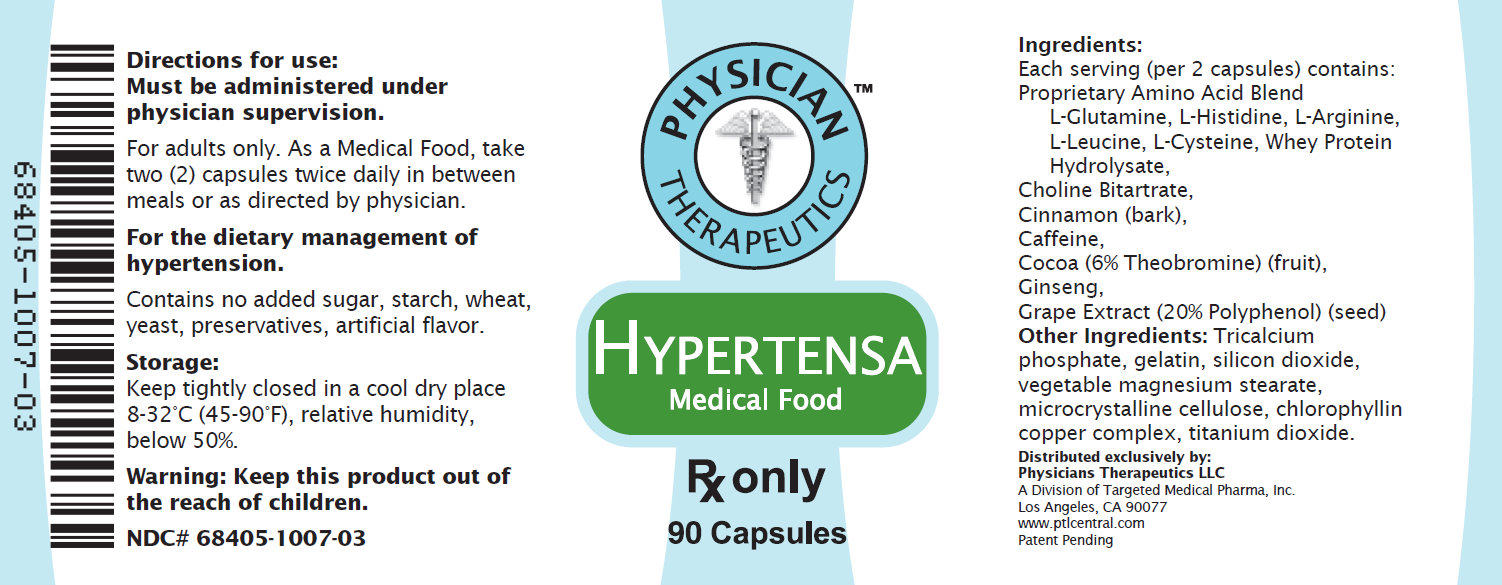
ADVERSE REACTIONS Oral supplementation with L-arginine at high doses up to 15 grams daily is generally well tolerated. The most commonly reported adverse reactions at higher doses — from 15 to 30 grams daily — are nausea, abdominal cramps, and diarrhea. Some patients may experience these symptoms at lower doses. The total combined amount of amino acids in each Hypertensa capsule does not exceed 400 mg.