The efficacy of fulvestrant 500 mg versus fulvestrant 250 mg was compared in CONFIRM. The efficacy of fulvestrant 250 mg was compared to 1 mg anastrozole in Studies 0020 and 0021. The efficacy of fulvestrant 500 mg was compared to 1 mg anastrozole in FALCON.
Monotherapy
Comparison of Fulvestrant 500 mg and Fulvestrant 250 mg (CONFIRM)
A randomized, double-blind, controlled clinical trial (CONFIRM, NCT00099437) was completed in 736 postmenopausal women with advanced breast cancer who had disease recurrence on or after adjuvant endocrine therapy or progression following endocrine therapy for advanced disease. This trial compared the efficacy and safety of fulvestrant 500 mg (n=362) with fulvestrant 250 mg (n=374).
Fulvestrant 500 mg was administered as two 5 mL injections each containing fulvestrant 250 mg/5 mL, one in each buttock, on Days 1, 15, 29 and every 28 (+/-3) days thereafter. Fulvestrant 250 mg was administered as two 5 mL injections (one containing fulvestrant 250 mg/5 mL injection plus one placebo injection), one in each buttock, on Days 1, 15 (2 placebo injections only), 29, and every 28 (+/-3) days thereafter.
The median age of study participants was 61 years. All patients had ER+ advanced breast cancer. Approximately 30% of subjects had no measurable disease. Approximately 55% of patients had visceral disease.
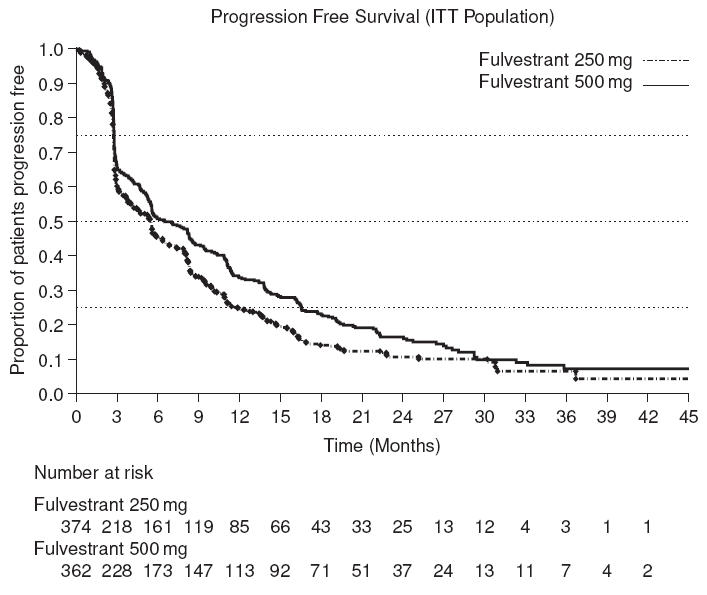
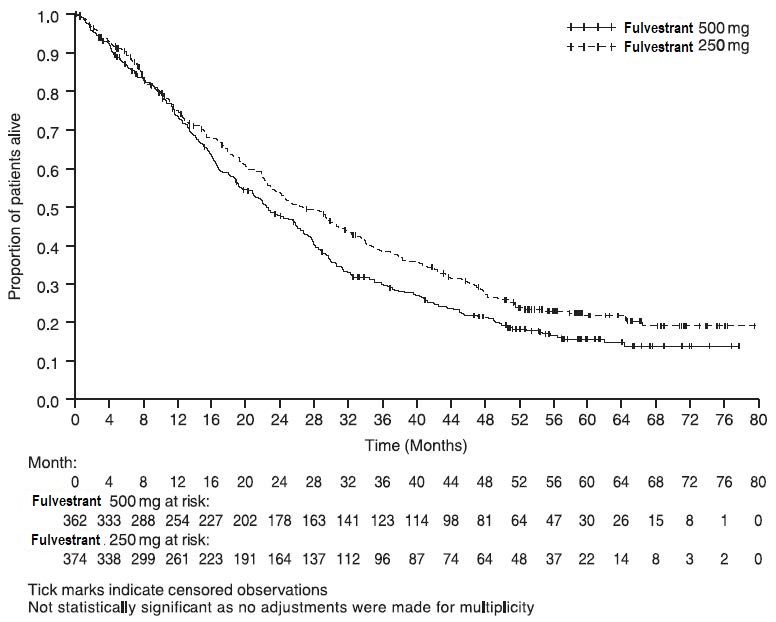
Results of CONFIRM are summarized in Table 12. The efficacy of fulvestrant 500 mg was compared to that of fulvestrant 250 mg. Figure 6 shows a Kaplan-Meier plot of the Progression Free Survival (PFS) data after a minimum follow-up duration of 18 months demonstrating statistically significant superiority of fulvestrant 500 mg vs. fulvestrant 250 mg. In the initial Overall Survival (OS) analysis after a minimum follow-up duration of 18 months, there was no statistically significant difference in OS between the two treatment groups. After a minimum follow-up duration of 50 months, an updated OS analysis was performed. Figure 7 shows a Kaplan-Meier plot of the updated OS data.
Table 12: Efficacy Results in CONFIRM (Intent-To-Treat (ITT) Population)
Endpoint | Fulvestrant 500 mg N=362 | Fulvestrant 250 mg N=374 |
PFS1 Median (months) | 6.5 | 5.4 |
Hazard Ratio2 (95% CI3) | 0.80 (0.68 to 0.94) |
p-value | 0.006 |
|
OS4 Updated Analysis5 (% patients who died) | 261 (72.1%) | 293 (78.3%) |
Median OS (months) | 26.4 | 22.3 |
Hazard Ratio2 (95% CI3)6 | 0.81 (0.69 to 0.96) |
|
ORR7 (95% CI3) | 13.8% (9.7%, 18.8%) (33/240) | 14.6% (10.5%, 19.4%) (38/261) |
1PFS (Progression Free Survival) = the time between randomization and the earliest of progression or death from any cause. Minimum follow-up duration of 18 months.
2Hazard Ratio <1 favors fulvestrant 500 mg.
3CI=Confidence Interval
4OS=Overall Survival
5Minimum follow up duration of 50 months.
6Not statistically significant as no adjustments were made for multiplicity.
7ORR (Objective Response Rate), as defined as number (%) of patients with complete response or partial response, was analyzed in the evaluable patients with measurable disease at baseline (fulvestrant 500 mg N=240; fulvestrant 250 mg N=261). Minimum follow-up duration of 18 months.
Figure 6 Kaplan-Meier PFS: CONFIRM ITT Population
Figure 7 Kaplan-Meier OS (Minimum Follow-up Duration of 50 Months): CONFIRM ITT Population
Comparison of Fulvestrant 500 mg and Anastrozole 1 mg (FALCON)
A randomized, double-blind, double-dummy, multi-center study (FALCON, NCT01602380) of fulvestrant 500 mg versus anastrozole 1 mg was conducted in postmenopausal women with ER-positive and/or PgR-positive, HER2-negative locally advanced or metastatic breast cancer who had not previously been treated with any hormonal therapy. A total of 462 patients were randomized 1:1 to receive administration of fulvestrant 500 mg as an intramuscular injection on Days 1, 15, 29, and every 28 (+/-3) days thereafter or daily administration of 1 mg of anastrozole orally. This study compared the efficacy and safety of fulvestrant 500 mg and anastrozole 1 mg.
Randomization was stratified by disease setting (locally advanced or metastatic), use of prior chemotherapy for advanced disease, and presence or absence of measurable disease.
The major efficacy outcome measure of the study was investigator-assessed progression-free survival (PFS) evaluated according to RECIST v.1.1 (Response Evaluation Criteria in Solid Tumors). Key secondary efficacy outcome measures included overall survival (OS), objective response rate (ORR), and duration of response (DoR).
Patients enrolled in this study had a median age of 63 years (range 36 to 90). The majority of patients (87%) had metastatic disease at baseline. Fifty-five percent (55%) of patients had visceral metastasis at baseline. A total of 17% of patients had received one prior chemotherapy regimen for advanced disease; 84% of patients had measurable disease. Sites of metastases were as follows: musculoskeletal 59%, lymph nodes 50%, respiratory 40%, liver (including gall bladder) 18%.
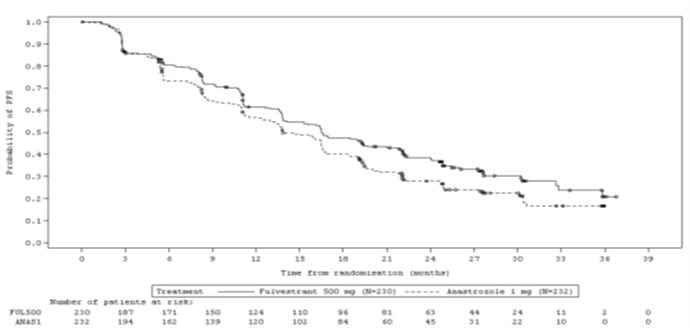
The efficacy results of FALCON are presented in Table 13 and Figure 8.
Table 13: Efficacy Results in FALCON (Investigator Assessment, ITT Population)
| Fulvestrant
500 mg
N=230 | Anastrozole
1 mg
N=232 |
Progression-Free Survival |
Number of PFS Events (%) | 143 (62.2%) | 166 (71.6%) |
Median PFS (months) | 16.6 | 13.8 |
PFS Hazard Ratio (95% CI) | 0.797 (0.637 to 0.999) |
p-value | 0.049 |
Overall Survival1 | | |
Number of OS Events | 67 (29.1%) | 75 (32.3%) |
Median OS (months) | NR | NR |
OS Hazard Ratio (95% CI) | 0.874 (0.629 to 1.216) |
Objective Response for Patients with Measurable Disease | N=193 | N=196 |
Objective Response Rate (%, 95% CI) | 46.1% (38.9%, 53.4%) | 44.9% (37.8%, 52.1%) |
Median DoR (months) | 20 | 13.2 |
NR: Not reached
1Interim OS analysis with 61% of total number of events required for the final OS analysis.
Figure 8 Kaplan-Meier Plot of Progression-Free Survival (Investigator Assessment, ITT Population) ─ FALCON
Comparison of Fulvestrant 250 mg and Anastrozole 1 mg in Combined Data (Studies 0020 and 0021)
Efficacy of fulvestrant was established by comparison to the selective aromatase inhibitor anastrozole in two randomized, controlled clinical trials (one conducted in North America, Study 0021, NCT00635713; the other predominantly in Europe, Study 0020) in postmenopausal women with locally advanced or metastatic breast cancer. All patients had progressed after previous therapy with an antiestrogen or progestin for breast cancer in the adjuvant or advanced disease setting.
The median age of study participants was 64 years. 81.6% of patients had ER+ and/or PgR+ tumors. Patients with ER-/PgR-or unknown tumors were required to have demonstrated a prior response to endocrine therapy. Sites of metastases occurred as follows: visceral only 18.2%; viscera – liver involvement 23%; lung involvement 28.1%; bone only 19.7%; soft tissue only 5.2%; skin and soft tissue 18.7%.
In both trials, eligible patients with measurable and/or evaluable disease were randomized to receive either fulvestrant 250 mg intramuscularly once a month (28 days + 3 days) or anastrozole 1 mg orally once a day. All patients were assessed monthly for the first three months and every three months thereafter. Study 0021 was a double-blind, randomized trial in 400 postmenopausal women. Study 0020 was an open-label, randomized trial conducted in 451 postmenopausal women. Patients on the fulvestrant arm of Study 0021 received two separate injections (2 x 2.5 mL), whereas fulvestrant patients received a single injection (1 x 5 mL) in Study 0020. In both trials, patients were initially randomized to a 125 mg per month dose as well, but interim analysis showed a very low response rate, and low dose groups were dropped.
Results of the trials, after a minimum follow-up duration of 14.6 months, are summarized in Table 14. The effectiveness of fulvestrant 250 mg was determined by comparing Objective Response Rate (ORR) and Time to Progression (TTP) results to anastrozole 1 mg, the active control. The two studies ruled out (by one-sided 97.7% confidence limit) inferiority of fulvestrant to anastrozole of 6.3% and 1.4% in terms of ORR. There was no statistically significant difference in overall survival (OS) between the two treatment groups after a follow-up duration of 28.2 months in Study 0021 and 24.4 months in Study 0020.
Table 14: Efficacy Results in Studies 0020 and 0021 (Objective Response Rate (ORR) and Time to Progression (TTP))
| Study 0021 (Double-Blind) | Study 0020 (Open-Label) |
| FULVESTRANT | Anastrozole | FULVESTRANT | Anastrozole |
Endpoint | 250 mg N=206 | 1 mg N=194 | 250 mg N=222 | 1 mg N=229 |
Objective Tumor Response Number (%) of subjects with CR1 + PR2 | 35 (17.0) | 33 (17.0) | 45 (20.3) | 34 (14.9) |
% Difference in Tumor Response Rate (FAS3-ANA4) 2–sided 95.4% CI5 | 0.0 (-6.3, 8.9) | 5.4 (-1.4, 14.8) |
| | | | |
Time to Progression (TTP) Median TTP (days) | 165 | 103 | 166 | 156 |
Hazard Ratio6 2-sided 95.4% CI | 0.9 (0.7, 1.1) | 1.0 (0.8, 1.2) |
Stable Disease for ≥24 weeks (%) | 26.7 | 19.1 | 24.3 | 30.1 |
Overall Survival (OS) | | | | |
Died n (%) Median Survival (days) | 152 (73.8%) 844 | 149 (76.8%) 913 | 167 (75.2%) 803 | 173 (75.5%) 736 |
Hazard Ratio6 (2-sided 95% CI) | 0.98 (0.78, 1.24) | 0.97 (0.78, 1.21) |
| | | | |
1CR = Complete Response
2PR = Partial Response
3FAS = FULVESTRANT
4ANA = anastrozole
5CI = Confidence Interval
6Hazard Ratio < 1 favors FULVESTRANT