In rare cases, oral contraceptives can cause benign but dangerous liver tumors. These benign liver tumors can rupture and cause fatal internal bleeding. In addition, some studies report an increased risk of developing liver cancer. However, liver cancers are rare.
- 5.Cancer of the reproductive organs and breasts
Various studies give conflicting reports on the relationship between breast cancer and oral contraceptive use. Oral contraceptive use may slightly increase your chance of having breast cancer diagnosed, particularly after using hormonal contraceptives at a younger age. After you stop using hormonal contraceptives, the chances of having breast cancer diagnosed begin to go back down. You should have regular breast examinations by a healthcare professional and examine your own breasts monthly. Tell your healthcare professional if you have a family history of breast cancer or if you have had breast nodules or an abnormal mammogram. Women who currently have or have had breast cancer should not use oral contraceptives because breast cancer is usually a hormone-sensitive tumor.
Some studies have found an increase in the incidence of cancer of the cervix in women who use oral contraceptives. However, this finding may be related to factors other than the use of oral contraceptives. There is insufficient evidence to rule out the possibility that the pill may cause such cancers.
ESTIMATED RISK OF DEATH FROM A BIRTH CONTROL METHOD OR PREGNANCY
All methods of birth control and pregnancy are associated with a risk of developing certain diseases which may lead to disability or death. An estimate of the number of deaths associated with different methods of birth control and pregnancy has been calculated and is shown in the following table.
ANNUAL NUMBER OF BIRTH-RELATED OR METHOD-RELATED DEATHS ASSOCIATED WITH CONTROL OF FERTILITY PER 100,000 NONSTERILE WOMEN, BY FERTILITY CONTROL METHOD ACCORDING TO AGE| Method of control and outcome | 15 to 19 | 20 to 24 | 25 to 29 | 30 to 34 | 35 to 39 | 40 to 44 |
|---|
No fertility-control methods | 7.0 | 7.4 | 9.1 | 14.8 | 25.7 | 28.2 |
Oral contraceptives non-smoker | 0.3 | 0.5 | 0.9 | 1.9 | 13.8 | 31.6 |
Oral contraceptives smoker | 2.2 | 3.4 | 6.6 | 13.5 | 51.1 | 117.2 |
IUD | 0.8 | 0.8 | 1.0 | 1.0 | 1.4 | 1.4 |
Condom | 1.1 | 1.6 | 0.7 | 0.2 | 0.3 | 0.4 |
Diaphragm/ spermicide | 1.9 | 1.2 | 1.2 | 1.3 | 2.2 | 2.8 |
Periodic abstinence | 2.5 | 1.6 | 1.6 | 1.7 | 2.9 | 3.6 |
In the above table, the risk of death from any birth control method is less than the risk of childbirth, except for oral contraceptive users over the age of 35 who smoke and pill users over the age of 40 even if they do not smoke. It can be seen in the table that for women aged 15 to 39, the risk of death was highest with pregnancy (7 to 26 deaths per 100,000 women, depending on age). Among pill users who do not smoke, the risk of death was always lower than that associated with pregnancy for any age group, although over the age of 40, the risk increases to 32 deaths per 100,000 women, compared to 28 associated with pregnancy at that age. However, for pill users who smoke and are over the age of 35, the estimated number of deaths exceeds those for other methods of birth control. If a woman is over the age of 40 and smokes, her estimated risk of death is four times higher (117/100,000 women) than the estimated risk associated with pregnancy (28/100,000 women) in that age group.
The suggestion that women over 40 who do not smoke should not take oral contraceptives is based on information from older, higher-dose pills. An Advisory Committee of the FDA discussed this issue in 1989 and recommended that the benefits of low-dose oral contraceptive use by healthy, non-smoking women over 40 years of age may outweigh the possible risks.
WARNING SIGNALS
If any of these adverse effects occur while you are taking oral contraceptives, call your healthcare professional immediately:
- Sharp chest pain, coughing of blood, or sudden shortness of breath (indicating a possible clot in the lung)
- Pain in the calf (indicating a possible clot in the leg)
- Crushing chest pain or heaviness in the chest (indicating a possible heart attack)
- Sudden severe headache or vomiting, dizziness or fainting, disturbances of vision or speech, weakness, or numbness in an arm or leg (indicating a possible stroke)
- Sudden partial or complete loss of vision (indicating a possible clot in the eye)
- Breast lumps (indicating possible breast cancer or fibrocystic disease of the breast; ask your healthcare professional to show you how to examine your breasts)
- Severe pain or tenderness in the stomach area (indicating a possibly ruptured liver tumor)
- Difficulty in sleeping, weakness, lack of energy, fatigue, or change in mood (possibly indicating severe depression)
- Jaundice or a yellowing of the skin or eyeballs, accompanied frequently by fever, fatigue, loss of appetite, dark colored urine, or light colored bowel movements (indicating possible liver problems)
SIDE EFFECTS OF ORAL CONTRACEPTIVES
1. Vaginal bleeding
Irregular vaginal bleeding or spotting may occur while you are taking the pills. Irregular bleeding may vary from slight staining between menstrual periods to breakthrough bleeding which is a flow much like a regular period. Irregular bleeding occurs most often during the first few months of oral contraceptive use, but may also occur after you have been taking the pill for some time. Such bleeding may be temporary and usually does not indicate any serious problems. It is important to continue taking your pills on schedule. If the bleeding occurs in more than one cycle or lasts for more than a few days, talk to your healthcare professional.
2. Contact lenses
If you wear contact lenses and notice a change in vision or an inability to wear your lenses, contact your healthcare professional.
3. Fluid retention
Oral contraceptives may cause edema (fluid retention) with swelling of the fingers or ankles and may raise your blood pressure. If you experience fluid retention, contact your healthcare professional.
4. Melasma
A spotty darkening of the skin is possible, particularly of the face, which may persist.
5. Other side effects
Other side effects may include nausea, vomiting and diarrhea, muscle cramps, change in appetite, headache, nervousness, depression, dizziness, loss of scalp hair, rash, vaginal infections, pancreatitis, skin sensitivity to the sun or ultraviolet and allergic reactions.
If any of these side effects bother you, call your healthcare professional.
GENERAL PRECAUTIONS
1. Missed periods and use of oral contraceptives before or during early pregnancy
There may be times when you may not menstruate regularly after you have completed taking a cycle of pills. If you have taken your pills regularly and miss one menstrual period, continue taking your pills for the next cycle but be sure to inform your healthcare professional before doing so. If you have not taken the pills daily as instructed and missed a menstrual period, you may be pregnant. If you missed two consecutive menstrual periods, you may be pregnant. Check with your healthcare professional immediately to determine whether you are pregnant. Do not continue to take oral contraceptives until you are sure you are not pregnant, but continue to use another method of contraception.
There is no conclusive evidence that oral contraceptive use is associated with an increase in birth defects, when taken inadvertently during early pregnancy. Previously, a few studies had reported that oral contraceptives might be associated with birth defects, but these findings have not been seen in more recent studies. Nevertheless, oral contraceptives should not be used during pregnancy. You should check with your healthcare professional about risks to your unborn child of any medication taken during pregnancy.
2. While breastfeeding
If you are breastfeeding, consult your healthcare professional before starting oral contraceptives. Some of the drug will be passed on to the child in the milk. A few adverse effects on the child have been reported, including yellowing of the skin (jaundice) and breast enlargement. In addition, combined oral contraceptives may decrease the amount and quality of your milk. If possible, do not use combined oral contraceptives while breastfeeding. You should use another method of contraception since breastfeeding provides only partial protection from becoming pregnant and this partial protection decreases significantly as you breastfeed for longer periods of time. You should consider starting combined oral contraceptives only after you have weaned your child completely.
3. Laboratory tests
If you are scheduled for any laboratory tests, tell your healthcare professional you are taking birth control pills. Certain blood tests may be affected by birth control pills.
4. Drug interactions
Tell your healthcare provider about all medicines and herbal products that you take.
Some medicines and herbal products may make hormonal birth control less effective, including, but not limited to:
- certain seizure medicines (carbamazepine, felbamate, oxcarbazepine, phenytoin, rufinamide, and topiramate)
- aprepitant
- barbiturates
- bosentan
- colesevelam
- griseofulvin
- certain combinations of HIV medicines (nelfinavir, ritonavir, ritonavir-boosted protease inhibitors)
- certain non-nucleoside reverse transcriptase inhibitors (nevirapine)
- rifampin and rifabutin
- St. John's wort
Use another birth control method (such as a condom and spermicide or diaphragm and spermicide) when you take medicines that may make ALYACEN 7/7/7 and ALYACEN 1/35 less effective.
Some medicines and grapefruit juice may increase your level of the hormone ethinyl estradiol if used together, including:
- acetaminophen
- ascorbic acid
- medicines that affect how your liver breaks down other medicines (itraconazole, ketoconazole, voriconazole, and fluconazole)
- certain HIV medicines (atazanavir, indinavir)
- atorvastatin
- rosuvastatin
- etravirine
Hormonal birth control methods may interact with lamotrigine, a seizure medicine used for epilepsy. This may increase the risk of seizures, so your healthcare provider may need to adjust the dose of lamotrigine.
Women on thyroid replacement therapy may need increased doses of thyroid hormone.
Know the medicines you take. Keep a list of them to show your doctor and pharmacist when you get a new medicine.
5. Sexually transmitted diseases
This product (like all oral contraceptives) is intended to prevent pregnancy. It does not protect against transmission of HIV (AIDS) and other sexually transmitted diseases such as chlamydia, genital herpes, genital warts, gonorrhea, hepatitis B, and syphilis.
HOW TO TAKE THE PILL
IMPORTANT POINTS TO REMEMBER |
BEFORE YOU START TAKING YOUR PILLS:
- 1.BE SURE TO READ THESE DIRECTIONS:
Before you start taking your pills.
Anytime you are not sure what to do. - 2.THE RIGHT WAY TO TAKE THE PILL IS TO TAKE ONE PILL EVERY DAY AT THE SAME TIME.
If you miss pills you could get pregnant. This includes starting the pack late.
The more pills you miss, the more likely you are to get pregnant. - 3.MANY WOMEN HAVE SPOTTING OR LIGHT BLEEDING, OR MAY FEEL SICK TO THEIR STOMACH DURING THE FIRST 1 TO 3 PACKS OF PILLS. If you feel sick to your stomach, do not stop taking the pill. The problem will usually go away. If it doesn't go away, check with your healthcare professional.
- 4.MISSING PILLS CAN ALSO CAUSE SPOTTING OR LIGHT BLEEDING, even when you make up these missed pills. On the days you take 2 pills to make up for missed pills, you could also feel a little sick to your stomach.
- 5.IF YOU HAVE VOMITING OR DIARRHEA, or IF YOU TAKE SOME MEDICINES, including some antibiotics, your pills may not work as well. Use a back-up method (such as a condom or spermicide) until you check with your healthcare professional.
- 6.IF YOU HAVE TROUBLE REMEMBERING TO TAKE THE PILL, talk to your healthcare professional about how to make pill taking easier or about using another method of birth control.
- 7.IF YOU HAVE ANY QUESTIONS OR ARE UNSURE ABOUT THE INFORMATION IN THIS LEAFLET, call your healthcare professional.
BEFORE YOU START TAKING YOUR PILLS |
- 1.DECIDE WHAT TIME OF DAY YOU WANT TO TAKE YOUR PILL.
It is important to take it at about the same time every day. - 2.LOOK AT YOUR PILL PACK.
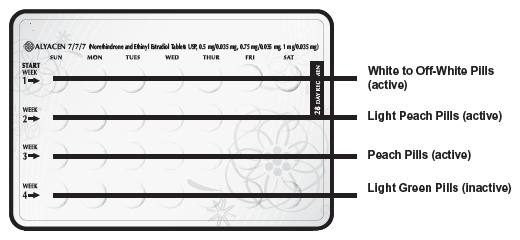
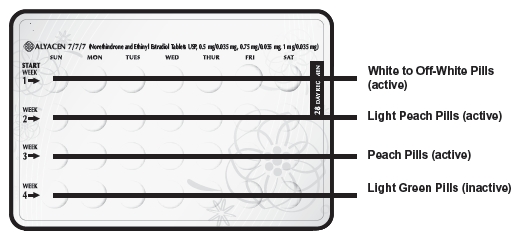
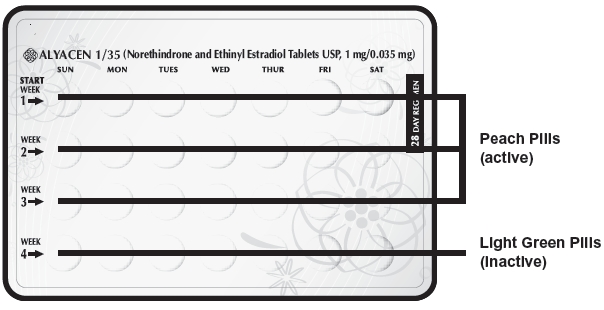
The pill pack has 21 "active" pills (with hormones) to take for 3 weeks. This is followed by 1 week of light green "reminder" pills (without hormones). ALYACEN 7/7/7: There are 7 white to off-white “active” pills, 7 light peach “active” pills, 7 peach “active” pills and 7 light green “reminder” pills.
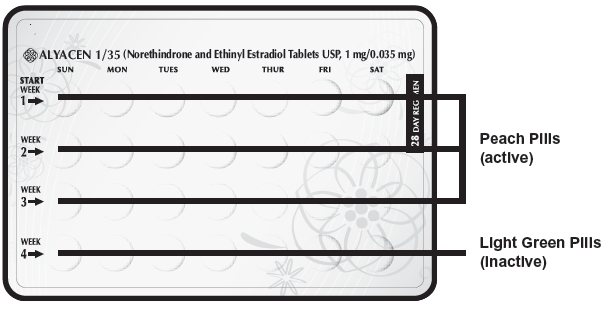
ALYACEN 1/35: There are 21 peach "active" pills and 7 light green "reminder" pills.
- 3. ALSO FIND:
- 1)where on the pack to start taking pills,
- 2)in what order to take the pills.
- 3)see pill package diagram above.
- 4. BE SURE YOU HAVE READY AT ALL TIMES:
ANOTHER KIND OF BIRTH CONTROL (such as a condom or spermicide) to use as a back-up method in case you miss pills.
AN EXTRA, FULL PILL PACK. WHEN TO START THE FIRST PACK OF PILLS |
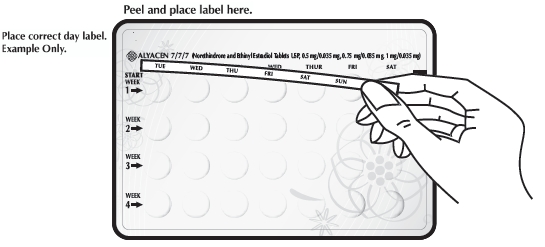
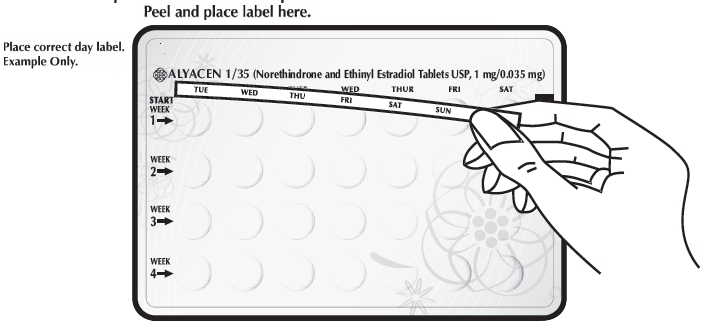
You have a choice of which day to start taking your first pack of pills. ALYACEN 7/7/7 and ALYACEN 1/35 tablets are available in a blister pack which is preset for a Sunday Start. Day 1 Start is also available. Decide with your healthcare professional which is the best day for you. Pick a time of day which will be easy to remember.
SUNDAY START:
ALYACEN 7/7/7: Take the first white to off-white "active" pill of the first pack on the Sunday after your period starts, even if you are still bleeding. If your period begins on Sunday, start the pack the same day.
ALYACEN 1/35: Take the first "active" peach pill of the first pack on the Sunday after your period starts, even if you are still bleeding. If your period begins on Sunday, start the pack the same day.
Use another method of birth control such as a condom or spermicide as a back-up method if you have sex anytime from the Sunday you start your first pack until the next Sunday (7 days).
DAY 1 START:
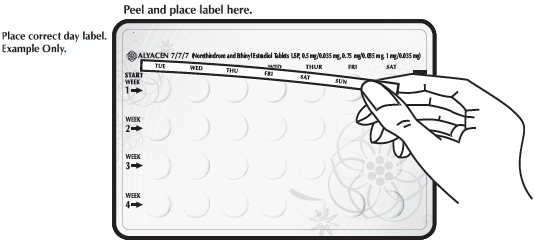
ALYACEN 7/7/7: Take the first white to off-white "active" pill of the first pack during the first 24 hours of your period.
- 1.Pick the day label strip that starts with the first day of your period (this is the day you start bleeding or spotting, even if it is almost midnight when the bleeding begins).
- 2.Place this day label strip on the tablet blister card over the area that has the days of the week (starting with Sunday) imprinted in the plastic.
Note: If the first day of your period is a Sunday, you can skip steps #1 and #2.
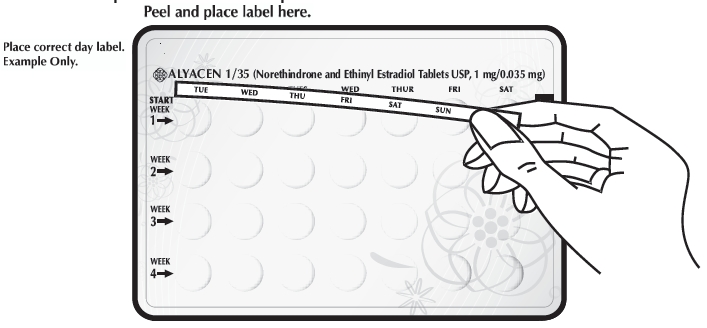
ALYACEN 1/35: Take the first "active" peach pill of the first pack during the first 24 hours of your period.
- 1.Pick the day label strip that starts with the first day of your period (this is the day you start bleeding or spotting, even if it is almost midnight when the bleeding begins).
- 2.Place this day label strip on the tablet blister card over the area that has the days of the week (starting with Sunday) imprinted in the plastic.
Note: If the first day of your period is a Sunday, you can skip steps #1 and #2.
You will not need to use a back-up method of birth control, since you are starting the pill at the beginning of your period.
WHAT TO DO DURING THE MONTH |
- 1.TAKE ONE PILL AT THE SAME TIME EVERY DAY UNTIL THE PACK IS EMPTY.
Do not skip pills even if you are spotting or bleeding between monthly periods or feel sick to your stomach (nausea). Do not skip pills even if you do not have sex very often. - 2.WHEN YOU FINISH A PACK OR SWITCH YOUR BRAND OF PILLS:
Start the next pack on the day after your last light green "reminder" pill. Do not wait any days between packs. WHAT TO DO IF YOU MISS PILLS |
ALYACEN 7/7/7:
If you MISS 1 white to off-white, light peach, or peach "active" pill:
- 1.Take it as soon as you remember. Take the next pill at your regular time. This means you may take 2 pills in 1 day.
- 2.You do not need to use a back-up birth control method if you have sex.
If you MISS 2 white to off-white or light peach "active" pills in a row in WEEK 1 OR WEEK 2 of your pack:
- 1.Take 2 pills on the day you remember and 2 pills the next day.
- 2.Then take 1 pill a day until you finish the pack.
- 3.You COULD BECOME PREGNANT if you have sex in the 7 days after you miss pills. You MUST use another birth control method (such as a condom or spermicide) as a back-up method for those 7 days.
If you MISS 2 peach "active" pills in a row in THE 3RD WEEK:
1a. If you are a Sunday Starter:
Keep taking 1 pill every day until Sunday. On Sunday, THROW OUT the rest of the pack and start a new pack of pills that same day.
1b. If you are a Day 1 Starter:
THROW OUT the rest of the pill pack and start a new pack that same day.
- 2. You may not have your period this month but this is expected. However, if you miss your period 2 months in a row, call your healthcare professional because you might be pregnant.
- 3. You COULD BECOME PREGNANT if you have sex in the 7 days after you miss pills. You MUST use another birth control method (such as a condom or spermicide) as a back-up method for those 7 days.
If you MISS 3 OR MORE white to off-white, light peach, or peach "active" pills in a row (during the first 3 weeks):
1a. If you are a Sunday Starter:
Keep taking 1 pill every day until Sunday. On Sunday, THROW OUT the rest of the pack and start a new pack of pills that same day.
1b. If you are a Day 1 Starter:
THROW OUT the rest of the pill pack and start a new pack that same day.
- 2. You may not have your period this month but this is expected. However, if you miss your period 2 months in a row, call your healthcare professional because you might be pregnant.
- 3. You COULD BECOME PREGNANT if you have sex in the 7 days after you miss pills. You MUST use another birth control method (such as a condom or spermicide) as a back-up method for those 7 days.
ALYACEN 1/35:
If you MISS 1 peach "active" pill:
- 1.Take it as soon as you remember. Take the next pill at your regular time. This means you may take 2 pills in 1 day.
- 2.You do not need to use a back-up birth control method if you have sex.
If you MISS 2 peach "active" pills in a row in WEEK 1 OR WEEK 2 of your pack:
- 1.Take 2 pills on the day you remember and 2 pills the next day.
- 2.Then take 1 pill a day until you finish the pack.
- 3.You COULD BECOME PREGNANT if you have sex in the 7 days after you miss pills. You MUST use another birth control method (such as a condom or spermicide) as a back-up method for those 7 days.
If you MISS 2 peach "active" pills in a row in THE 3RD WEEK:
1a. If you are a Sunday Starter:
Keep taking 1 pill every day until Sunday. On Sunday, THROW OUT the rest of the pack and start a new pack of pills that same day.
1b. If you are a Day 1 Starter:
THROW OUT the rest of the pill pack and start a new pack that same day.
- 2. You may not have your period this month but this is expected. However, if you miss your period 2 months in a row, call your healthcare professional because you might be pregnant.
- 3. You COULD BECOME PREGNANT if you have sex in the 7 days after you miss pills. You MUST use another birth control method (such as a condom or spermicide) as a back-up method for those 7 days.
If you MISS 3 OR MORE peach "active" pills in a row (during the first 3 weeks):
1a. If you are a Sunday Starter:
Keep taking 1 pill every day until Sunday. On Sunday, THROW OUT the rest of the pack and start a new pack of pills that same day.
1b. If you are a Day 1 Starter:
THROW OUT the rest of the pill pack and start a new pack that same day.
- 2. You may not have your period this month but this is expected. However, if you miss your period 2 months in a row, call your healthcare professional because you might be pregnant.
- 3. You COULD BECOME PREGNANT if you have sex in the 7 days after you miss pills. You MUST use another birth control method (such as a condom or spermicide) as a back-up method for those 7 days.
A REMINDER |
If you forget any of the 7 light green "reminder" pills in Week 4: THROW AWAY the pills you missed. Keep taking 1 pill each day until the pack is empty. You do not need a back-up method. |
FINALLY, IF YOU ARE STILL NOT SURE WHAT TO DO ABOUT THE PILLS YOU HAVE MISSED: |
Use a BACK-UP METHOD anytime you have sex.
KEEP TAKING ONE "ACTIVE" PILL EACH DAY until you can reach your healthcare professional. |
PREGNANCY DUE TO PILL FAILURE
Combined Oral Contraceptives
The incidence of pill failure resulting in pregnancy is approximately one percent (i.e., one pregnancy per 100 women per year) if taken every day as directed, but more typical failure rates are 5%. If failure does occur, the risk to the fetus is minimal.
PREGNANCY AFTER STOPPING THE PILL
There may be some delay in becoming pregnant after you stop using oral contraceptives, especially if you had irregular menstrual cycles before you used oral contraceptives. It may be advisable to postpone conception until you begin menstruating regularly once you have stopped taking the pill and desire pregnancy.
There does not appear to be any increase in birth defects in newborn babies when pregnancy occurs soon after stopping the pill.
OVERDOSAGE
Serious ill effects have not been reported following ingestion of large doses of oral contraceptives by young children. Overdosage may cause nausea and withdrawal bleeding in females. In case of overdosage, contact your healthcare professional or pharmacist.
OTHER INFORMATION
Your healthcare professional will take a medical and family history before prescribing oral contraceptives and will re-examine you. The physical examination may be delayed to another time if you request it and the healthcare professional believes that it is a good medical practice to postpone it. You should be reexamined at least once a year. Be sure to inform your healthcare professional if there is a family history of any of the conditions listed previously in this leaflet. Be sure to keep all appointments with your healthcare professional, because this is a time to determine if there are early signs of side effects of oral contraceptive use.
Do not use the drug for any condition other than the one for which it was prescribed. This drug has been prescribed specifically for you; do not give it to others who may want birth control pills.
HEALTH BENEFITS FROM ORAL CONTRACEPTIVES
In addition to preventing pregnancy, use of combined oral contraceptives may provide certain benefits. They are:
- menstrual cycles may become more regular
- blood flow during menstruation may be lighter and less iron may be lost. Therefore, anemia due to iron deficiency is less likely to occur.
- pain or other symptoms during menstruation may be encountered less frequently
- ectopic (tubal) pregnancy may occur less frequently
- noncancerous cysts or lumps in the breast may occur less frequently
- acute pelvic inflammatory disease may occur less frequently
- oral contraceptive use may provide some protection against developing two forms of cancer: cancer of the ovaries and cancer of the lining of the uterus.
If you want more information about birth control pills, ask your healthcare professional or pharmacist. They have a more technical leaflet called the Professional Labeling, which you may wish to read.
Store at 20° to 25°C (68° to 77°F); excursions permitted between 15° to 30°C (59° to 86°F) [see USP Controlled Room Temperature].
Manufactured by:
Glenmark Pharmaceuticals Ltd.
Colvale-Bardez, Goa 403 513, India
Manufactured for:
Glenmark Pharmaceuticals Inc., USA
Mahwah, NJ 07430
Questions? 1 (888)721-7115
www.glenmarkpharma.com/usa
September 2017