Absorption
In a single-dose, crossover clinical study conducted in 39 healthy, non-smoking premenopausal women under fasting condition, norethindrone acetate and ethinyl estradiol capsules and ferrous fumarate capsules were bioequivalent to norethindrone acetate 1 mg/ethinyl estradiol 0.020 mg tablets (24-day regimen tablets) based on the exposure (AUC) and peak concentration (Cmax) of norethindrone and ethinyl estradiol.
Norethindrone acetate appears to be completely and rapidly deacetylated to norethindrone after oral administration, because the disposition of norethindrone acetate is indistinguishable from that of orally administered norethindrone. Norethindrone acetate and ethinyl estradiol are rapidly absorbed from norethindrone acetate/ethinyl estradiol tablets, with maximum plasma concentrations of norethindrone and ethinyl estradiol occurring 1 to 4 hours post-dose. Both are subject to first-pass metabolism after oral dosing, resulting in an absolute bioavailability of approximately 64% for norethindrone and 43% for ethinyl estradiol.
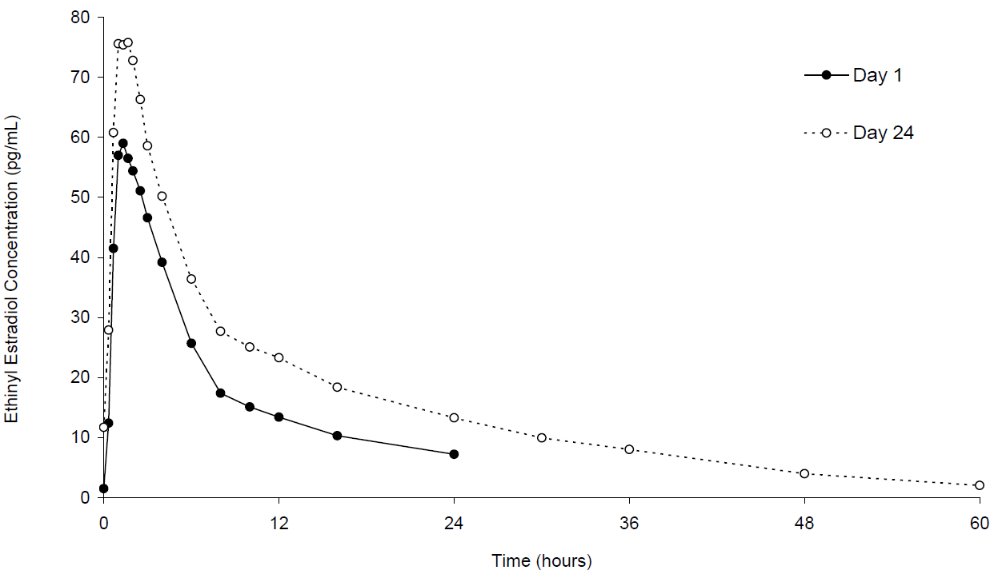
The plasma norethindrone and ethinyl estradiol pharmacokinetics following single- and multiple-dose administrations of norethindrone acetate/ethinyl estradiol tablets in 17 healthy female volunteers are provided in Figures 2 and 3, and Table 1.
Following multiple-dose administration of norethindrone acetate/ethinyl estradiol tablets, mean maximum concentrations of norethindrone and ethinyl estradiol were increased by 95% and 27%, respectively, as compared to single-dose administration. Mean norethindrone and ethinyl estradiol exposures (AUC values) were increased by 164% and 51% respectively, as compared to single-dose administration of norethindrone acetate/ethinyl estradiol tablets.
Steady-state with respect to norethindrone was reached by Day 17 and steady-state with respect to ethinyl estradiol was reached by Day 13.
Mean SHBG concentrations were increased by 150% from baseline (57.5 nmol/L) to 144 nmol/L at steady-state.
Figure 2. Mean Plasma Norethindrone Concentration-Time Profiles Following Single- and Multiple-Dose Oral Administration of Norethindrone Acetate/Ethinyl Estradiol Tablets to Healthy Female Volunteers under Fasting Condition (n = 17)
Figure 3. Mean Plasma Ethinyl Estradiol Concentration-Time Profiles Following Single- and Multiple-Dose Oral Administration of Norethindrone Acetate/Ethinyl Estradiol Tablets to Healthy Female Volunteers Under Fasting Condition (n = 17)
Table 1. Summary of Norethindrone (NE) and Ethinyl Estradiol (EE) Pharmacokinetics Following Single-and Multiple-Dose Oral Administration of Norethindrone Acetate/Ethinyl Estradiol Tablets to Healthy Female Volunteers Under Fasting Condition (n = 17)
| Regimen | Analyte | Arithmetic Meana (% CV) by Pharmacokinetic Parameter |
|---|
Cmax
(pg/mL) | tmax (hr) | AUC(0 to 24)
(pg/mL•h) | Cmin
(pg/mL) | t½
(hr) | Cavg
(pg/mL) |
|---|
| | 8420 (31) | 1 | 33390 (40) | -‑ | -‑ | -‑ |
| 64.5 (27) | 1.3 | 465.4 (26) | -‑ | -‑ | -‑ |
| -‑ | -‑ | -‑ | 57.5 (37)b | -‑ | -‑ |
Day 24 (Multiple | | 16400 (26) | 1.3 | 88160 (30) | | 8.4 | 3670 (30) |
| 81.9 (24) | 1.7 | 701.3 (28) | 11.4 (43) | 14.5 | 29.2 (28) |
| -‑ | -‑ | -‑ | | -‑ | -- |
Cmax = Maximum plasma concentration
tmax = Time of Cmax
Cmin = minimum plasma concentration at steady-state
AUC(0 to 24) = Area under plasma concentration versus time curve from 0 to 24 hours
t½ = Apparent first-order terminal elimination half-life
Cavg = Average plasma concentration = AUC(0 to 24)/24
% CV = Coefficient of Variation (%)
SHBG = Sex Hormone Binding Globulin (nmol/L)
aThe harmonic mean (0.693/mean apparent elimination rate constant) is reported for t½, and the median (range) is reported for tmax.
bThe SHBG concentration reported here is the pre-dose concentration
Food Effect
Norethindrone acetate and ethinyl estradiol capsules and ferrous fumarate capsules may be administered without regard to meals.
A single-dose administration of norethindrone acetate and ethinyl estradiol capsules and ferrous fumarate capsules with food in 38 healthy, non-smoking premenopausal women decreased the maximum concentration of norethindrone and ethinyl estradiol by 38% and 33%, respectively. Food intake did not affect the extent of ethinyl estradiol absorption, but increased the extent of norethindrone absorption by 19%.
Distribution
Volume of distribution of norethindrone and ethinyl estradiol ranges from 2 to 4 L/kg. Plasma protein binding of both steroids is extensive (>95%); norethindrone binds to both albumin and SHBG, whereas ethinyl estradiol binds only to albumin. Although ethinyl estradiol does not bind to SHBG, it induces SHBG synthesis.
Metabolism
Norethindrone undergoes extensive biotransformation, primarily via reduction, followed by sulfate and glucuronide conjugation. The majority of metabolites in the circulation are sulfates, with glucuronides accounting for most of the urinary metabolites.
Ethinyl estradiol is also extensively metabolized, both by oxidation and by conjugation with sulfate and glucuronide. Sulfates are the major circulating conjugates of ethinyl estradiol and glucuronides predominate in urine. The primary oxidative metabolite is 2-hydroxy ethinyl estradiol, formed by the CYP3A4 isoform of cytochrome P450. Part of the first-pass metabolism of ethinyl estradiol is believed to occur in gastrointestinal mucosa. Ethinyl estradiol may undergo enterohepatic circulation.
Excretion
Norethindrone and ethinyl estradiol are excreted in both urine and feces, primarily as metabolites.
Plasma clearance values for norethindrone and ethinyl estradiol are similar (approximately 0.4 L/hr/kg). Steady-state elimination half-lives of norethindrone and ethinyl estradiol following administration of norethindrone acetate/ethinyl estradiol tablets are approximately 8 hours and 14 hours, respectively.
Drug Interactions
No drug-drug interaction studies were conducted with norethindrone acetate and ethinyl estradiol capsules and ferrous fumarate capsules.