Because clinical trials are conducted under widely varying conditions, adverse reaction rates observed in the clinical trials of a drug cannot be directly compared to rates in the clinical trials of another drug and may not reflect the rates observed in practice.
Adverse reactions associated with ophthalmic steroids including ILUVIEN include cataract formation and subsequent cataract surgery, elevated intraocular pressure, which may be associated with optic nerve damage, visual acuity and field defects, secondary ocular infection from pathogens including herpes simplex, and perforation of the globe where there is thinning of the cornea or sclera.
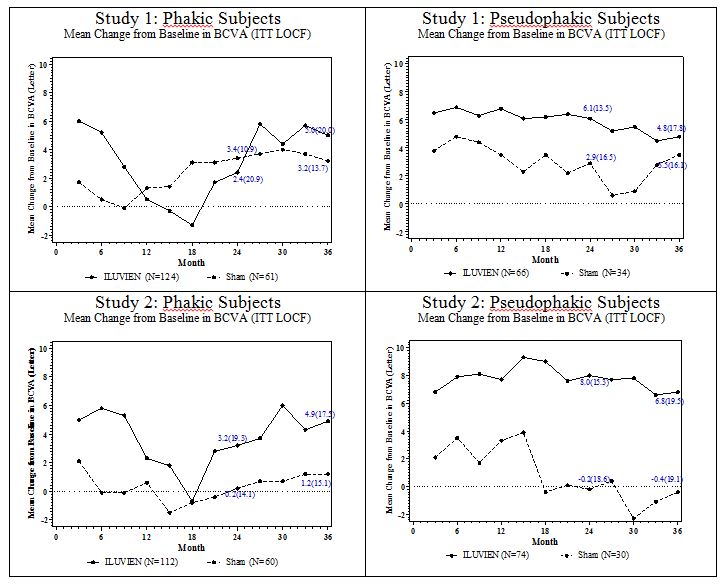
ILUVIEN was studied in two multicenter, randomized, sham-controlled, masked trials in which patients with diabetic macular edema (DME) were treated with either ILUVIEN (n=375) or sham (n=185).
Table 1 summarizes safety data available when the last subject completed the last 36 month follow up visit for the two primary ILUVIEN trials. In these trials, subjects were eligible for retreatment no earlier than 12 months after study entry. Over the three year follow up period, approximately 75% of the ILUVIEN treated subjects received only one ILUVIEN implant.
The most common ocular (study eye) and non-ocular adverse reactions are shown in Tables 1 and 2:
Table 1: Ocular Adverse Reactions Reported by ≥1% of Patients and
Non-ocular Adverse Reactions Reported by ≥5% of Patients| 1 Includes cataract, cataract nuclear, cataract subcapsular, cataract cortical and cataract diabetic in patients who were phakic at baseline. Among these patients, 80% of ILUVIEN subjects vs. 27% of sham-controlled subjects underwent cataract surgery. |
| 2 235 of the 375 ILUVIEN subjects were phakic at baseline; 121 of 185 sham-controlled subjects were phakic at baseline. |
| Adverse Reactions | ILUVIEN
(N=375)
n (%) | Sham
(N=185)
n (%) |
| Ocular |
| Cataract1 | 192/2352 (82%) | 61/1212 (50%) |
| Myodesopsia | 80 (21%) | 17 (9%) |
| Eye pain | 57 (15%) | 25 (14%) |
| Conjunctival haemorrhage | 50 (13%) | 21 (11%) |
| Posterior capsule opacification | 35 (9%) | 6 (3%) |
| Eye irritation | 30 (8%) | 11 (6%) |
| Vitreous detachment | 26 (7%) | 12 (7%) |
| Conjunctivitis | 14 (4%) | 5 (3%) |
| Corneal oedema | 13 (4%) | 3 (2%) |
| Foreign body sensation in eyes | 12 (3%) | 4 (2%) |
| Eye pruritus | 10 (3%) | 3 (2%) |
| Ocular hyperaemia | 10 (3%) | 3 (2%) |
| Optic atrophy | 9 (2%) | 2 (1%) |
| Ocular discomfort | 8 (2%) | 1 (1%) |
| Photophobia | 7 (2%) | 2 (1%) |
| Retinal exudates | 7 (2%) | 0 (0%) |
| Anterior chamber cell | 6 (2%) | 1 (1%) |
| Eye discharge | 6 (2%) | 1 (1%) |
| Non-ocular |
| Anemia | 40 (11%) | 10 (5%) |
| Headache | 33 (9%) | 11 (6%) |
| Renal Failure | 32 (9%) | 10 (5%) |
| Pneumonia | 28 (7%) | 8 (4%) |
Increased intraocular Pressure
Table 2: Summary of Elevated IOP Related Adverse Reactions| Event | ILUVIEN
(N=375)
n (%) | Sham
(N=185)
n (%) |
| IOP elevation ≥ 10 mmHg from Baseline | 127 (34%) | 18 (10%) |
| IOP elevation ≥ 30 mmHg | 75 (20%) | 8 (4%) |
| Any IOP-lowering medication | 144 (38%) | 26 (14%) |
| Any surgical intervention for elevated intraocular pressure | 18 (5%) | 1 (1%) |
Figure 1: Mean IOP during the study 
Iluvien-figure-1 (Iluvien Figure 1)
Cataracts and Cataract Surgery
At baseline, 235 of the 375 ILUVIEN subjects were phakic; 121 of 185 sham-controlled subjects were phakic. The incidence of cataract development in patients who had a phakic study eye was higher in the ILUVIEN group (82%) compared with Sham (50%). The median time of cataract being reported as an adverse event was approximately 12 months in the ILUVIEN group and 19 months in the Sham group. Among these patients, 80% of ILUVIEN subjects vs. 27% of sham-controlled subjects underwent cataract surgery, generally within the first 18 months (Median Month 15 for both ILUVIEN group and for Sham) of the studies.