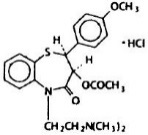
Other
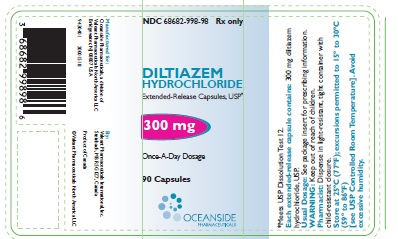
(Once-a-Day Dosage)
Rx only
Hypertension: Diltiazem produces its antihypertensive effect primarily by relaxation of vascular smooth muscle and the resultant decrease in peripheral vascular resistance. The magnitude of blood pressure reduction is related to the degree of hypertension; thus hypertensive individuals experience an antihypertensive effect, whereas there is only a modest fall in blood pressure in normotensives.
Angina: Diltiazem has been shown to produce increases in exercise tolerance, probably due to its ability to reduce myocardial oxygen demand. This is accomplished via reductions in heart rate and systemic blood pressure at submaximal and maximal workloads. Diltiazem has been shown to be a potent dilator of coronary arteries, both epicardial and subendocardial. Spontaneous and ergonovine-induced coronary artery spasms are inhibited by diltiazem.
In animal models, diltiazem interferes with the slow inward (depolarizing) current in excitable tissue. It causes excitation-contraction uncoupling in various myocardial tissues without changes in the configuration of the action potential. Diltiazem produces relaxation of coronary vascular smooth muscle and dilation of both large and small coronary arteries at drug levels that cause little or no negative inotropic effect. The resultant increases in coronary blood flow (epicardial and subendocardial) occur in ischemic and nonischemic models and are accompanied by dose-dependent decreases in systemic blood pressure and decreases in peripheral resistance.
Diltiazem Hydrochloride Extended-Release Capsules (Once-a-Day Dosage): When compared to a regimen of diltiazem hydrochloride tablets at steady-state, more than 95% of drug is absorbed from the Diltiazem Hydrochloride Extended-Release capsules formulation. A single 360 mg dose of the capsule results in detectable plasma levels within 2 hours and peak plasma levels between 10 and 14 hours; absorption occurs throughout the dosing interval. When Diltiazem Hydrochloride Extended-Release Capsules (Once-a-Day Dosage) were coadministered with a high fat content breakfast, the extent of diltiazem absorption was not affected. Dose-dumping does not occur. The apparent elimination half-life after single or multiple dosing is 5 to 8 hours. A departure from linearity similar to that seen with diltiazem hydrochloride tablets and Diltiazem Hydrochloride Extended-Release capsules is observed. As the dose of Diltiazem Hydrochloride Extended-Release Capsules (Once-a-Day Dosage) is increased from a daily dose of 120 mg to 240 mg, there is an increase in the area under the curve of 2.7 times. When the dose is increased from 240 mg to 360 mg, there is an increase in the area under the curve of 1.6 times.
In an in vitro dissolution study, the release rate of diltiazem from Diltiazem Hydrochloride Extended-Release capsules increased significantly as the alcohol percentage in the dissolution medium increased. The effect of alcohol on the release rate may lead to a change in the pharmacokinetics of diltiazem, such as a more rapid absorption and/or an increase in the systemic exposure of diltiazem (see PRECAUTIONS, Drug Interactions).
Anesthetics: The depression of cardiac contractility, conductivity, and automaticity as well as the vascular dilation associated with anesthetics may be potentiated by calcium channel blockers. When used concomitantly, titrate anesthetics and calcium blockers slowly.
Benzodiazepines: Studies showed that diltiazem increased the AUC of midazolam and triazolam by 3- to 4-fold and the Cmax by 2-fold, compared to placebo. The elimination half-life of midazolam and triazolam also increased (1.5- to 2.5-fold) during coadministration with diltiazem. These pharmacokinetic effects seen during diltiazem coadministration can result in increased clinical effects (e.g., prolonged sedation) of both midazolam and triazolam.
Beta-blockers: Controlled and uncontrolled domestic studies suggest that concomitant use of diltiazem and beta-blockers is usually well tolerated, but available data are not sufficient to predict the effects of concomitant treatment in patients with left ventricular dysfunction or cardiac conduction abnormalities.
Administration of diltiazem hydrochloride concomitantly with propranolol in five normal volunteers resulted in increased propranolol levels in all subjects and bioavailability of propranolol was increased approximately 50%. In vitro, propranolol appears to be displaced from its binding sites by diltiazem. If combination therapy is initiated or withdrawn in conjunction with propranolol, an adjustment in the propranolol dose may be warranted (see WARNINGS).
Buspirone: In nine healthy subjects, diltiazem significantly increased the mean buspirone AUC 5.5-fold and Cmax 4.1-fold compared to placebo. The T1/2 and Tmax of buspirone were not significantly affected by diltiazem. Enhanced effects and increased toxicity of buspirone may be possible during concomitant administration with diltiazem. Subsequent dose adjustments may be necessary during coadministration, and should be based on clinical assessment.
Carbamazepine: Concomitant administration of diltiazem with carbamazepine has been reported to result in elevated serum levels of carbamazepine (40% to 72% increase), resulting in toxicity in some cases.
Cimetidine: A study in six healthy volunteers has shown a significant increase in peak diltiazem plasma levels (58%) and area under the curve (53%) after a 1-week course of cimetidine at 1200 mg per day and a single dose of diltiazem 60 mg. Ranitidine produced smaller, nonsignificant increases. The effect may be mediated by cimetidine's known inhibition of hepatic cytochrome P450, the enzyme system responsible for the first-pass metabolism of diltiazem. Patients currently receiving diltiazem therapy should be carefully monitored for a change in pharmacological effect when initiating and discontinuing therapy with cimetidine. An adjustment in the diltiazem dose may be warranted.
Clonidine: Sinus bradycardia resulting in hospitalization and pacemaker insertion has been reported in association with the use of clonidine concurrently with diltiazem. Monitor heart rate in patients receiving concomitant diltiazem and clonidine.
Cyclosporine: A pharmacokinetic interaction between diltiazem and cyclosporine has been observed during studies involving renal and cardiac transplant patients. In renal and cardiac transplant recipients, a reduction of cyclosporine dose ranging from 15% to 48% was necessary to maintain cyclosporine trough concentrations similar to those seen prior to the addition of diltiazem. If these agents are to be administered concurrently, cyclosporine concentrations should be monitored, especially when diltiazem therapy is initiated, adjusted, or discontinued. The effect of cyclosporine on diltiazem plasma concentrations has not been evaluated.
Digitalis: Administration of diltiazem with digoxin in 24 healthy male subjects increased plasma digoxin concentrations approximately 20%. Another investigator found no increase in digoxin levels in 12 patients with coronary artery disease. Monitor digoxin levels be monitored when initiating, adjusting, and discontinuing diltiazem therapy to avoid possible over- or under- digitalization (see WARNINGS).
Ivabradine: Concurrent use of diltiazem increases exposure to ivabradine and may exacerbate bradycardia and conduction disturbances. Avoid concomitant use of ivabradine and diltiazem.
Quinidine: Diltiazem significantly increases the AUC(0→∞) of quinidine by 51%, T1/2 by 36%, and decreases its CLoral by 33%. Monitor for quinidine adverse effects and adjust the dose accordingly.
Rifampin: Coadministration of rifampin with diltiazem lowered the diltiazem plasma concentrations to undetectable levels. Avoid coadministration of diltiazem with rifampin or any known CYP3A4 inducer.
Statins: Diltiazem is an inhibitor of CYP3A4 and has been shown to increase significantly the AUC of some statins. The risk of myopathy and rhabdomyolysis with statins metabolized by CYP3A4 may be increased with concomitant use of diltiazem. When possible, use a non-CYP3A4-metabolized statin together with diltiazem; otherwise, monitor for signs and symptoms of any statin-related adverse events, and adjust the doses accordingly.
In a healthy volunteer crossover study (N=10), coadministration of a single 20 mg dose of simvastatin at the end of a 14 day-regimen with 120 mg BID diltiazem SR resulted in a 5-fold increase in mean simvastatin AUC versus simvastatin alone. Subjects with increased average steady-state exposures of diltiazem showed a greater fold increase in simvastatin exposure. Computer-based simulations showed that at a daily dose of 480 mg of diltiazem, an 8- to 9-fold mean increase in simvastatin AUC can be expected. If coadministration of simvastatin with diltiazem is required, limit the daily doses of simvastatin to 10 mg and diltiazem to 240 mg.
In a ten-subject randomized, open-label, 4-way crossover study, coadministration of diltiazem (120 mg BID diltiazem SR for 2 weeks) with a single 20 mg dose of lovastatin resulted in 3- to 4-fold increase in mean lovastatin AUC and Cmax versus lovastatin alone. In the same study, there was no significant change in 20 mg single dose pravastatin AUC and Cmax during diltiazem coadministration. Diltiazem plasma levels were not significantly affected by lovastatin or pravastatin.
Alcohol: Alcohol increases the rate at which Diltiazem Hydrochloride Extended-Release capsules release diltiazem in vitro. This effect may lead to more rapid absorption and an increase in the systemic exposure of diltiazem, and associated dose-related adverse reactions. Avoid consumption of alcohol with Diltiazem Hydrochloride Extended-Release capsules (see CLINICAL PHARMACOLOGY).
Hypertension: Adjust dosage to individual patient needs. When used as monotherapy, reasonable starting doses are 180 to 240 mg once daily, although some patients may respond to lower doses. Maximum antihypertensive effect is usually observed by 14 days of chronic therapy; therefore, schedule dosage adjustments accordingly. The usual dosage range studied in clinical trials was 240 to 360 mg once daily. Individual patients may respond to higher doses of up to 480 mg once daily.
Angina: Dosages for the treatment of angina should be adjusted to each patient's needs, starting with a dose of 120 or 180 mg once daily. Individual patients may respond to higher doses of up to 480 mg once daily. When necessary, titration may be carried out over a 7- to 14-day period.
Manufactured for:
Oceanside Pharmaceuticals,
a division of Valeant Pharmaceuticals North America LLC
Bridgewater, NJ 08807 USA
By:
Valeant Pharmaceuticals International, Inc.
Steinbach, MB
Canada R5G 1Z7
©Valeant Pharmaceuticals North America LLC
9430502
20001874
Rev. 02/2017