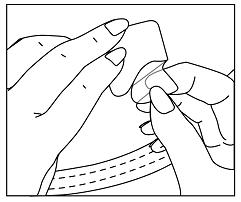
The pharmacokinetics of DAYTRANA when applied to the hip for 9 hours have been studied in ADHD patients 6 to 17 years old.
Absorption
The amount of methylphenidate absorbed systemically is a function of both wear time and patch size. In patients with ADHD, peak plasma levels of methylphenidate are reached at about 10 hours after single application and 8 hours after repeat patch applications (12.5cm
2 to 37.5cm
2) when worn up to 9 hours.
On single dosing of children or adolescents with DAYTRANA, there was a delay of, on average, 2 hours before
d-methylphenidate was detectable in the circulation. On repeat dosing, low concentrations (1.2-3.0 ng/mL in children and 0.5-1.7ng/mL in adolescents, on average across the dose range) were observed earlier in the profile, due to carry-over effect. Following the application of DAYTRANA once daily with a 9 hour wear time, the mean pharmacokinetic parameters of
d-methylphenidate in children and adolescents with ADHD after 4 weeks of therapy are summarized in Table 3.
|
Table 3
Mean Plasma d-Methylphenidate Pharmacokinetic Parameters After Repeated 9-Hour Applications of DAYTRANA or Oral ER-MPH for up to 28 days to Pediatric ADHD Patients (Aged 6 - 17 years)
|
| Children |
| Parameter | DAYTRANA
1
12.5cm
2
(N=12)
| DAYTRANA
2
37.5cm
2
(N=10)
| Oral ER-MPH
3
18mg
| Oral ER-MPH
3
54mg
|
C
ssmax
(ng/mL)
| 15.7 ± 9.39 | 42.9 ± 22.4 | 8.37 ± 4.14 | 26.1 ± 11.2 |
C
ssmin
(ng/mL)
| 1.04 ± 1.17 | 1.96 ± 1.73 | 0.708 ± 1.08 | 1.19 ± 1.54 |
AUC
ss
(ng·hr/mL)
| 163 ± 101 | 447 ± 230 | 97.7 ± 67.0 | 317 ± 160 |
t
lag
(h)
4 | 0 (0 - 2.0) | 0 (0 - 1.0) | 0 | 0 |
| Adolescents |
C
ssmax
(ng/mL)
| 8.32 ± 4.60 | 16.5 ± 6.94 | 5.23 ± 1.72 | 18.0 ± 6.97 |
C
ssmin
(ng/mL)
| 0.544 ± 0.383 | 1.02 ± 0.629 | 0.360 ± 0.478 | 1.50 ± 0.937 |
AUC
ss
(ng·hr/mL)
| 85.7 ± 50.0 | 167 ± 66.0 | 59.7 ± 19.1 | 216 ± 80.8 |
t
lag
(h)
4 | 0 (0 - 2.0) | 0 (0 - 2.0) | 0 | 0 |
Following administration of DAYTRANA 12.5cm
2 to pediatric and adolescent ADHD patients daily for 7 days, there were 13% and 14% increases, respectively, in steady state area under the plasma concentration-time curve (AUC
ss) relative to that anticipated on the basis of single dose pharmacokinetics (AUC0
-∞); after 28 days administration, these increments increased to 64% and 76%, respectively. C
max increased by nearly 69% and 100% within 4 weeks of daily administration of the starting dose in children and adolescents, respectively.
The observed exposures with DAYTRANA could not be explained by drug accumulation predicted from observed single dose pharmacokinetics and there was no evidence that clearance or rate of elimination changed between single and repeat dosing. Neither were they explainable by differences in dosing patterns between treatments, age, race, or gender. This suggests that transdermal absorption of methylphenidate may increase with repeat dosing with DAYTRANA; on average, steady-state is likely to have been achieved by approximately 14 days of dosing.
In the single- and multiple dose study described above, exposure to
l-methylphenidate was 46% of the exposure to
d-methylphenidate in children and 40% in adolescents.
l-methylphenidate is less pharmacologically active than
d-methylphenidate
[
see Pharmacodynamics (12.2)]
.
In a phase 2 PK/PD study in children aged 6-12 years, 2/3 of patients had 2-hour
d-MPH concentrations < 5 ng/mL on chronic dosing, and at 3 hours 40% of patients had
d-MPH concentrations < 5 ng/mL
[
see Clinical Studies (14)]
.
When DAYTRANA is applied to inflamed skin both the rate and extent of absorption are increased as compared with intact skin. When applied to inflamed skin, lag time is no greater than 1 hour, T
max is 4 hours, and both C
max and AUC are approximately 3-fold higher.
When heat is applied to DAYTRANA after patch application, both the rate and the extent of absorption are significantly increased. Median T
lag occurs 1 hour earlier, T
max occurs 0.5 hours earlier, and median C
max and AUC are 2-fold and 2.5-fold higher, respectively.
Application sites other than the hip can have different absorption characteristics and have not been adequately studied in safety or efficacy studies.
Dose Proportionality
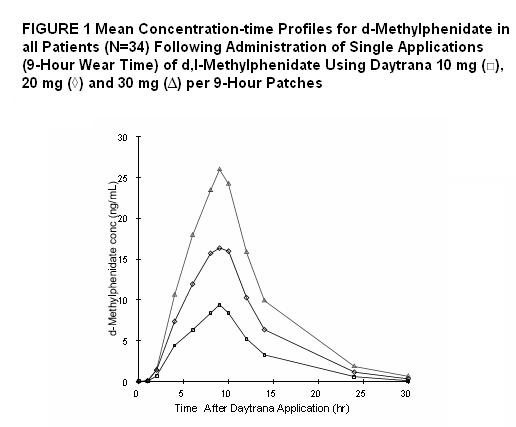
Following a single 9-hour application of DAYTRANA doses of 10 mg / 9 hours to 30 mg / 9 hours patches to 34 children with ADHD, C
max and AUC
0-t of
d-methylphenidate were proportional to the patch dose. Mean plasma concentration-time plots are shown in Figure 1. C
max of
l-methylphenidate was also proportional to the patch dose. AUC
0-t of
l-methylphenidate was only slightly greater than proportional to patch dose.
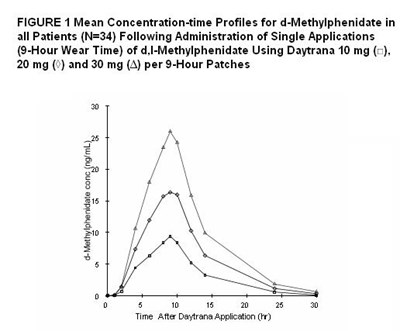
Daytrana-figure1 (Daytrana 03)
Distribution
Upon removal of DAYTRANA, methylphenidate plasma concentrations in children with ADHD decline in a biexponential manner. This may be due to continued distribution of MPH from the skin after patch removal.
Metabolism and Excretion
Methylphenidate is metabolized primarily by de-esterification to alpha-phenyl-piperidine acetic acid (ritalinic acid), which has little or no pharmacologic activity.
Transdermal administration of methylphenidate exhibits much less first pass effect than oral administration. Consequently, a much lower dose of DAYTRANA on a mg/kg basis compared to oral dosages may still produce higher exposures of
d-MPH with transdermal administration compared to oral administration. In addition, very little, if any,
l-methylphenidate is systemically available after oral administration due to first pass metabolism, whereas after transdermal administration of racemic methylphenidate exposure to
l-methylphenidate is nearly as high as to
d-methylphenidate.
The mean elimination t
1/2 from plasma of
d-methylphenidate after removal of DAYTRANA in children aged 6 to 12 years and adolescents aged 13-17 years was approximately 4 to 5 hours. The t
1/2 of
l-methylphenidate was shorter than for
d-methylphenidate and ranged from 1.4 to 2.9 hours, on average.
The C
max and AUC of
d-methylphenidate were approximately 50% lower in adolescents, compared to children, following either a 1-day or 7-day administration of DAYTRANA (10mg/9hr). Multiple-dose administration of DAYTRANA did not result in significant accumulation of methylphenidate; following 7 days of DAYTRANA administration (10mg/9hr) in children and adolescents, the accumulation index of methylphenidate was 1.1, based on the mean steady state area under the plasma concentration-time curve (AUC
ss) relative to that anticipated on the basis of single dose pharmacokinetics (AUC
0-∞).
Food Effects
The pharmacokinetics or the pharmacodynamic food effect performance after application of DAYTRANA has not been studied, but because of the transdermal route of administration, no food effect is expected.
Special Populations
Gender
The pharmacokinetics of methylphenidate after single and repeated doses of DAYTRANA were similar between boys and girls with ADHD, after allowance for differences in body weight.
Race
The influence of race on the pharmacokinetics of methylphenidate after administration of DAYTRANA has not been defined.
Age
The pharmacokinetics of methylphenidate after administration of DAYTRANA have not been studied in children less than 6 years of age.
Renal Impairment
There is no experience with the use of DAYTRANA in patients with renal insufficiency.
Hepatic Impairment
There is no experience with the use of DAYTRANA in patients with hepatic insufficiency.