Other
WARNING: SUICIDAL THOUGHTS AND BEHAVIORS
Antidepressants increased the risk of suicidal thoughts and behavior in children, adolescents, and young adults in short-term studies. These studies did not show an increase in the risk of suicidal thoughts and behavior with antidepressant use in patients over age 24; there was a reduction in risk with antidepressant use in patients aged 65 and older [see Warnings and Precautions (5.1)].
In patients of all ages who are started on antidepressant therapy, monitor closely for worsening, and for emergence of suicidal thoughts and behaviors. Advise families and caregivers of the need for close observation and communication with the prescriber [see Warnings and Precautions (5.1)].
Duloxetine is indicated for the treatment of:
- Major Depressive Disorder [see Clinical Studies (14.1)]
- Generalized Anxiety Disorder [see Clinical Studies (14.2)]
- Diabetic Peripheral Neuropathy [see Clinical Studies (14.3)]
- Chronic Musculoskeletal Pain [see Clinical Studies (14.5)]
- Suicidal Thoughts and Behaviors in Children, Adolescents and Young Adults [see Boxed Warning and Warnings and Precautions (5.1)]
- Hepatotoxicity [see Warnings and Precautions (5.2)]
- Orthostatic Hypotension, Falls and Syncope [see Warnings and Precautions (5.3)]
- Serotonin Syndrome [see Warnings and Precautions (5.4)]
- Abnormal Bleeding [see Warnings and Precautions (5.5)]
- Severe Skin Reactions [see Warnings and Precautions (5.6)]
- Discontinuation of Treatment with duloxetine [see Warnings and Precautions (5.7)]
- Activation of Mania/Hypomania [see Warnings and Precautions (5.8)]
- Angle-Closure Glaucoma [see Warnings and Precautions (5.9)]
- Seizures [see Warnings and Precautions (5.10)]
- Effect on Blood Pressure [see Warnings and Precautions (5.11)]
- Clinically Important Drug Interactions [see Warnings and Precautions (5.12)]
- Hyponatremia [see Warnings and Precautions (5.13)]
- Urinary Hesitation and Retention [see Warnings and Precautions (5.15)]
Swallow duloxetine delayed-release capsules USP whole. Do not chew or crush. Do not open the capsule and sprinkle its contents on food or mix with liquids. All of these might affect the enteric coating. Duloxetine delayed-release capsules USP can be given without regard to meals. If a dose of duloxetine delayed-release capsules USP is missed, take the missed dose as soon as it is remembered. If it is almost time for the next dose, skip the missed dose and take the next dose at the regular time. Do not take two doses of duloxetine delayed-release capsules USP at the same time.
Duloxetine delayed-release capsule USP, is available as:
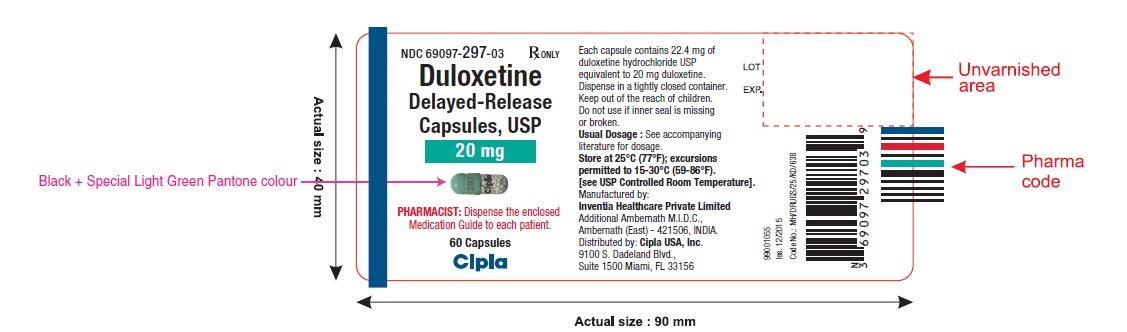
20 mg – White to off white spherical to oval pellets filled in hard gelatin capsule shells of size "4" with "Cipla"imprinted in grey colour ink on opaque green colored cap and "297" imprinted in black ink on clear transparent body.
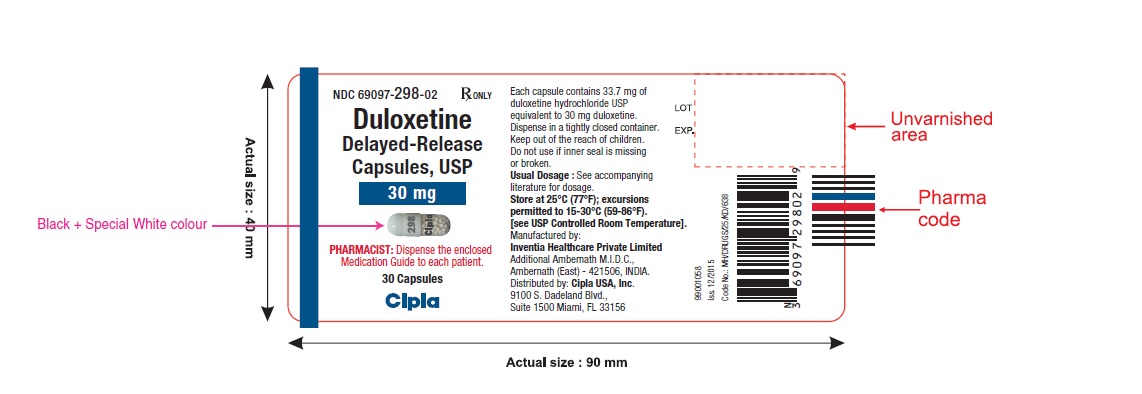
30 mg – White to off white spherical to oval pellets filled in hard gelatin capsule shells of size "3" with "Cipla"imprinted in grey colour ink on opaque white colored cap and "298" imprinted in black ink on clear transparent body.
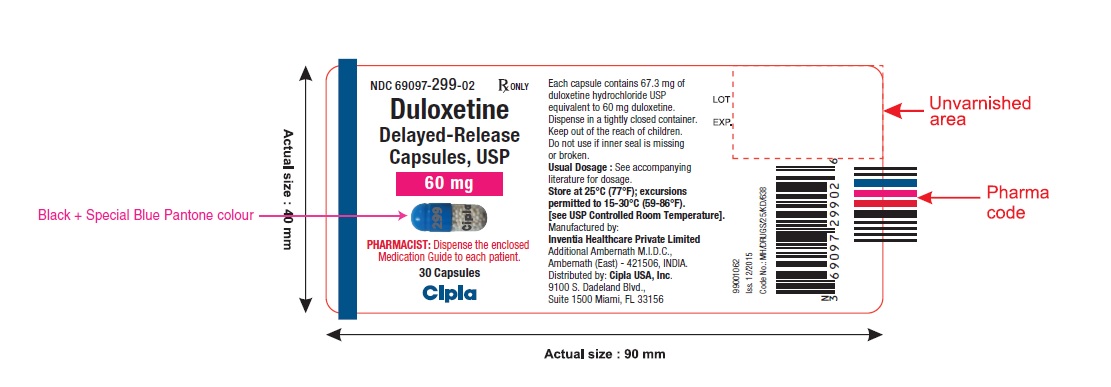
60 mg – White to off white spherical to oval pellets filled in hard gelatin capsule shells of size "1" with "Cipla"imprinted in grey colour ink on opaque blue colored cap and "299" imprinted in black ink on clear transparent body.
Monoamine Oxidase Inhibitors (MAOIs) -The use of MAOIs intended to treat psychiatric disorders with duloxetine or within 5 days of stopping treatment with duloxetine is contraindicated because of an increased risk of serotonin syndrome. The use of duloxetine within 14 days of stopping an MAOI intended to treat psychiatric disorders is also contraindicated [see Dosage and Administration (2.8) and Warnings and Precautions (5.4)].
Starting duloxetine in a patient who is being treated with MAOIs such as linezolid or intravenous methylene blue is also contraindicated because of an increased risk of serotonin syndrome [see Dosage and Administration (2.9) and Warnings and Precautions (5.4)].
Screening Patients for Bipolar Disorder — A major depressive episode may be the initial presentation of bipolar disorder. It is generally believed (though not established in controlled trials) that treating such an episode with an antidepressant alone may increase the likelihood of precipitation of a mixed/manic episode in patients at risk for bipolar disorder. Whether any of the symptoms described above represent such a conversion is unknown. However, prior to initiating treatment with an antidepressant, patients with depressive symptoms should be adequately screened to determine if they are at risk for bipolar disorder; such screening should include a detailed psychiatric history, including a family history of suicide, bipolar disorder, and depression. It should be noted that duloxetine is not approved for use in treating bipolar depression.
The following serious adverse reactions are described below and elsewhere in the labeling:
Both CYP1A2 and CYP2D6 are responsible for duloxetine metabolism.