Vilazodone activity is due primarily to the parent drug. The pharmacokinetics of vilazodone (5 mg - 80 mg) are dose-proportional. Accumulation of vilazodone after administration of single vilazodone doses did not vary with dose, and steady-state was achieved in about 3 days. Elimination of vilazodone is primarily by hepatic metabolism with a terminal half-life of approximately 25 hours. At steady-state, after daily dosing of vilazodone hydrochloride 40 mg under fed conditions, the mean Cmax value was 156 ng/mL, and the mean AUC (0 - 24 hours) value was 1645 ng.h/mL.
Absorption
Vilazodone concentrations peaked at a median of 4 to 5 hours (Tmax) after vilazodone administration and declined with a terminal half-life of approximately 25 hours. The absolute bioavailability of vilazodone was 72% with food. Vilazodone AUC and Cmax in the fasted state can be decreased by approximately 50% and 60%, respectively, compared to the fed state. Administration without food can result in inadequate drug concentrations and may reduce effectiveness.
Coadministration of vilazodone hydrochloride with ethanol or with a proton pump inhibitor (pantoprazole) did not affect the rate or extent of vilazodone absorption. In addition, neither the Tmax nor terminal elimination rate of vilazodone was altered by coadministration with either pantoprazole or ethanol.
Absorption is decreased by approximately 25% if vomiting occurs within 7 hours of ingestion; no replacement dose is needed.
Distribution
Vilazodone is widely distributed and approximately 96 to 99% protein-bound. Administration of vilazodone to a patient taking another drug that is highly protein bound may cause increased free concentrations of the other drug, because vilazodone is highly bound to plasma protein. The interaction between vilazodone and other highly protein-bound drugs has not been evaluated.
Metabolism and Elimination
Vilazodone hydrochloride is extensively metabolized through CYP and non-CYP pathways (possibly by carboxylesterase), with only 1% of the dose recovered in the urine and 2% of the dose recovered in the feces as unchanged vilazodone. CYP3A4 is primarily responsible for its metabolism among CYP pathways, with minor contributions from CYP2C19 and CYP2D6.
Drug Interaction Studies
Figure 1 below includes the impact of other drugs on the pharmacokinetics of vilazodone [see Drug Interactions (7)]
Figure 1. Effect of Other Drugs on Vilazodone Pharmacokinetics

Vilazodone_fig1 (Vilazodone Hydrochloride Figure 1)
In vitro studies indicate that vilazodone is unlikely to inhibit or induce the metabolism of substrates for CYP1A1, 1A2, 2A6, 2B6, 2C9, 2C19, 2D6, 2E1, 3A4 or 3A5, except for CYP2C8. The effect of vilazodone on CYP2C8 activity has not been tested in vivo. Figure 2 below includes the impact of vilazadone on the pharmacokinetics of other drugs in vivo.
Figure 2. Impact of Vilazodone on Other Drug Pharmacokinetics

Vilazodone_fig2 (Vilazodone Hydrochloride Figure 2)
AUCp = area under plasma concentration-time curve of nifedipine; CRmp = plasma concentration ratio of paraxanthine vs caffeine at 8 hours; URmp = urinary recovery ratio of 4-OH-debrisoquine vs debrisoquine; CLrm = renal clearance of 4'-OH-flurbiprofen; Um = urinary recovery of 4'-OH-mephenytoin; Cmax = maximal plasma concentration of digoxin; AUC = area under concentration-time curve of digoxin; P-gp = P-glycoprotein.
Studies in Specific Populations:
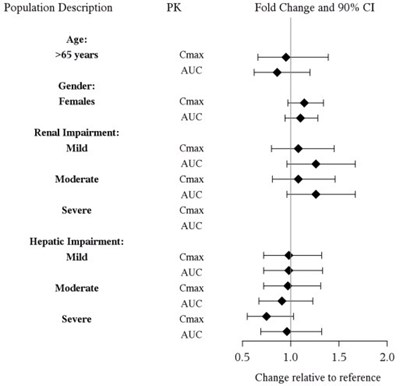
The presence of mild to severe renal impairment or mild to severe hepatic impairment did not affect the apparent clearance of vilazodone (see Figure 3). There were no pharmacokinetic differences of vilazodone in geriatric patients compared to younger patients, or between males and females (see Figure 3).
Figure 3: Impact of Intrinsic Factors on Vilazodone Pharmacokinetics
Vilazodone_fig3 (Vilazodone Hydrochloride Figure 3)
The data shown for elderly subjects (>65 years) are relative to younger subjects (24 - 55 years).
The data shown for female subjects are relative to male subjects.
The data shown for renal and hepatic impairment are relative to subjects with normal renal and hepatic function, respectively.


