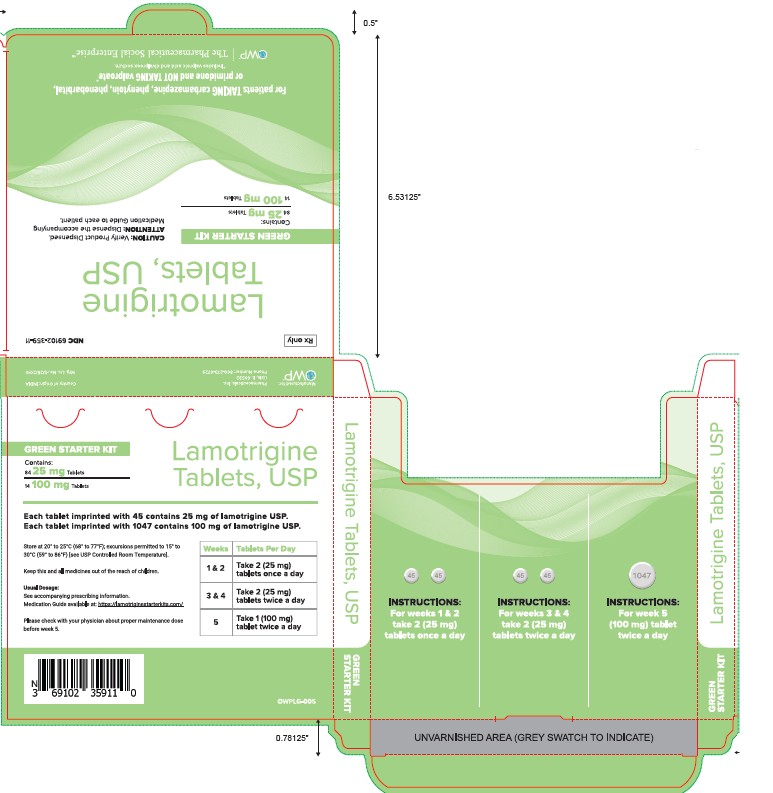
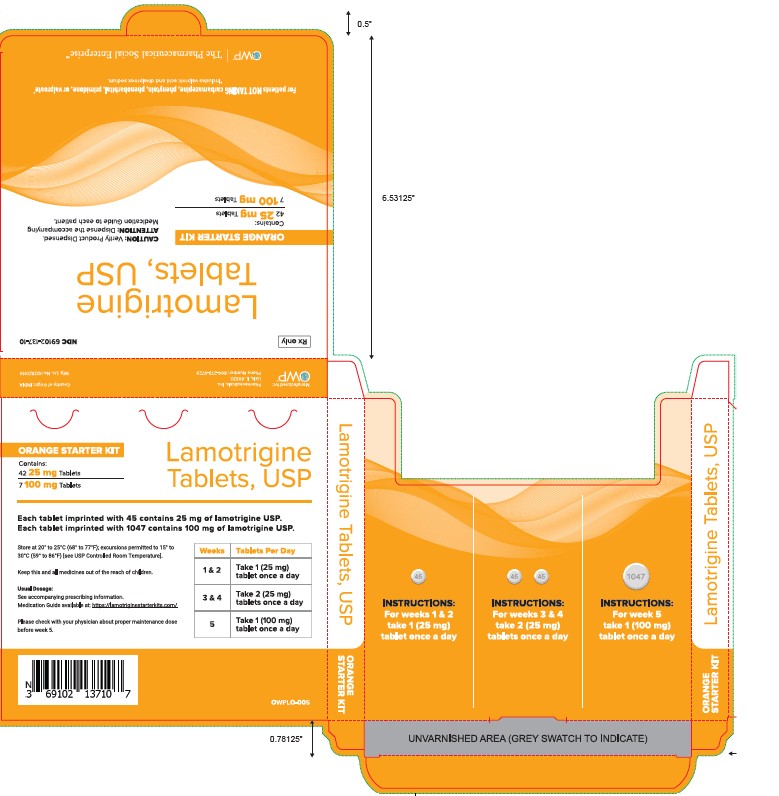
Other
Lamotrigine tablets can cause serious rashes requiring hospitalization and discontinuation of treatment. The incidence of these rashes, which have included Stevens-Johnson syndrome, is approximately 0.3% to 0.8% in pediatric patients (aged 2 to 17 years) and 0.08% to 0.3% in adults receiving lamotrigine tablets. One rash-related death was reported in a prospectively followed cohort of 1,983 pediatric patients (aged 2 to 16 years) with epilepsy taking lamotrigine tablets as adjunctive therapy. In worldwide postmarketing experience, rare cases of toxic epidermal necrolysis and/or rash-related death have been reported in adult and pediatric patients, but their numbers are too few to permit a precise estimate of the rate.
In addition to age, factors that may increase the risk of occurrence or the severity of rash caused by lamotrigine tablets include (1) coadministration of lamotrigine tablets with valproate (includes valproic acid and divalproex sodium), (2) exceeding the recommended initial dose of lamotrigine tablets, (3) exceeding the recommended dose escalation for lamotrigine tablets, or (4) the presence of the HLA-B*1502 allele However, cases have occurred in the absence of these factors.
Nearly all cases of life-threatening rashes caused by lamotrigine tablets have occurred within 2 to 8 weeks of treatment initiation. However, isolated cases have occurred after prolonged treatment (e.g., 6 months). Accordingly, duration of therapy cannot be relied upon as means to predict the potential risk heralded by the first appearance of a rash.
Although benign rashes are also caused by lamotrigine tablets, it is not possible to predict reliably which rashes will prove to be serious or life threatening. Accordingly, lamotrigine tablets should ordinarily be discontinued at the first sign of rash, unless the rash is clearly not drug related. Discontinuation of treatment may not prevent a rash from becoming life threatening or permanently disabling or disfiguring [see Warnings and Precautions (5.1)] .
Lamotrigine tablets are contraindicated in patients who have demonstrated hypersensitivity (e.g., rash, angioedema, acute urticaria, extensive pruritus, mucosal ulceration) to the drug or its ingredients [see Boxed Warning, Warnings and Precautions (5.1, 5.3)] .
The following serious adverse reactions are described in more detail in the Warnings and Precautionssection of the labeling:
- Serious Skin Rashes [see Warnings and Precautions (5.1)]
- Hemophagocytic Lymphohistiocytosis [see Warnings and Precautions (5.2)]
- Multiorgan Hypersensitivity Reactions and Organ Failure [see Warnings and Precautions (5.3)]
- Cardiac Rhythm and Conduction Abnormalities [see Warnings and Precautions (5.4)]
- Blood Dyscrasias [see Warnings and Precautions (5.5)]
- Suicidal Behavior and Ideation [see Warnings and Precautions (5.6)]
- Aseptic Meningitis [see Warnings and Precautions (5.7)]
- Withdrawal Seizures [see Warnings and Precautions (5.10)]
- Status Epilepticus [see Warnings and Precautions (5.11)]
- take lamotrigine tablets while taking valproate [DEPAKENE (valproic acid) or DEPAKOTE (divalproex sodium)].
- take a higher starting dose of lamotrigine tablets than your healthcare provider prescribed.
- increase your dose of lamotrigine tablets faster than prescribed.
- a skin rash
- blistering or peeling of your skin
- hives
- painful sores in your mouth or around your eyes
- fever
- frequent infections
- severe muscle pain
- swelling of your face, eyes, lips, or tongue
- swollen lymph glands
- unusual bruising or bleeding, looking pale
- weakness, fatigue
- yellowing of your skin or the white part of your eyes
- trouble walking or seeing
- seizures for the first time or happening more often
- pain and/or tenderness in the area towards the top of your stomach (enlarged liver and/or spleen)
- have a fast, slow, or pounding heart beat.
- feel your heart skip a beat.
- have shortness of breath.
- have chest pain.
- feel lightheaded.
- thoughts about suicide or dying
- attempt to commit suicide
- new or worse depression
- new or worse anxiety
- feeling agitated or restless
- panic attacks
- trouble sleeping (insomnia)
- new or worse irritability
- acting aggressive, being angry, or violent
- acting on dangerous impulses
- an extreme increase in activity and talking (mania)
- other unusual changes in behavior or mood
- Stopping lamotrigine tablets suddenly can cause serious problems.
- Suicidal thoughts or actions can be caused by things other than medicines. If you have suicidal thoughts or actions, your healthcare provider may check for other causes.
- Pay attention to any changes, especially sudden changes, in mood, behaviors, thoughts, or feelings.
- Keep all follow-up visits with your healthcare provider as scheduled.
- Call your healthcare provider between visits as needed, especially if you are worried about symptoms.
- headache
- fever
- nausea
- vomiting
- stiff neck
- rash
- unusual sensitivity to light
- muscle pains
- chills
- confusion
- drowsiness
- Make sure you can read it clearly.
- Talk to your pharmacist to check that you are given the correct medicine.
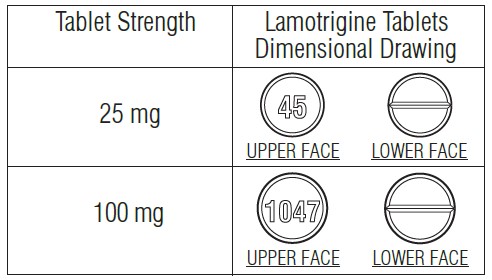
- Each time you fill your prescription, check the tablets you receive against the pictures of the tablets below.
- if you have had an allergic reaction to lamotrigine or to any of the inactive ingredients in lamotrigine tablets. See the end of this leaflet for a complete list of ingredients in lamotrigine tablets.
- have had a rash or allergic reaction to another antiseizure medicine.
- are of Asian origin, have had HLA testing before, and know you are carrying the genetic variant, HLA-B*1502.
- have or have had depression, mood problems, or suicidal thoughts or behavior.
- have a history of heart problems or irregular heart beats or any of your family members have any heart problem, including genetic abnormalities.
- have had aseptic meningitis after taking lamotrigine tablets.
- are taking estrogen-containing products, including oral contraceptives (birth control pills) or other female hormonal medicines (such as hormone replacement therapy). Do not start or stop taking birth control pills or other female hormonal medicine until you have talked with your healthcare provider. Tell your healthcare provider if you have any changes in your menstrual pattern such as breakthrough bleeding. Stopping these medicines while you are taking lamotrigine tablets may cause side effects (such as dizziness, lack of coordination, or double vision). Starting these medicines may lessen how well lamotrigine tablet works.
- are pregnant or plan to become pregnant. It is not known if lamotrigine tablets may harm your unborn baby. If you become pregnant while taking lamotrigine tablets, talk to your healthcare provider about registering with the North American Antiepileptic Drug Pregnancy Registry. You can enroll in this registry by calling 1-888-233-2334. The purpose of this registry is to collect information about the safety of antiepileptic drugs during pregnancy.
- are breastfeeding. Lamotrigine passes into breast milk and may cause side effects in a breastfed baby. If you breastfeed while taking lamotrigine tablets, watch your baby closely for trouble breathing, episodes of temporarily stopping breathing, sleepiness, or poor sucking. Call your baby’s healthcare provider right away if you see any of these problems. Talk to your healthcare provider about the best way to feed your baby if you take lamotrigine tablets.
- Take lamotrigine tablets exactly as prescribed.
- Your healthcare provider may change your dose. Do not change your dose without talking to your healthcare provider.
- Do not stop taking lamotrigine without talking to your healthcare provider. Stopping lamotrigine tablets suddenly may cause serious problems. For example, if you have epilepsy and you stop taking lamotrigine tablets suddenly, you may have seizures that do not stop. Talk with your healthcare provider about how to stop lamotrigine tablets slowly.
- If you miss a dose of lamotrigine tablets, take it as soon as you remember. If it is almost time for your next dose, just skip the missed dose. Take the next dose at your regular time. Do not take 2 doses at the same time.
- If you take too much lamotrigine tablets, call your healthcare provider or your local Poison Control Center or go to the nearest hospital emergency room right away.
- You may not feel the full effect of lamotrigine tablets for several weeks.
- If you have epilepsy, tell your healthcare provider if your seizures get worse or if you have any new types of seizures.
- Swallow lamotrigine tablets whole.
- If you have trouble swallowing lamotrigine tablets, tell your healthcare provider because there may be another form of lamotrigine you can take.
- If you receive lamotrigine tablets in a blister pack, examine the blister pack before use. Do not use if blisters are torn, broken, or missing.
- dizziness
- sleepiness
- tremor
- back pain
- headache
- nausea, vomiting
- rash
- diarrhea
- blurred or double vision
- tiredness
- fever
- insomnia
- lack of coordination
- dry mouth
- abdominal pain
- stuffy nose
- infections, including seasonal flu
- sore throat
- Store lamotrigine tablets at 20° to 25°C (68° to 77°F); excursions permitted to 15° to 30°C (59° to 86°F) [See USP Controlled Room Temperature].
Significant drug interactions with lamotrigine tablets are summarized in this section.
Uridine 5´-diphospho-glucuronyl transferases (UGT) have been identified as the enzymes responsible for metabolism of lamotrigine. Drugs that induce or inhibit glucuronidation may, therefore, affect the apparent clearance of lamotrigine. Strong or moderate inducers of the cytochrome P450 3A4 (CYP3A4) enzyme, which are also known to induce UGT, may also enhance the metabolism of lamotrigine.
Those drugs that have been demonstrated to have a clinically significant impact on lamotrigine metabolism are outlined in Table 13. Specific dosing guidance for these drugs is provided in the Dosage and Administration section, and, for women taking estrogen-containing products, including oral contraceptives, in the Warnings and Precautions section [see Dosage and Administration (2.1), Warnings and Precautions (5.9)].
Additional details of these drug interaction studies are provided in the Clinical Pharmacology section [see Clinical Pharmacology (12.3)] .
↓= Decreased (induces lamotrigine glucuronidation). | ||
↑= Increased (inhibits lamotrigine glucuronidation). | ||
?= Conflicting data. | ||
| Concomitant Drug | Effect on Concentration of Lamotrigine or Concomitant Drug | Clinical Comment |
| Estrogen-containing oral contraceptive preparations containing 30 mcg ethinylestradiol and 150 mcg levonorgestrel | ↓ lamotrigine ↓ levonorgestrel | Decreased lamotrigine concentrations approximately 50%. Decrease in levonorgestrel component by 19%. |
| Carbamazepine and carbamazepine epoxide | ↓ lamotrigine ? carbamazepine epoxide | Addition of carbamazepine decreases lamotrigine concentration approximately 40%. May increase carbamazepine epoxide levels. |
| Lopinavir/ritonavir | ↓ lamotrigine | Decreased lamotrigine concentration approximately 50%. |
| Atazanavir/ritonavir | ↓ lamotrigine | Decreased lamotrigine AUC approximately 32%. |
| Phenobarbital/primidone | ↓ lamotrigine | Decreased lamotrigine concentration approximately 40%. |
| Phenytoin | ↓ lamotrigine | Decreased lamotrigine concentration approximately 40%. |
| Rifampin | ↓ lamotrigine | Decreased lamotrigine AUC approximately 40%. |
| Valproate | ↑ lamotrigine ? valproate | Increased lamotrigine concentrations slightly more than 2-fold. There are conflicting study results regarding effect of lamotrigine on valproate concentrations: 1) a mean 25% decrease in valproate concentrations in healthy volunteers, 2) no change in valproate concentrations in controlled clinical trials in patients with epilepsy. |
Effect of Lamotrigine Tablets on Organic Cationic Transporter 2 Substrates
Lamotrigine is an inhibitor of renal tubular secretion via organic cationic transporter 2 (OCT2) proteins [see Clinical Pharmacology (12.3)] . This may result in increased plasma levels of certain drugs that are substantially excreted via this route. Coadministration of lamotrigine tablets with OCT2 substrates with a narrow therapeutic index (e.g., dofetilide) is not recommended.
Torrentlogo (Logo Pi Owp)
Manufactured by:
Torrent Pharmaceuticals LTD., India.
Manufactured for:
OWP Pharmaceuticals, Inc., 701 Warrenville Road, Suite 200, Lisle, IL 60532.
8106217 Revised: December 2025
OWOSLAMPI0126
MEDICATION GUIDE Lamotrigine (la-MOE-tri-jeen) Tablets, USP |
What is the most important information I should know about lamotrigine tablets? 1. Lamotrigine tablets may cause a serious skin rash that may cause you to be hospitalized or even cause death. There is no way to tell if a mild rash will become more serious. A serious skin rash can happen at any time during your treatment with lamotrigine tablets, but is more likely to happen within the first 2 to 8 weeks of treatment. Children and teenagers aged between 2 and 17 years have a higher chance of getting this serious skin rash while taking lamotrigine tablets. The risk of getting a serious skin rash is higher if you: The risk of serious skin reactions may be associated with a variant in genes called HLA-B*1502 in people from Asian origin (mainly of Han Chinese and Thai origin). See, “Before taking lamotrigine tablets, tell your healthcare provider about all of your health conditions”. Call your healthcare provider right away if you have any of the following: These symptoms may be the first signs of a serious skin reaction. A healthcare provider should examine you to decide if you should continue taking lamotrigine tablets. 2. Other serious reactions, including serious blood problems or liver problems. Lamotrigine tablets can also cause other types of allergic reactions or serious problems that may affect organs and other parts of your body like your liver or blood cells. You may or may not have a rash with these types of reactions. Call your healthcare provider right away if you have any of these symptoms: 3. In patients with known heart problems, the use of lamotrigine tablets may lead to a fast heart beat. Call your healthcare provider right away if you: 4. Like other antiepileptic drugs, lamotrigine tablets may cause suicidal thoughts or actions in a very small number of people, about 1 in 500. Call a healthcare provider right away if you have any of these symptoms, especially if they are new, worse, or worry you: Do not stop lamotrigine tablets without first talking to a healthcare provider. How can I watch for early symptoms of suicidal thoughts and actions in myself or a family member? 5. Lamotrigine tablets may cause aseptic meningitis, a serious inflammation of the protective membrane that covers the brain and spinal cord. Call your healthcare provider right away if you have any of the following symptoms: Meningitis has many causes other than lamotrigine tablets, which your doctor would check for if you developed meningitis while taking lamotrigine tablets. Lamotrigine tablets can cause other serious side effects. For more information ask your healthcare provider or pharmacist. Tell your healthcare provider if you have any side effect that bothers you. Be sure to read the section below entitled “What are the possible side effects of lamotrigine tablets?” 6. People prescribed lamotrigine tablets have sometimes been given the wrong medicine because many medicines have names similar to lamotrigine tablets, so always check that you receive lamotrigine tablets. Taking the wrong medication can cause serious health problems. When your healthcare provider gives you a prescription for lamotrigine tablets: These pictures show the distinct wording, colors, and shapes of the tablets that help to identify the right strength of lamotrigine tablets. Immediately call your pharmacist if you receive a lamotrigine tablet that does not look like one of the tablets shown below, as you may have received the wrong medication. Lamotrigine Tablets Shape (Tabletimage Owp) |
What are lamotrigine tablets? • Lamotrigine tablets are a prescription medicine used: o together with other medicines to treat certain types of seizures (partial-onset seizures, primary generalized tonic-clonic seizures, generalized seizures of Lennox-Gastaut syndrome) in people aged 2 years and older.o alone when changing from 1 other medicine used to treat partial-onset seizures in people aged 16 years and older. o for the long-term treatment of bipolar I disorder to lengthen the time between mood episodes in people who have been treated for mood episodes with other medicine. • It is not known if lamotrigine tablets are safe or effective in people younger than 18 years with mood episodes such as bipolar disorder or depression. • It is not known if lamotrigine tablets are safe or effective when used alone as the first treatment of seizures. • It is not known if lamotrigine tablets are safe or effective for people with mood episodes who have not already been treated with other medicines. • Lamotrigine tablets should not be used for acute treatment of manic or mixed mood episodes. |
Do not take lamotrigine tablets: |
Before taking lamotrigine tablets, tell your healthcare provider about all of your health conditions, including if you: Tell your healthcare provider about all the medicines you take, including prescription and over-the-counter medicines, vitamins, and herbal supplements. Lamotrigine tablets and certain other medicines may interact with each other. This may cause serious side effects. Know the medicines you take. Keep a list of them to show your healthcare provider and pharmacist when you get a new medicine. |
How should I take lamotrigine tablets? |
What should I avoid while taking lamotrigine tablets? Do not drive, operate machinery, or do other dangerous activities until you know how lamotrigine tablets affect you. |
What are the possible side effects of lamotrigine tablets? Lamotrigine tablets can cause serious side effects. See “What is the most important information I should know about lamotrigine tablets?” Common side effects of lamotrigine tablets include: These are not all the possible side effects of lamotrigine tablets. Call your doctor for medical advice about side effects. You may report side effects to FDA at 1-800-FDA-1088. |
How should I store lamotrigine tablets? Keep lamotrigine tablets and all medicines out of the reach of children. |
General information about the safe and effective use of lamotrigine tablets. Medicines are sometimes prescribed for purposes other than those listed in a Medication Guide. Do not use lamotrigine tablets for a condition for which it was not prescribed. Do not give lamotrigine tablets to other people, even if they have the same symptoms that you have. It may harm them. If you take a urine drug screening test, lamotrigine tablets may make the test result positive for another drug. If you require a urine drug screening test, tell the healthcare professional administering the test that you are taking lamotrigine tablets. You can ask your healthcare provider or pharmacist for information about lamotrigine tablets that is written for health professionals. |
What are the ingredients in lamotrigine tablets? Active ingredient: lamotrigine, USP. Inactive ingredients: lactose monohydrate; magnesium stearate; microcrystalline cellulose; povidone; and sodium starch glycolate. For more information, call 1-800-273-6729. The brands listed are trademarks of their respective owners. Torrentlogo-2 (Logo mg Owp) Manufactured by: Torrent Pharmaceuticals LTD., India. Manufactured for: OWP Pharmaceuticals, Inc., 701 Warrenville Road, Suite 200, Lisle, IL 60532. 8106218 Revised: December 2025 OWOSLAMMGI0126 |

This Medication Guide has been approved by the U.S. Food and Drug Administration.